

Drawings and documents
National Archives restored drawings: drawing
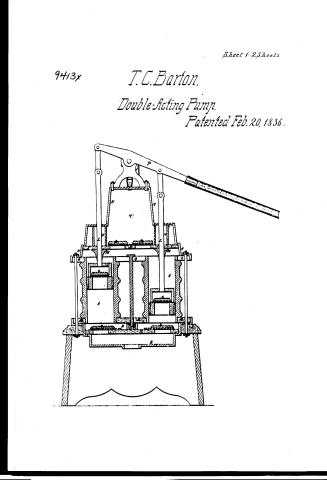
T.C. Barton's Patent Drawing for a Suction and Forcing Pump


National Archives, Restored Patent Drawings (Record Group 241) · Full-size scan at the National Archives · Catalog record
Show the text on the drawing Hide (63 words)
Words on the drawing as machine-read by the National Archives; not checked. Useful mainly for searching.
Sheet 1. T. = G.BARTON'S / MPS, / ting Piston, / Suction of Forcing / Jara / Patented Jeby20th 1836 / Patent office anril 24"1338. / CLASSIDICATION / Made under direction of the commenor of / 9413X / Patents w contemity with the act of 3"March. 1837- / DIVISION / MLinmoth / 9413X / Pat. Peb. 20-/836 / 4/2
Sheet 2. P.O.
USPTO scan
The patent as scanned by the USPTO
-
 Page 1
-
 Page 2
-
 Page 3
-
 Page 4


U.S. Patent and Trademark Office · Google Patents
Show the transcription Hide (466 words)
Machine transcription (LightOnOCR) of the pages as scanned by the USPTO, most of them the handwritten copies made when the records were restored after the 1836 fire. Not checked; it can misread handwriting, so compare it with the scan.
Page 1.
Sheet 1 of 2 Sheets
9413x
T.C. Barton.
Double-Acting Pump.
Patented Feb. 20, 1836.
Page 3.
74
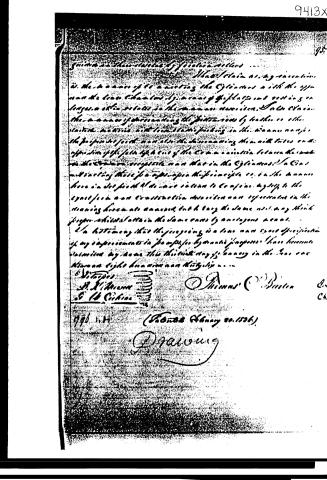
in a Cylinder at their upper ends, which Piston is to slip into a tube made of glass or large in a Copper, which is to be closed in such a manner as to let the Cylinder, the Copper tube is commonly called the Cylinder being made of brass or other metal in the manner that the tube is to be a few degrees more than at the bottom which the action is to be formed by each of the lower or upper which as a common direction it is to be of a small pipe to be formed through holes. So the application of this false top there are two tubes receiving the openings, one communicating with the Cylinder alone each lower.
The Piston is to pass freely through holes in the false top, in exactly so the Center of each lower is to cause them to be airtight and not tight. I have not yet a means of knowing how in the lower holes of the false top by the little Cotton which is filled they answer all the ordinary purposes of stuffing, being proportionately any friction. I have a trick to cause pieces of leather on the lower side of the false top through open spaces in the Center of which leads the Piston so as to be airtight. Now leather is a very poor substance for a piston deserving to be used having been used in a packing to turn it and the piston. When the Cylinder the leather as the piston is to be formed on a little Cotton with so that by the friction on the sides of the water, which is to be made with proper care through it, the application of the false top the hole through which the piston passes is to be a very good a tube or Cylinder which is to be a tube and with it to be a tube which is to be a tube of the same size and weight as before said.
This is to be a very heavy which the water might be used to be a very heavy and in the manner of the piston.
The piston is to be a very heavy which the water might be used to be a very heavy and in the manner of the piston.
The piston is to be a very heavy which the water might be used to be a very heavy and in the manner of the piston.
9413x
Published accounts: journal notice
Notice in the monthly list of patents, with remarks
Journal of the Franklin Institute, new ser., vol. 18 (1836), p. 252 · View the page
74. For an improvement in Suction and Forcing Pumps; Thomas C. Barton, Washington, Warren county, New Jersey, February 20.
Remarks. This patent is not taken for any improvement in the principle of construction, but for certain modes of putting the parts together; these improvements are described as to be applied to a double cylinder pump, such as is generally employed in fire engines, and without the drawings an attempt to describe them would demand too much space and time for the subject matter.
About this record
- Patentee
- DATAMP
- Date
- the Name and Date index of patents, DATAMP, USPTO records
- Invention
- DATAMP
- Listed in
- the Name and Date index of patents, DATAMP, USPTO records, Jim Shaw's X-patent list, the Journal of the Franklin Institute, Burke's List of Patents (1847)
- Burke's 1847 Patent Office list gives the same patent.