

Drawings and documents
National Archives restored drawings: drawing
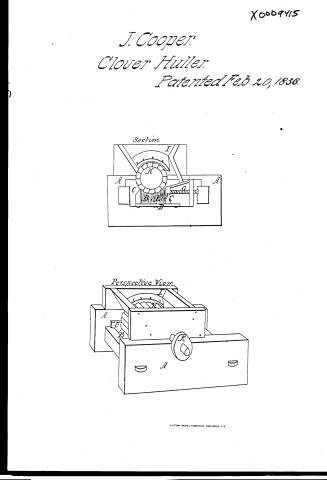
James Cooper's Patent Drawing for a Clover Machine

National Archives, Restored Patent Drawings (Record Group 241) · Full-size scan at the National Archives · Catalog record
Show the text on the drawing Hide (36 words)
Words on the drawing as machine-read by the National Archives; not checked. Useful mainly for searching.
130. THORASHIN bing / [1,59] Clover Hullers. / or / # 1 - / JAMES COOPER'S / Patented 20theb 1836. / classerication / 9415-+ / blave Machine / DIVISION. / 9415X / Perspective view / Section
USPTO scan
The patent as scanned by the USPTO
-
 Page 1
-
 Page 2
-
 Page 3


U.S. Patent and Trademark Office · Google Patents
Show the transcription Hide (696 words)
Machine transcription (LightOnOCR) of the pages as scanned by the USPTO, most of them the handwritten copies made when the records were restored after the 1836 fire. Not checked; it can misread handwriting, so compare it with the scan.
Page 1.
X0009415
J. Cooper
Clover Huller
Patented Feb. 20, 1830.
Section

Perspective View

A PETERS PHOTO LITHOGRAPHER WASHINGTON, D.C.
Page 2.
9415 X
Feb. 20, 1836
James Cooper of Green County Ohio
Letters Patent
This Article referred to in the Letters Patent and making part of the same, containing a description in the said James Cooper himself of his improvement in the machine for threshing clover and other seed.
Be it known that I, James Cooper of Green County, State of Ohio, have made a new and useful improvement in the machine for threshing out clover and other small seeds, which is described as follows, reference being had to the annexed drawing of the same making part of this Specification. This machine consists of the following principal parts: 1. The frame. 2. The concave or bed. 3. The threshing or rubbing cylinder. 4. The hopper. 5. The gearing.
1. The frame (marked A in the drawing) is made similar to the frame of a common threshing machine, of sufficient size and strength to contain and support the machinery hereafter described.
2. The concave or bed B is made in the following manner: Make a box C, as wide as the cylinder is long with a perforated bottom D. Fill this box with straw or plaid material, then place a movable board E, a piece of timber in one end of the box against the straw and force it forward by means of a wedge to compress the straw next to the cylinder are then to be cut off in such a manner as to form a concave, corresponding to the cylinder and extending half round it, or thereabouts. This box and concave are then placed under the cylinder in the frame.
The concave may also be formed by placing the cylinder in the box and then inserting the straw through the bottom of the box with the ends thereof resting against the circumference of the cylinder which will form the concave without the necessity of cutting it out. The movable board is to be driven against the straw by means of the wedge or wedge, as before described and drawn, after which the lower ends of the straw are to be cut off and a slide or board placed against the straw and
Page 3.
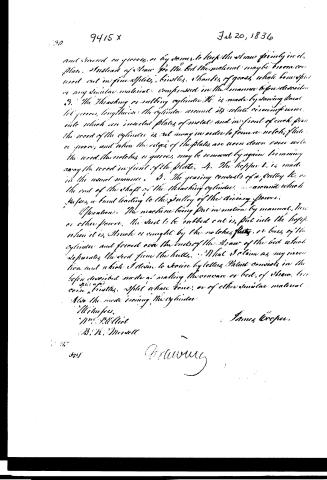
and secured in grooves, or by screws, to keep the straw firmly in its place. Instead of straw for the bed the material may be broomcorn used cut in fine splints, bristles, shavings of grass, whole bones split or any similar material, compressed in the manner before described.
3. The threshing or rubbing cylinder H is made by sawing basal 16 grooves lengthwise the cylinder around its whole circumference into which are inserted plates of metal and in front of each plate the wood of the cylinder is cut away in order to form a notch, flutes or grooves; and when the edges of the plates are worn down even with the wood the notches or grooves may be renewed by again trimming away the wood in front of the plates.
4. The hopper L is made in the usual manner.
5. The gearing consists of a pulley K on the end of the shaft of the threshing cylinder, around which passes a band leading to the pulley of the driving power.
Operation. The machine being put in motion by manual, horse or other power, the seed to be rubbed out is put into the hopper when it is struck or caught by the notches, flutes, or bars of the cylinder and forced over the ends of the bars of the bed which separates the seed from the hulls.
What I claim as my invention and which I desire to secure by letters Patent consists in the before described mode of making the concave or bed, of straw, broomcorn, bristles, split whole bones or of other similar material. Also the mode ironing the cylinder.
Witnesses,
Wm. H. Elliot
B. R. Morell
James Cropper.
Drawing
Published accounts: journal notice
Notice in the monthly list of patents, with remarks
Journal of the Franklin Institute, new ser., vol. 18 (1836), p. 253 · View the page
80. For a machine for Thrashing out Clover, and other small seeds; James Cooper, Greene county, Ohio, February 20.
Remarks. A cylinder is to be made of wood, armed with strips of iron, which are to rub the seeds against a concave placed under it; the concave is to consist of straw, broom-corn, or other fibrous substances placed endwise in a box, and compressed firmly together, the surface of which must, of course, be cut into such a form as will adapt it to the cylinder. The claim is to "the mode described of making the concave, or bed, of straw, broom-corn, split wood, bristles, split whale bone, or of other similar materials; also the mode of ironing the cylinder."
About this record
- Patentee
- DATAMP
- Date
- the Name and Date index of patents, DATAMP, USPTO records
- Invention
- DATAMP
- Listed in
- the Name and Date index of patents, DATAMP, USPTO records, Jim Shaw's X-patent list, the Journal of the Franklin Institute, Burke's List of Patents (1847)
- Burke's 1847 Patent Office list gives the same patent.