

Drawings and documents
National Archives restored drawings: drawing
Thomas Bruffs' Patent Drawing for a Machine for Making Ball and Shot


National Archives, Restored Patent Drawings (Record Group 241) · Full-size scan at the National Archives · Catalog record
Show the text on the drawing Hide (230 words)
Words on the drawing as machine-read by the National Archives; not checked. Useful mainly for searching.
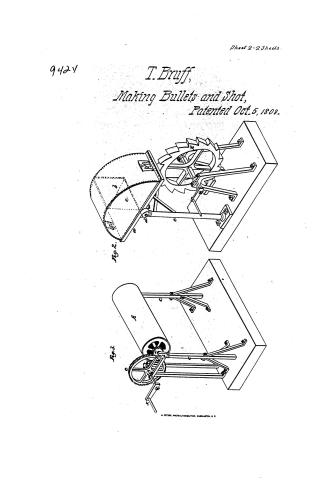
Sheet 1. 53. HARDWARE MANUFACTURE / [32] Bullets & Shot. / Thomas Bruff's machine for minding Ball & Shot by perch nu / Patented October 5ᵗʰ,1808. / CLASSIFICATION / 942-X / DIVISION. / Refference / Vol: R. grage 285. / Fig:1. Machine for making ball shot by pressure / Fig: H. " for rounding shot / Figa3. the finis.ring machine- / Figil. A, wooden horse or bench / B, your hard wood / e,c,c,i,k crews / g, bar / dop lead roves of hard wood / i,i, the rack / Fig: 1. / 1/2 inch slides, to let the groove d, slide side ways; / K,K, iron iron bars. / lever- / m, a ratchel moving on a screw / 0,0,0, iron rillers, / n, stul plate with two rows of squre holes- / p stul die / r, the weight- / X, the wheel / y, the screw clamp.- / Fig the 2, a,- cast iron plate ground smooth on / inside / c,ᵇ, in tion; half circular cover; / a, nivot:- / e,e. pillars. - / p, doors- / H, the wheel. / Fig: 3, A, the Cylinder polished / on the inside / b, iron axis- / C,C, iron frillars- / d, co: wheel - / e, lary wheel. / X, winch / [se] / Patent off / San 19th 1845. / made under the direction of it Commissioner of Paten / in. conformity with the act of 5.7 march 18.7 / (Correctly A.L. drawn. M Intire Dr. porf) / camun / Drawn / Commijurner I
Sheet 2. 942 / Fig I. / Fig: 3. / OIR
USPTO scan
The patent as scanned by the USPTO
-
 Page 1
-
 Page 2
-
 Page 3
-
 Page 4


U.S. Patent and Trademark Office · Google Patents
Show the transcription Hide (767 words)
Machine transcription (LightOnOCR) of the pages as scanned by the USPTO, most of them the handwritten copies made when the records were restored after the 1836 fire. Not checked; it can misread handwriting, so compare it with the scan.
Page 1.
Sheet 1-2 Sheets.
9424
T. Bruff,
Making Bullets and Shot,
Patented Oct. 5, 1908.
Fig. 1
A. PETERS, PHOTO-LITHOGRAPHER, WASHINGTON, D.C.
Page 2.
9421
Sheet 2-2 Sheets.
T. Bruff,
Making Bullets and Shot,
Patented Oct. 5, 1808.
Fig. 2.
Fig. 3.
H. PETER, PHOTO-LITHOGRAPHER, WASHINGTON, D. C.
Page 3.
Thomas Bouff
Letters Patent.
The Schedule referred to in these Letters Patent and making part of the same containing a description in the words of the said Thomas Bouff himself of his machine for making balls & shot by pressure.
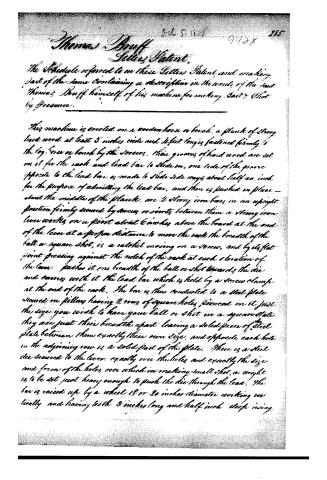
This machine is erected on a wooden horse or bench, a plank of strong hard wood at least 5 inches wide and 4 feet long is fastened firmly to the log horse or bench by the screws. Then grooves of hard wood are set on it for the rack and lead bar to slide in, one side of the groove opposite to the lead bar is made to slide side ways about half an inch for the purpose of admitting the lead bar, and then is fastened in place—about the middle of the plank, are 2 strong iron bars in an upright position firmly secured by screws or rivets between them a strong iron lever works on a pivot about 6 inches above the board at the end of the lever at a proper distance to move the rack the breadth of the ball or square shot, is a ratchet moving on a screw, and by its flat point pressing against the notch of the rack at each elevation of the lever pushes it one breadth of the ball or shot towards the die and carries with it the lead bar which is held by a screw clamp at the end of the rack. The bar is thus conducted to a steel plate secured in pillars having 2 rows of square holes pierced in it just the size you wish to have your ball or shot in a square state, they are just their breadth apart leaving a solid piece of steel plate between them exactly their own size, and opposite each hole in the adjoining row is a solid part of the plate. There is a steel die secured to the lever, exactly over the holes and exactly the size and form of the holes over which in making small shot, a weight is to be set just heavy enough to push the die through the lead. The bar is raised up by a wheel 18 or 20 inches diameter working vertically and having teeth 3 inches long and half inch deep rising
Page 4.
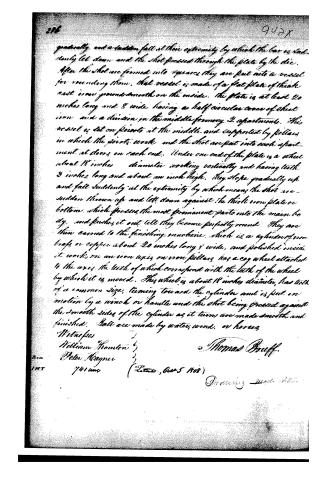
gradually and a sudden fall at their extremity by which the bar is suddenly let down and the shot pressed through the plate by the die. After the shot are formed into squares, they are put into a vessel for rounding them. That vessel is made of a flat plate of thick cast iron ground smooth on the inside. The plate is at least 20 inches long and 8 wide, having a half circular crown of sheet iron and a division in the middle forming 2 apartments. This vessel is set on pivots at the middle and supported by pillars in which the pivots work and the shot are put into each apartment at doors on each end. Under one end of the plate is a wheel about 18 inches diameter working vertically and having teeth 3 inches long and about an inch high. They slope gradually up and fall suddenly at the extremity by which means the shot are suddenly thrown up and let down against the thick iron plate or bottom, which presses the most prominent parts into the main body, and finishes it out till they become perfectly round. They are then carried to the finishing machine, which is a cylinder of iron brass or copper about 20 inches long & wide, and polished inside. It works on an iron axis on iron pillars, has a cog wheel attached to the axis, the teeth of which correspond with the teeth of the wheel by which it is moved. This wheel is about 18 inches diameter, has teeth of a common size, turning towards the cylinder and is put in motion by a winch or handle and the shot being pressed against the smooth sides of the cylinder as it turns are made smooth and finished. All are made by water, wind, or horses.
Witnesses
William Hamilton
Peter Wagner
Thomas Buff.
(2nd, Oct 5 1808)
Drawing made while
About this record
- Patentee
- DATAMP
- Date
- the Name and Date index of patents, DATAMP, USPTO records
- Invention
- DATAMP
- Listed in
- the Name and Date index of patents, DATAMP, USPTO records, Jim Shaw's X-patent list, S. A. Elliot's printed list of patents, Burke's List of Patents (1847)
- S. A. Elliot's printed list of patents gives the same name and date.
- Burke's 1847 Patent Office list gives the same patent.