

Drawings and documents
National Archives restored drawings: drawing
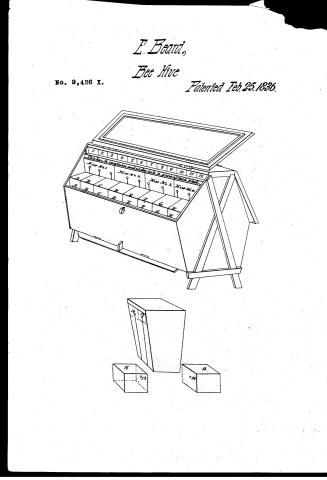
Ebenezer Beard's Patent Drawing for Bee Hives and Houses

National Archives, Restored Patent Drawings (Record Group 241) · Full-size scan at the National Archives · Catalog record
Show the text on the drawing Hide (118 words)
Words on the drawing as machine-read by the National Archives; not checked. Useful mainly for searching.
6. 6. BEE CULTURE. / Bee-Hives. / Chenizer Beard / Patented Feb 25th 1836 / 9426-4 / ITVISTORY / Bee hires and houses. / 9426 X / The figures from the 12 inclusive and the letters / A. B.C.D.B.F.R. represent Honey boxes / Similar loxes are placed on the other / side of the Hives. / one locked es which an / non / closed. / Man / 11 / is / of birds improved Bee Mouse. / or / This, prepresentione / of the wires. / inwutichthebees,live. / the heles or openings / thri which the / bees pass into the / honey boyes marked / mhieh maybe / removed at / pleasure / 16 / A honey boy. / A honey lose / makes 2 families of 4 ewarms / 14 / 13 / ameni emarmingtime - / "they amal gamali
USPTO scan
The patent as scanned by the USPTO
-
 Page 1
-
 Page 2
-
 Page 3
-
 Page 4


U.S. Patent and Trademark Office · Google Patents
Show the transcription Hide (1,050 words)
Machine transcription (LightOnOCR) of the pages as scanned by the USPTO, most of them the handwritten copies made when the records were restored after the 1836 fire. Not checked; it can misread handwriting, so compare it with the scan.
Page 1.
E. Beard,
Bee Hive
No. 9,426 X. Patented Feb. 25, 1836.

Page 2.
94267 Feb 25 1896 281.
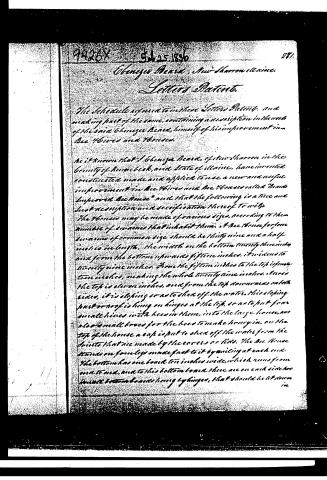
Cheneger Beard, New Sharon Maine.
Letters Patent.
The Schedule referred to in these Letters Patent, and making part of the same, containing a description in the words of the said Cheneger Beard, himself of his improvement in Bee Hives and Houses.
Be it known that I Cheneger Beard, of New Sharon in the County of Kennebec, and State of Maine, have invented, constructed, made and applied to use a new and useful improvement in Bee Hives and Bee Houses called "Bees Improved Bee House" and that the following is a true and just description and specification thereof.
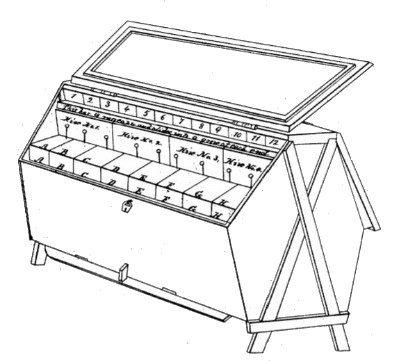
The Houses may be made of various sizes, according to the number of swarms that inhabit them. A Bee House for some swarms of common size should be thirty-nine and a half inches in length, the width on the bottom twenty-three inches and from the bottom upwards fifteen inches, it widens to twenty-nine inches. From the fifteen inches to the top is some ten inches, making the whole twenty-nine inches. Across the top is eleven inches, and from the top downwards on both sides, it is sloping so as to shed off the water. This sloping part or roof is hung on hinges at the top, so as to put four small hives with bees in them, into the large house, and also small boxes for the bees to make honey in, on the top of the house a cap is put to shed off the water from the joints that are made by the covers or lids. The Bee House stands on four legs made fast to it by nails at each end. The bottom has one board ten inches wide, which runs from one to end, and to this bottom board there are on each side two small bottom boards hung by hinges, that should be let down in
Page 3.
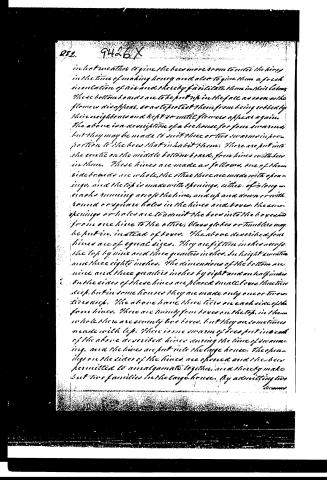
in hot weather to give the bees more room to enter the hive in the time of making honey and also to give them a fresh circulation of air and thereby facilitate them in their labour. These bottom boards are to be put up in the fall as soon as the flowers disappear, so as to protect them from being robbed by their neighbours and kept so until flowers appear again. The above is a description of a beehouse for some seasons, but they may be made to suit three or two seasons in proportion to the bees that inhabit them. There are put into the centre of the middle bottom board, four hives with bees in them. These hives are made as follows. One of them side boards are whole, the other three are made with openings, and the top is made with openings, either of slanting cracks running across the hive, and up and down or with round or square holes in the hives and boxes. The openings or holes are to admit the bees into the boxes and from one hive to the other; glass globes or tumblers may be put in, instead of boxes. The above described four hives are of equal sizes. They are fifteen inches across the top by nine and three quarters inches in height twenty and three eighths inches. The dimensions of the bottom are nine and three quarters inches by eight and an half inches. In the sides of these hives are placed small clover, thirteen deep, but in some houses they are made only once or twice to a deep. The above have three tiers on each side of the four hives. There are usually four boxes on the top, in them whole there are usually two boxes, but they are sometimes made with tops. There is one swarm of bees put in each of the above described hives during the time of swarming, and the hives are put into the large house. The openings on the sides of the hives are opened and the bees permitted to amalgamate together, and thereby make but two families in the large house. By admitting two
Page 4.
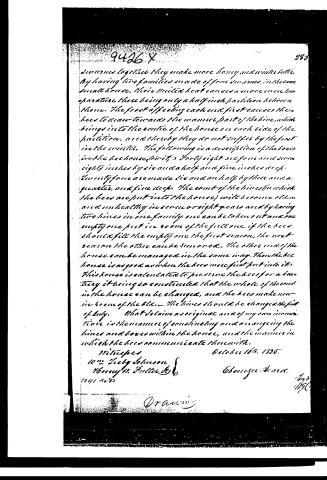
Swarms together they make more honey and winter better. By having two families made of from swarms, in the same small house, their united heat causes a more even temperature there being only a half-inch partition between them. The frost affecting each end first causes the bees to draw towards the warmer parts of the hive, which brings into the centre of the house on each side of the partition, and thereby they do not suffer by the frost in the winter. The following is a description of the boxes in the beehouse, thirty-two forty-eight are four and seven eights inches by six and a half and five inches deep. Seventy-four are made six and a half by three and a quarter, and five deep. The comb of the hives (in which the bees are put into the house) will become old and unhealthy in seven or eight years and by having two hives in one family, one can be taken out and one empty one put in room of the full one. If the bees should fill the empty one the first season, the next season the other can be removed. The other end of the house can be managed in the same way. Thus the beehouse is as good as when the bees were first put into it. This house is calculated to preserve the bees for a century it being so constructed that the whole of the comb in the house can be changed, and the bees make new in room of the old. The hives should be changed the first of July. What I claim as original and of my own invention is the manner of constructing and arranging the hives and boxes within the house, and the manner in which the bees communicate therewith.
Witnesses
Wm. Lecky Johnson
Henry H. Fuller
1041 N.W.
October 16th, 1886.
George Beard
End
1896
Drawing
Published accounts: journal notice
Notice in the monthly list of patents, with remarks
Journal of the Franklin Institute, new ser., vol. 18 (1836), p. 255 · View the page
The saw used is to be furnished with teeth on each of its edges, and is to cut the stuff as the carriage travels in either direction. There are to be two rag wheels with teeth in opposite directions, and two feed hands, one for each wheel; the double toothed saw is not new, and is not claimed as euch, the claim being confined to the particular arrangement adopted for moving the rag wheels; a thing in which there is no difficulty whatever, every machinist knowing methods of accomplishing this object, which no patent can prevent him from employing. 91. For a Bee House; Ebenezer Beard, New Sharon, Kennebec county, Maine, February 25.
Remarks. The claim made is to "the manner of constructing and arranging the hives and boxes within the house, and the manner in which the bees communicate therewith." We have no doubt that the arrangement described, is convenient and beneficial, but we do not think that it is sufficiently distinguished, in the description, from other similar contrivances, to admit of a claim so general.
DATAMP: illustration
Illustrations from DATAMP

DATAMP (Directory of American Tool and Machinery Patents), via the Internet Archive · Archived DATAMP page
About this record
- Patentee
- DATAMP
- Date
- the Name and Date index of patents, DATAMP, USPTO records
- Invention
- DATAMP
- Listed in
- the Name and Date index of patents, DATAMP, USPTO records, Jim Shaw's X-patent list, the Journal of the Franklin Institute, Burke's List of Patents (1847)
- Burke's 1847 Patent Office list gives the same patent.