

Drawings and documents
National Archives restored drawings: drawing
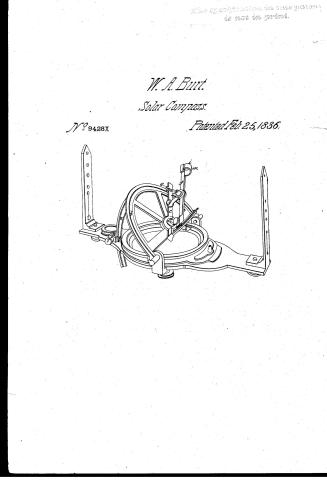
W.A. Burt's Patent Drawing for an Improvement for Determining the Variation of the Needle

National Archives, Restored Patent Drawings (Record Group 241) · Full-size scan at the National Archives · Catalog record
Show the text on the drawing Hide (20 words)
Words on the drawing as machine-read by the National Archives; not checked. Useful mainly for searching.
8. OPTICS. / [157] Altitude Instr. / Mr.
USPTO scan
The patent as scanned by the USPTO
-
 Page 1
-
 Page 2
-
 Page 3


U.S. Patent and Trademark Office · Google Patents
Show the transcription Hide (494 words)
Machine transcription (LightOnOCR) of the pages as scanned by the USPTO, most of them the handwritten copies made when the records were restored after the 1836 fire. Not checked; it can misread handwriting, so compare it with the scan.
Page 1.
W. A. Butt.
Solar Compass.
No. 9428X
Patented Feb. 25, 1836.
Page 2.
9428X
1.
William T. Durl (Mound Vernon) Sec. of Michigan
(Patented February 25, 1830)
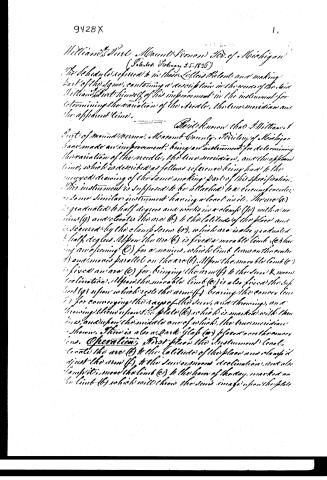
The Schedule referred to in these Letters Patent and making part of the same, containing a description in the words of the said William T. Durl himself of his improvement in the instrument for determining the variation of the needle, the true meridian and the apparent time.
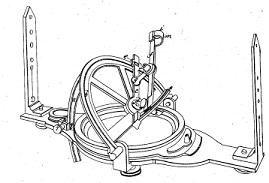
Be it known that William T. Durl of Mound Vernon, Macomb County, Territory of Michigan has made an improvement being an instrument for determining the variation of the needle, the true meridian, and the apparent time, which is described as follows reference being had to the annexed drawing of the same making part of this specification. This instrument is supposed to be attached to a circumference or some similar instrument having a level in it. The arc (a) is graduated to half degrees and works in a clamp (b) with a no (g) and a bristle the arc (b) to the latitude of the place and is secured by the clamp screw (d), which arc is also graduated to half degrees. Upon the arc (b) is fixed a movable limb (c) having an opening (C) for a mirror, which limb turns on the center (d) and moves parallel on the arc (b). Upon the movable limb (c) is fixed an arc (e) for bringing the arm (f) to the sun & moon declination. Upon the movable limb (c) is also fixed the light (g) upon which rests the arm (f) having the convex lens (i) for converging the rays of the sun, and throwing, and throwing them upon the plate (k), which is marked with three lines, and upon the middle one of which, the true meridian is shown. There is also a dark glass (m) placed over the convex lens. Operation: First place the instrument level, locate the arc (b) to the latitude of the place and clamp it. Adjust the arm (f) to the sun or moon declination, and also tamper it, move the limb (c) to the hour of the day marked on the limb (b) which will throw the sun’s image upon the plate
Page 3.
9428X 2-25-1836 2.
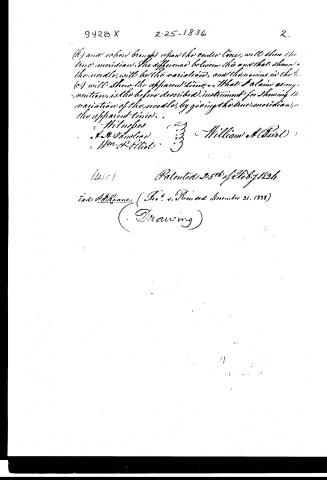
(b) and when brought upon the center lines, will show the true meridian. The difference between this and that shown by the needle, will be the variation, and the minus in the (c) will show the apparent time. What I claim as my invention, is the before described instrument for showing the variation of the needle, by giving the true meridian, the apparent time.
Witnesses
H. A. Vandever
Wm. P. Elliot
William A. Baird
(450) Patented 25th of Feb. 1836
See Office (See 450, Recorded December 31, 1838)
(Drawing)
Published accounts: journal notice
Notice in the monthly list of patents, with remarks
Journal of the Franklin Institute, new ser., vol. 18 (1836), p. 256 · View the page
95. For an Instrument for determining the variation of the needle, the true meridian, and the apparent time; William A. Burt, Mount Vernon, Macomb county, Michigan, February 25.
Remarks. The graduated arcs of circles, and the other appendages used, must be placed upon a circumferentor, or other analagous instrument, furnished with a level. The particular construction of the parts might be made known by verbal description, did we think proper to give the necessary space and time, but these we cannot now afford. There is nothing in the principle which would be new to the scientific observer; the only novelty being the particular arrangement of its parts.
DATAMP: illustration
Illustrations from DATAMP

DATAMP (Directory of American Tool and Machinery Patents), via the Internet Archive · Archived DATAMP page
About this record
- Patentee
- DATAMP
- Date
- the Name and Date index of patents, DATAMP, USPTO records
- Invention
- DATAMP
- Listed in
- the Name and Date index of patents, DATAMP, USPTO records, Jim Shaw's X-patent list, the Journal of the Franklin Institute, Burke's List of Patents (1847)
- Burke's 1847 Patent Office list gives the same patent.