

Drawings and documents
USPTO scan
The patent as scanned by the USPTO
-
 Page 1
-
 Page 2
-
 Page 3
-
 Page 4


U.S. Patent and Trademark Office · Google Patents
Show the transcription Hide (1,224 words)
Machine transcription (LightOnOCR) of the pages as scanned by the USPTO, most of them the handwritten copies made when the records were restored after the 1836 fire. Not checked; it can misread handwriting, so compare it with the scan.
Page 1.
NO PRINTED SPECIFICATION AVAILABLE
9436X
A. MUDGE.
SMUT MACHINE.
Patented Feb. 25, 1836
Page 2.
9436X
Feb 25, 1836
Abraham Mudge. Canajoharie. New York
Letters Patent
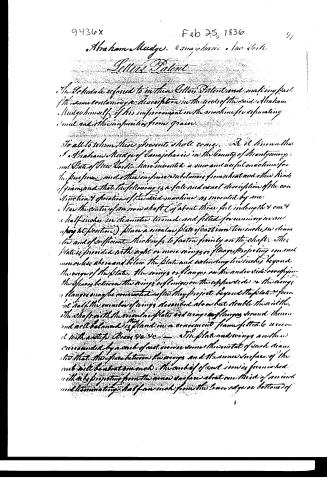
The Schedule referred to in these Letters Patent and making part of the same containing a description in the words of the said Abraham Mudge himself of his improvement in the machine for separating coal and other impurities from grain.
To all to whom these presents shall come, Be it known that I, Abraham Mudge of Canajoharie in the County of Montgomery and State of New York, have invented a new and useful machine for the purpose and the invention and substance of which and other kinds of grain and that the following is a full and exact description of the construction and operation of the said machine as invented by me.
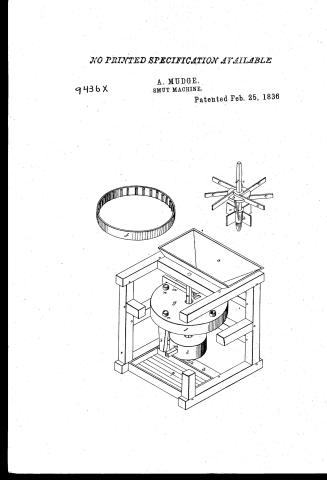
Near the center of an iron shaft (of about three feet in length and one and a half inches in diameter turned and fitted for running in one upright bearing) place a circular plate of cast iron two inches in diameter and of sufficient thickness to fasten firmly on the shaft. This plate is provided with eight or more wings or flanges projecting one and one-half inches above and below the plate and extending two inches beyond the verge of the plate. The wings or flanges on the under side correspond to the spaces between the wings or flanges on the upper side, so that the wings or flanges may be connected so far they project beyond the plate and form it half the number of wings described above but double those on the upper side. The shaft with the circular plate and wings or flanges round thereon and well balanced is placed in a convenient frame fitted to receive it with a step, cross, &c. — The plate and wings are thus surrounded by a circle of cast iron or some other metal of such diameter that the space between the wings and the inner surface of the circle will be about one inch. The circle of cast iron is furnished with a key projecting from the inner surface about one-third of an inch and terminating half an inch from the lower edge or bottom of
Page 3.
9436x
Feb 25, 1836
The cask, and about two inches apart. Or if the cask is made of sheet iron it may be perforated with small holes, or the cask may be made of iron. — The depth or height of the cask is such that the wings will be about one third of an inch from the floor on which the cask rests, and the same distance from the cover of the cask rests on a floor of cast or sheet iron and is covered at top also with cast or sheet iron. Near the center of the cover is an opening to admit the grain into the machine. And through the floor on which the cask rests, and near the outer side is also an opening of about three inches long and one and one half inches wide for the purpose of allowing the grain to escape. On the inner shaft and at a convenient distance below the bottom of the cask is a wind wheel of about fourteen inches diameter and about five inches in depth enclosed in a case of thin or sheet iron having two places of discharge, one of two spots or places of discharge directs to the grain as it escapes from the machine above. The grain as it escapes from the cask is conducted by a short spout into the current of air set in motion by the wind, which current of air is confined and forced by the wind blades through the stream of grain as it falls from the short spout into a narrow spout placed to receive it standing on an inclination of about fifty degrees elevation through which the wind drives the dust etc. and the grain is secondarily received below. Then the wind spout replaces the charge for wind is in the opposite side of the machine and the wind is conducted upwards to the upper side of the cask by means of a spout or conduit and then inclined across the cover of the cask and made to pass through the grain before it enters the machine for the purpose of separating corn hull etc. from the grain. There is also one or more openings through the covering of the cask near the outer edge and spouts attached thereto for the purpose of allowing dust etc. to escape from the machine. The machine is set in motion by means of a pulley and strap at the rate of about seven hundred revolutions per minute. The grain being introduced through
Page 4.
9436x
Feb 25, 1836
The throwing of the corn over the centre is thrown by the wings or flanges attached to the circular plate against the cork and ribs or projections attached thereto with sufficient force to break the corn balls and disengage same and other impure substances which adhere to grain and as the fit passing swiftly around the cork until it occupies the space in the floor on which the cork rests and is conducted by the short shaft into the current of wind in motion by the wind wheel before described. A machine of the above described dimensions will clean from eight to ten bushels of grain an hour. When a machine is required to perform more business, the dimensions are to be enlarged in proportion to the amount of business required to be performed, and two or more of the circular plates with wings or flanges (proportioned to the dimensions of the corn to be used) are to be placed on the shaft. The wings on the uppermost plate alternating or occupying the spaces between wings on the plates beneath them. The principles which I claim to have applied to the purpose of cleaning grain from corn and other impure substances by means of the machine above described, and which application I claim to have invented and which I believe to be new and useful is that of throwing the grain by means of wings or flanges attached to a circular plate as above described against some hard substance with sufficient force to break the corn balls, etc.
And whether the plate be circular or any other form or whether the wings or flanges be of any other dimensions than I have described, the invention of attaching wings or flanges to a plate of cast iron or of any other substance for the purpose of cleaning grain I claim as my invention. The form of the cork with ribs projecting inward from the inner surface whether made of cast iron or any other material I also claim as my invention. The slitted cork or the with ribs or furrows or without either I also claim as part of my invention and the wind wheel with two places of discharge through the casing I also claim as part of my invention.
Witnesses
Ole A. Dury
Henry J. Lichen
Abraham Hodge
(1170 Words) (February 25, 1836)
Published accounts: journal notice
Notice in the monthly list of patents, with remarks
Journal of the Franklin Institute, new ser., vol. 18 (1836), p. 255 · View the page
89. For a Smut Machine; Abraham Mudge, Canajohaire, Montgomery county, New York, February 25.
Remarks. "The principle which I claim to have applied to the purpose of cleaning grain from smut and other impure substances, by means of the machine above described, and which application I claim to have invented, is that of throwing the grain by means of wings, or flanches, attached to a circular plate as above described, against some hard substance with sufficient force to break smut balls, &c." This apparatus appears to be very well calculated to effect the proposed object, and to blow off the dust from the smut and other sources, but the form of the claim is objectionable, as the same principle has been before applied for attaining the same end, and it is the particular method of applying the principle, alone, which is the proper subject for a claim.
About this record
- Patentee
- DATAMP
- Date
- the Name and Date index of patents, DATAMP, USPTO records
- Invention
- DATAMP
- Listed in
- the Name and Date index of patents, DATAMP, USPTO records, Jim Shaw's X-patent list, the Journal of the Franklin Institute, Burke's List of Patents (1847)
- Burke's 1847 Patent Office list gives the same patent.