

Drawings and documents
USPTO scan
The patent as scanned by the USPTO
-
 Page 1
-
 Page 2
-
 Page 3


U.S. Patent and Trademark Office · Google Patents
Show the transcription Hide (566 words)
Machine transcription (LightOnOCR) of the pages as scanned by the USPTO, most of them the handwritten copies made when the records were restored after the 1836 fire. Not checked; it can misread handwriting, so compare it with the scan.
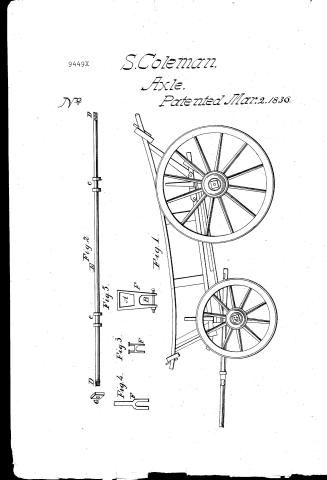
Page 1.
9449X
S. Coleman.
Axle.
Patented Mar. 2, 1836.
No.
Fig. 1.
Fig. 2.
Fig. 3.
Fig. 4.
Fig. 5.
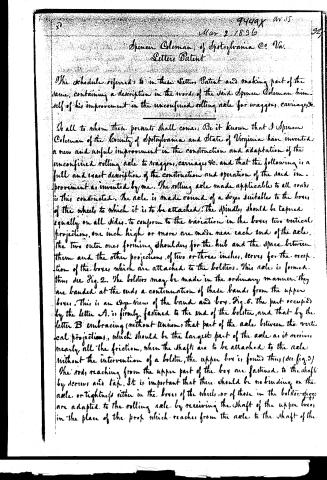
Page 2.
9449X W.15
Mar. 2, 1836
Spencer Coleman, of Spotsylvania Co. Va.
Letters Patent
The schedule referred to in these Letters Patent and making part of the same, containing a description in the words of the said Spencer Coleman himself of his improvement in the unconfined rolling axle for waggons, carriages, &c.
To all to whom these presents shall come: Be it known that I Spencer Coleman of the County of Spotsylvania and State of Virginia have invented a new and useful improvement in the construction and adaptation of the unconfined rolling axle to waggons, carriages, &c. and that the following is a full and exact description of the construction and operation of the said improvement as invented by me. The rolling axle made applicable to all roads is thus constructed. The axle is made round of a size suitable to the boxes of the wheels to which it is to be attached. The spindle should be tapered equally on all sides to conform to the variation in the boxes; two vertical projections, one inch high or more are made near each end of the axle, the two outer ones forming shoulders for the hub and the space between them and the other projections, of two or three inches, serves for the reception of the boxes which are attached to the bolsters. This axle is formed thus, see Fig. 2. The bolsters may be made in the ordinary manner: they are banded at the ends, a continuation of these bands from the upper boxes. This is an edge view of the band and box, Fig. 5. The part occupied by the letter A is firmly fastened to the end of the bolster, and that by the letter B embracing (without tension) that part of the axle between the vertical projections, which should be the largest part of the axle as it receives nearly all the friction, when the shafts are to be attached to the axle without the intervention of a bolster, the upper box is found thus (see fig. 3) The rods reaching from the upper part of the box are fastened to the shaft by screws and tap. It is important that there should be no binding on the axle or tightness either in the boxes of the wheels, or of those in the bolster; gags are adapted to the rolling axle by receiving the shaft of the upper boxes in the place of the prop which reaches from the axle to the shaft of the
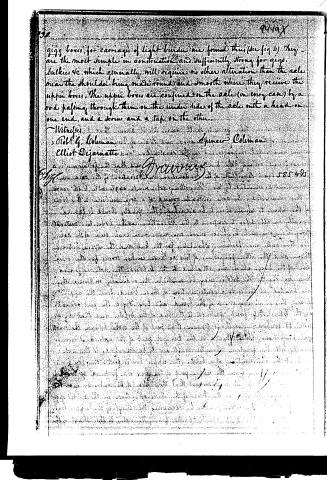
Page 3.
gig boxes for carriages of light burden, are formed thus (see fig 1). They are the most simple in construction and sufficiently strong for gigs. Sulkies &c which generally will require no other alteration than the axle near the shoulder being made round and smooth where they receive the upper boxes. The upper boxes are confined on the axle (in every case) by a rod passing through them on the under side of the axle with a head on one end, and a screw and a tap on the other.
Witnesses
Robert G. Coleman
Elliot Dejarnette
Spencer Coleman
585-695
Published accounts: journal notice
Notice in the monthly list of patents, with remarks
Journal of the Franklin Institute, new ser., vol. 18 (1836), p. 316 · View the page
14. For an improvement in the Axles of wagons, carriages, &c.; Spencer Coleman, Mount Pleasant, Spottsylvania county, Virginia, March 2.
Remarks. These axles are called rolling axles, and from the description it appears that they are so denominated from the whole axle being allowed to revolve in boxes fixed on the bolster, or other suitable part, of the frame of the carriage; whether the wheels are also to revolve freely on the axles we are not told, but suppose that they are, otherwise there would be a difficulty in turning the carriage. There is not any claim made, and the patentee is in error in supposing, as he must, that the revolution of the whole axle is a novelty.
Published accounts: journal notice
Notice in the monthly list of patents (listed with a different spelling or date)
Journal of the Franklin Institute, new ser., vol. 17 (1836), p. 437 · View the page
Carriage and car axle. Spenser Coleman, Mount Pleasant, Va.
About this record
- Patentee
- DATAMP
- Date
- the Name and Date index of patents, DATAMP, USPTO records
- Invention
- DATAMP
- Listed in
- the Name and Date index of patents, DATAMP, USPTO records, Jim Shaw's X-patent list, the Journal of the Franklin Institute, the Journal of the Franklin Institute, Journal, Burke's List of Patents (1847)
- Also listed in a contemporary journal or list under a different spelling or date; the record shown follows the standard lists.
- Burke's 1847 Patent Office list gives the same patent.