

Drawings and documents
National Archives restored drawings: drawing
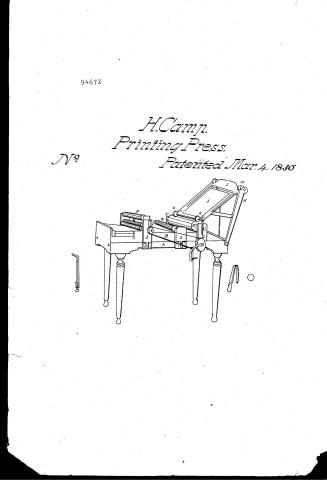
Hezekiah Camp's Patent Drawing for a Printing Press

National Archives, Restored Patent Drawings (Record Group 241) · Full-size scan at the National Archives · Catalog record
Show the text on the drawing Hide (137 words)
Words on the drawing as machine-read by the National Archives; not checked. Useful mainly for searching.
Petenly / Blcooese / CKs ASSIFICATION / 9467-X / BIT / 9467-A / patented 4th March 1836. / if / A. Is a rectangulary / B A minuble bed which is repports the signe / C.C. side plates which the Journals of He megs roller / D. preys Roller. / His / Asection of metal hook to consine the press-naller, one at each and / to CH section ofa siling applied to cack end of the prejumaller In raise it / H. Mirepts to He Whatform / I. Aplahymin lympall / J Allexible Tylusian / K. to confille Herjeaper tatter / N. 6 Iun pullies tocarry back the Syninon / 0.0. Two small where to slint His lower clambes / P. Juck reservali / Q. Distributive Rollers / R. / S.S. Plates researcher HIS distributing-zollers / a. Expiction allers shown in mesection a onwhich the bell runs
USPTO scan
The patent as scanned by the USPTO
-
 Page 1
-
 Page 2
-
 Page 3
-
 Page 4
-
 Page 5


U.S. Patent and Trademark Office · Google Patents
Show the transcription Hide (1,502 words)
Machine transcription (LightOnOCR) of the pages as scanned by the USPTO, most of them the handwritten copies made when the records were restored after the 1836 fire. Not checked; it can misread handwriting, so compare it with the scan.
Page 1.
9467X
H. Camp.
Printing Press.
Patented Mar. 4. 1836
No. 4

Page 2.
9467X March 4, 1836 3/1
Kozchiah Camp.
Letters Patent.
The schedule referred to in these Letters Patent and making part of the same, containing a description in the words of the said Kozchiah Camp, himself of his improvement in the Printing Press.
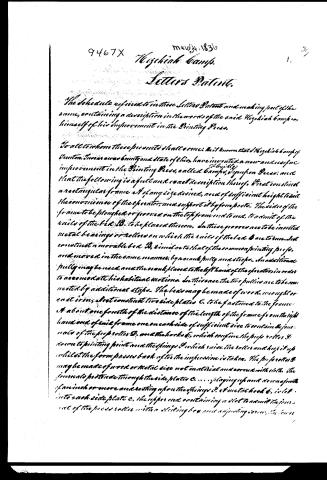
To all to whom these presents shall come: He it known that I Kozchiah Camp of Canton, in the county of Montgomery, State of Ohio, have invented a new and useful improvement in the Printing Press, called Camp's Improved Press; and that the following is a full and exact description thereof, that is to say, a rectangular frame A of any size desired, and of sufficient height to suit the convenience of the operator, and support it by four posts. The sides of the frame to be ploughed or grooved on the top from end to end, to admit of the rails of the bed B to be placed therein. In these grooves are to be inserted metal bearings or hollows on which the rails of the bed B are to turn, and constitute a movable bed B, similar to that of the common printing press, and moved in the same manner, by a crank pully and straps. An additional pully may be used, and the crank placed to the left hand of the operator in order to accommodate his habitual motions. In this case the two pulleys are to be connected by additional straps. The bed may be made of wood, wrought or cast iron, and to constitute two side plates C, to be fastened to the frame A about one fourth of the distance of the length of the frame from the right hand end of said frame one on each side of sufficient size to contain the journals of the press rollers D, and the hooks E, which confine the press rollers D down to printing point and the springs F which raise the rollers and keep it up while the form passes back after the impression is taken. The press rollers D may be made of wood or metal, size not material and covered with cloth. The journals to be made through the side plates C, ... playing up and down a foot or an inch or more and resting upon the springs F, and metal hooks E, is let into each side plate C, the upper end containing a slot to admit the journal of the press rollers with a sliding box and adjusting screw, the lower
Page 3.
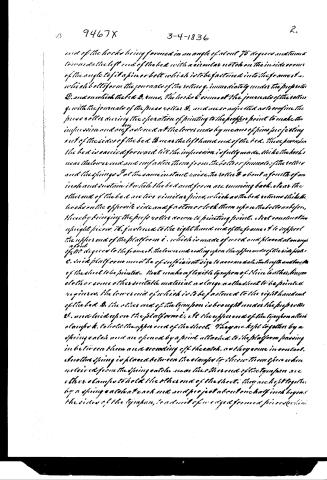
end of the hooks being formed in an angle of about 75 degrees and turned towards the left end of the bed with a circular notch on the inside corners of the angle to fit a pin or bolt which is to be fastened into the frame at D, which bolts form the journals of the rollers g, immediately under the press roller D, and on which the bed B, runs. The hooks E connect the journals of the roller g, with the journals of the press roller D, and are so adjusted as to confine the press roller during the operation of printing to the proper point to make the impression and any notches at the lower ends by means of pins projecting out of the sides of the bed B near the left hand end of the bed. These pins when the bed is carried forward till the impression is fully made, slide the hooks near the lower end and unfasten them from the bolts or journals of the rollers and the springs F at the same instant raise the roller D about a fourth of an inch and sustain it while the bed and form are running back. Near the other end of the bed are two similar pins, which as the bed returns slide the hooks on the opposite side and fasten or lock them upon the bolts or pins, thereby bringing the press roller down to printing point. A steel construction upright piece, H, fastened to the right hand end of the frame at I to support the upper end of the platform C, which is made of wood and placed at an angle of 110 degrees to the frame at the lower end resting upon the upper ends of the side pieces C. Said platform must be of sufficient size to accommodate the length and breadth of the sheet to be printed. Next makes a flexible tympan of thin leather, linen cloth or some other suitable material as large as the sheet to be printed. A spring, the lower end of which is to be fastened to the right hand end of the bed B, the other end of the tympan is brought under the press roller D, and laid upon the platform C, at the upper end of the tympan attach clamps K, to hold the upper end of the sheet. They are kept together by a spring catch and are opened by a pin attached to the platform passing in between them and drawing off the catch, as they come in contact. Another spring is placed between the clamps to throw them open when released from the spring catch, near the other end of the tympan are other clamps to hold the other end of the sheet. They are kept together by a spring catch at each end and project about one half inch beyond the sides of the tympan, to admit of two edged former pieces which
Page 4.
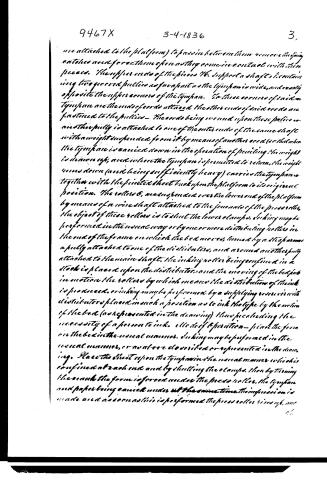
are attached to the platform) to pass in between them, remove the spring catches and force them open as they come in contact with the pieces. The upper ends of the pieces 16, support a shaft 21 containing two grooved pulleys as far apart as the tympan is wide, and exactly opposite the upper corners of the tympan. To these corners of said tympan are the ends of cords attached, the other ends of said cords are fastened to the pulleys—the cords being wound upon these pulleys and another pulley is attached to one of the outer ends of the same shaft with a weight suspended from it by means of another cord (so that when the tympan is carried down in the operation of printing, the weight is drawn up, and when the tympan is permitted to return, the weight runs down (and being sufficiently heavy) carries the tympan together with the printed sheet back upon the platform to its original position. The rollers 22, are suspended over the lower end of the platform by means of a wire shaft attached to the journals of the press rollers. The object of these rollers is to shut the lower clamps. Inking may be performed in the usual way or by one or more distributing rollers in the end of the frame on which the bed moves, turned by a step gear and a pulley attached to one of the distributors, and around another pulley attached to the main shaft, the inking roller being confined in a stock is placed upon the distributor, and the moving of the bed puts in motion the rollers by which means the distribution of the ink is produced. Inking may be performed by a supplying reservoir with distributors placed in such a position as to ink the type by the motion of the bed (as represented in the drawing) thus precluding the necessity of a person to ink. Mode of Operation—Since the form is the bed in the usual manner, inking may be performed in the usual manner, or as at 23, clover-leaf or represented in the drawing. Place the sheet upon the tympan in the usual manner which is confined at each end and by shutting the clamps, then by turning the crank the form is forced under the press rollers, the tympan and paper being carried under at the same time, the impression is made and as soon as this is performed the press rollers turn off, and
Page 5.
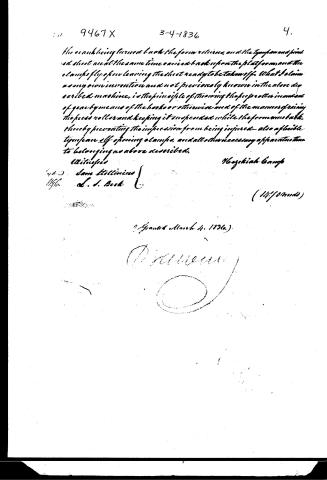
9467 X 3-4-1836 4.
The crank being turned back the form rises, and the type bar and pinned sheet are at the same time carried back upon the platform, and the clamps fly open leaving the sheet ready to be taken off. What I claim as my own invention and not previously known in the above described machine, is the principle of throwing the type roller in and out of gear by means of the hooks or otherwise and of the means of raising the press roller and keeping it suspended while the form moves back, thereby preventing the impression from being injured—also a flexible type bar self-opening clamps, and all other necessary apparatus to belong as above described.
Witnesses
Sam Stillman
L. S. Beck
Hagkiah Camp
(1470 words)
(Granted March 4, 1836.)
Published accounts: journal notice
Notice in the monthly list of patents
Journal of the Franklin Institute, new ser., vol. 17 (1836), p. 438 · View the page
169. Printing Press. Hezekiah Camp, Trenton, Ohio,
Published accounts: journal notice
Notice in the monthly list of patents, with remarks
Journal of the Franklin Institute, new ser., vol. 18 (1836), p. 320 · View the page
29. For an improvement in the Printing Press; Hezekiah Camp, Trenton, Tuscarawas county, Ohio, March 4.
Remarks. This is called a flexible tympan press; and it is so called because the tympan, with the sheet upon it, is drawn down under a press roller, to receive the impression. A claim is made to the manner of throwing this press roller in and out of gear; also to the flexible tympan, self-operating clamps, &c. The drawing is not sufficiently in detail to show the construction of the various parts; and the flexible tympan, which is broadly claimed, is not new.
About this record
- Patentee
- DATAMP
- Date
- the Name and Date index of patents, DATAMP, USPTO records
- Invention
- DATAMP
- Listed in
- the Name and Date index of patents, DATAMP, USPTO records, Jim Shaw's X-patent list, the Journal of the Franklin Institute, Burke's List of Patents (1847)
- Burke's 1847 Patent Office list gives the same patent.