

Drawings and documents
USPTO scan
The patent as scanned by the USPTO
-
 Page 1
-
 Page 2
-
 Page 3


U.S. Patent and Trademark Office · Google Patents
Show the transcription Hide (783 words)
Machine transcription (LightOnOCR) of the pages as scanned by the USPTO, most of them the handwritten copies made when the records were restored after the 1836 fire. Not checked; it can misread handwriting, so compare it with the scan.
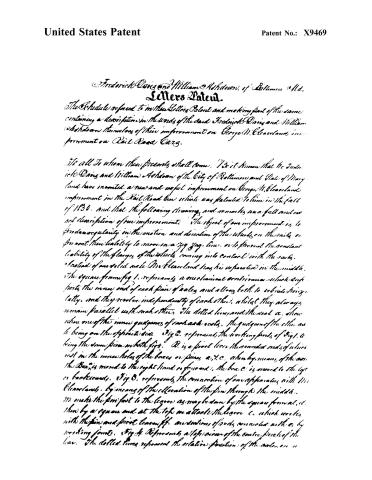
Page 2.
United States Patent
Patent No.: X9469
Frederick Davis and William Ashdown, of Baltimore Md.
Letters Patent.
The Schedule referred to in these Letters Patent and making part of the same containing a description in the words of the said Frederick Davis and William Ashdown themselves of their improvement on George W. Clearland’s improvement on Rail Road Cars.
To all to whom these presents shall come. We it known that the said Frederick Davis and William Ashdown of the City of Baltimore and State of Maryland have invented a new and useful improvement on George W. Clearland’s improvement in the Rail Road Cars which was patented to him in the fall of 1830. and that the following drawings and remarks are a full and exact description of said improvement. The object of our improvement is to produce regularity in the motion and direction of the wheels on the rails, or prevent their liability to move in a zig zag line, or to prevent the constant liability of the flanges of the wheels coming into contact with the rails.
Instead of one solid axle Mr. Clearland has his separated in the middle. The square frame fig 1. represents a mechanical contrivance which supports the inner end of each pair of axles and allows both to revolve horizontally, and they revolve independently of each other, whilst they always remain parallel with each other. The dotted lines and the seal a. show where one of the inner guideways of each axle rests. The guideways of the other are to be on the opposite side. Fig 2. represents the working parts of Fig 1. a. being the same piece in both figs. D is a pivot lever the rounded ends of which rest in the inner holes of the boxes or pins a, b, c. when by means of the axle the Box a is moved to the right hand or forward, the box c is moved to the left or backwards. Fig 3. represents the connection of our apparatus with Mr. Clearland’s, by means of the elevation of the pin through the middle. We make the pin fast to the lever as may be seen by the square frame at d. shown by a square and at the top we attach the lever e. which works with the pin and pivot lever f. on axles of rods connected with e. by working joints. Fig 4. Represents a top view of the centre piece of the Car. The dotted lines represent the relative position of the axles on a
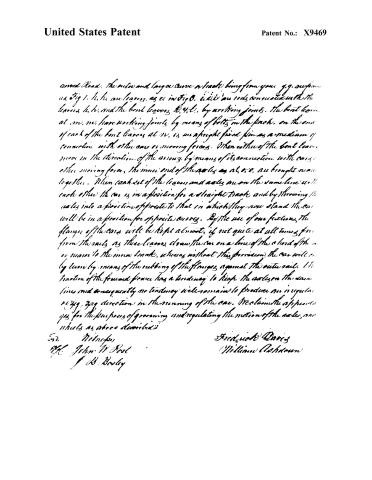
Page 3.
United States Patent
Patent No.: X9469
curved Road. the outer and larger curve or track being from your g.g. as from us Fig 1. h. h. are leaves, as c. in Fig 0. with two rods connected with the leaves h. h. and the bent leaves k. k. l. by working joints. the bent leaves at m. m. have working joints by means of bolts in the pack. on the end of each of the bent leaves at n. is an upright fixed pin as a medium of connection with other cars or moving forces. When either of the bent leaves moves in the direction of the arrows, by means of its connection with cars or other moving forces, the inner end of the axles as at o. o. are brought nearer together. When each set of the leaves and axles are on the same line with each other the car is in a position for a straight track and by throwing the axles into a position opposite to that in which they now stand the car will be in a position for opposite curves. By the use of our friction, the flanges of the cars will be kept almost, if not quite at all times from from the rails as these leaves draw the car on a line of the a lord of the or means to the inner track, whereas without this provision the car will only turn by means of the rubbing of the flanges against the outer rails. The traction of the forward force has a tendency to keep the axles on the same line and consequently no tendency will remain to produce an irregular zig zag direction in the running of the car. We claim the apparatus for the purposes of governing and regulating the motion of the axles and wheels as above described.
End.
W. M. Neisner
John W. Noel
J. B. Bowley
Frederick Davis
William Ashdown
Published accounts: journal notice
Notice in the monthly list of patents
Journal of the Franklin Institute, new ser., vol. 17 (1836), p. 438 · View the page
164. Rail road cars.-T. Davis and W. Ashdown, Baltimore,
Published accounts: journal notice
Notice in the monthly list of patents, with remarks
Journal of the Franklin Institute, new ser., vol. 18 (1836), p. 319 · View the page
24. For an improvement in Rail Road Cars; Frederick Davis and William Ashdown, Baltimore, Maryland, March 4.
Remarks. This is said to be an improvement upon the plan patented by G. W. Cleaveland, on the 14th October, 1835, in which axles, divided in the middle, were employed in what was called a self-adjusting rail road car. The present patentees adopt the divided axle, each wheel turning independently, and being connected by a system of levers by which they propose to adapt the wheels to the curvature of the road, whatever that may be, and thus to prevent the vibrating, or zig zag, motion of the car, and preserve the flanch from contact with the rail. It so happens, however, that this vibratory motion is not caused by the curvature of the road, as it takes place as strikingly in the straight parts, and results from those perpetually recurring inequalities, which are unavoidable even on the best roads. The same defect attends the proposed plan as that which we have noticed in some others, namely, the fore and hind wheels are simultaneously acted upon; yet it must happen at the beginning and the end of every curve, that one pair of wheels will be on the curve, whilst the other pair is on the straight rails.
About this record
- Patentee
- DATAMP
- Date
- the Name and Date index of patents, DATAMP, USPTO records
- Invention
- DATAMP
- Listed in
- the Name and Date index of patents, DATAMP, USPTO records, Jim Shaw's X-patent list, the Journal of the Franklin Institute, Burke's List of Patents (1847)
- Burke's 1847 Patent Office list gives the same patent.