

Drawings and documents
National Archives restored drawings: drawing
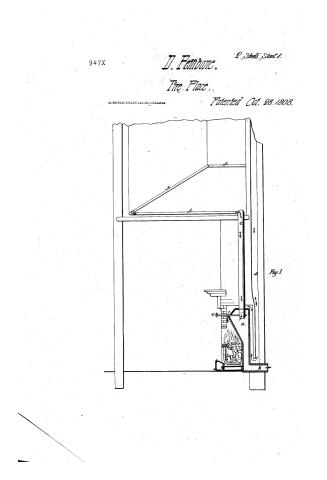
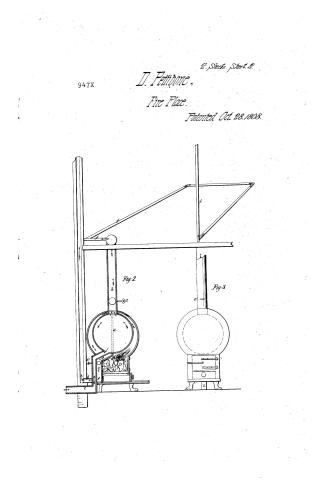
Daniel Pettibone's Patent Drawing for a Rarefying Air Stove

National Archives, Restored Patent Drawings (Record Group 241) · Full-size scan at the National Archives · Catalog record
Show the text on the drawing Hide (99 words)
Words on the drawing as machine-read by the National Archives; not checked. Useful mainly for searching.
Fire.places / Daniel I ettibones Oct 28 - 1808 / ILASSIFICATION / 947X / "rarefying airston" / 189 / Law Mar / DIV ISION. / Vol.2. ps & / STOVES & FURNACES, / Fire Places-Hot Air. / Patent / of / Prefirences / of / rarefying and / fresh hotanpipe. an / chimney / fift. condacting tubes. / Jy2. a Sig 3. Stoaes. / aigoessed. / hotair pipe / Stight / Sig2. / De / 0.00 / d' / smoke pipe. / 1" / oo / Section / Patent affic harch Front view 5th 1845. / Made under the direction of the Commissioner of / in conformity with act of 3. hareh 1837. / correct / nd Ellmonth / CW.MKelley / Lommition of Satent
USPTO scan
The patent as scanned by the USPTO
-
 Page 1
-
 Page 2
-
 Page 3
-
 Page 4
-
 Page 5


U.S. Patent and Trademark Office · Google Patents
Show the transcription Hide (1,118 words)
Machine transcription (LightOnOCR) of the pages as scanned by the USPTO, most of them the handwritten copies made when the records were restored after the 1836 fire. Not checked; it can misread handwriting, so compare it with the scan.
Page 1.
947X
D. Pettibone,
Fire Place.
Patented Oct. 28, 1808.
NO PRINTED SPECIFICATION AVAILABLE
2 Sheets. Sheet 1.
Fig. 1
Page 2.
947X
2 Sheets. Sheet 2.
D. Pettibone,
Fire Place.
Patented Oct. 28, 1808.
Fig. 2
Fig. 3
Page 3.
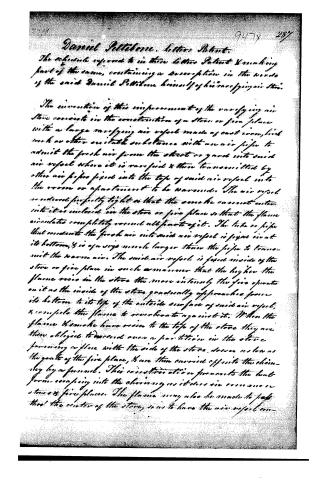
Daniel Pettibone. Letter Patent.
The schedule referred to in these Letters Patent & making part of the same, containing a description in the words of the said Daniel Pettibone himself of his rare & ingenious air stove.
The invention of this improvement of the rarefying air stove consists in the construction of a stove or fire place with a large rarefying air vessel made of cast iron, brick work or other suitable substance with an air pipe to admit the fresh air from the street or yard into said air vessel where it is rarefied & then transmitted by other air pipes fixed into the top of said air vessel into the room or apartment to be warmed. The air vessel is rendered perfectly tight so that the smoke cannot enter into it as enclosed in the stove or fire place so that the flame circulates completely around all parts of it. The tube or pipe that conducts the fresh air into said air vessel is fixed in at its bottom, & is of a size much larger than the pipe to transmit the warm air. The said air vessel is fixed inside of the stove or fire place in such a manner that the higher the flame rises in the stove the more intensely the fire operates on it as the inside of the stove gradually approaches from its bottom to its top of the outside surface of said air vessel, & compels the flame to overheat against it. When the flame & smoke have risen to the top of the stove they are then obliged to descend over a partition in the stove forming a flue with the side of the stove, down as low as the grate of the fire place, & are then carried off into the chimney by a funnel. This construction prevents the heat from escaping into the chimney as it does in common stoves or fire places. The flame may also be made to pass through the center of the stove, so as to have the air vessel con-
Page 4.
288
947x
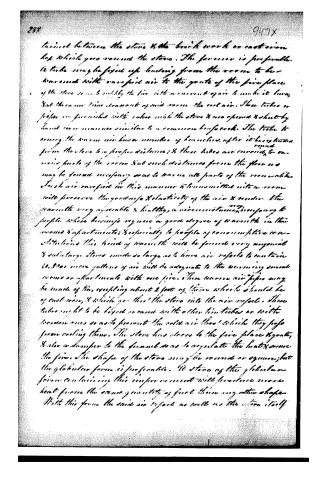
trained between the stone & the brick work or cast iron hop which goes round the stone. The furnace is preferable. A tube may be fixed up leading from the room to be warmed with a forced air to the grates of the fire place of the stove so as to supply the fire with a current of air to make it burn, & at the same time draw out of said room the cold air. These tubes or pipes are provided with valves right the stone & are opened & shut by hand in a manner similar to a common brosecook. The tubes to convey the warm air have number of branches, after it has returned from the stove to a proper distance; & these tubes are covered to various parts of the room & at such distances from the floor as may be found necessary, so as to warm all parts of the room while fresh air is forced in this manner & is transmitted into a room will preserve the goodness & elasticity of the air & render the warmth very agreeable & healthy, a circumstance very necessary to people where business requires a good degree of warmth in their rooms & apartments; & especially to people of consumptive constitutions this kind of warmth will be found very agreeable & salutary. Stoves made so large as to have air vessels to contain 10, 50 or more gallons of air will be adequate to the warming several rooms or apartments with one fire. These warm air pipes may be made of tin, excepting about 2 feet of them which should be of cast iron, & which go thro' the stove into the air vessel. These tubes might be boxed or covered with other tin tubes or with brass ones so as to prevent the cold air thro' which they pass from cooling them. The stove has doors to the fire place & grates, & also a damper to the furnace so as to regulate the heat & secure the fire. The shape of the stove may be round or square; but the globular form is preferable. A stove of the globular form containing this improvement will produce more heat from the same quantity of fuel than any other shape. With this form the said air vessel as well as the fire itself
Page 5.
being made of numerous half globes of cast iron, with grooved edges to shut together, one with one, be fixed together & connected perfectly tight with a little luting made of linseed & the white of eggs put into said grooves where the said vessels & stove are fixed together. But this globular stove the said air vessel is fixed much higher the top of the stove than any other part of it, so that the fire is driven very forcibly against all parts of the surface of said air vessel; & the smoke is carried down from the top of the stove by a partition, which is fitted to the concavity of the stove, & is let out into the furnace as low down as the grate. A stove of this form with an air vessel not larger than a common large iron tea kettle will produce a sensible & good effect. The size however may be as required. The said air vessel ought to be as large as the magnitude of the stove will conveniently admit, & the said air pipes made in due proportion & well luted so as to render said air vessel perfectly air tight, tubes specified. These air vessels and tubes may also be fixed into common chimneys a little above the mouth of the kettle, not disfiguring the fire place & will produce a good effect in warming the room. The same principles of rarifying air as above laid down may be applied in the construction of tin lamps or small stoves to be lighted & heated by oil lamps. In this case the air tubes extend but one inch or two from the sides of the lamp or stove. These are very convenient in cases of sickness in the night time.
Witnesses
John Fairbanks
Lack & G. Whitman
Daniel Pettibone
(115 words) (Patented October 25, 1808)
Expt. 1156.
About this record
- Patentee
- DATAMP
- Date
- the Name and Date index of patents, DATAMP, USPTO records
- Invention
- DATAMP
- Listed in
- the Name and Date index of patents, DATAMP, USPTO records, Jim Shaw's X-patent list, S. A. Elliot's printed list of patents, Burke's List of Patents (1847)
- S. A. Elliot's printed list of patents gives the same name and date.
- Burke's 1847 Patent Office list gives the same patent.