

Drawings and documents
National Archives restored drawings: drawing
E. Thomas' Patent Drawing for Metalic Sliding Splint

National Archives, Restored Patent Drawings (Record Group 241) · Full-size scan at the National Archives · Catalog record
Show the text on the drawing Hide (19 words)
Words on the drawing as machine-read by the National Archives; not checked. Useful mainly for searching.
is / If / 3. / OR
USPTO scan
The patent as scanned by the USPTO
-
 Page 1
-
 Page 2
-
 Page 3


U.S. Patent and Trademark Office · Google Patents
Show the transcription Hide (944 words)
Machine transcription (LightOnOCR) of the pages as scanned by the USPTO, most of them the handwritten copies made when the records were restored after the 1836 fire. Not checked; it can misread handwriting, so compare it with the scan.
Page 1.
9483X
E. Thomas.
Fracture Apparatus.
Patented Mar. 8, 1836.

AM. PHOTO-LITHO. CO. N. Y. (OSBORNE'S PROCESS.)
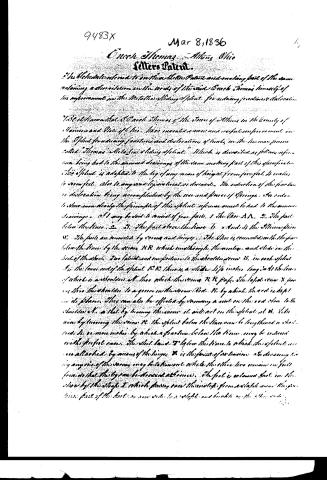
Page 2.
9483X
Mar 8, 1836
Cnoch Thomas, Athens, Ohio
Letters Patent.
I, the Subscriber, do hereby declare that I, Cnoch Thomas, of the Town of Athens in the County of Warren and State of Ohio, have invented a new and useful improvement in the Patent for reducing friction and destruction of limbs in the human frame called "Thomas' Metallic Sliding Splint," which is described as follows:
This splint is adapted to the leg of any person of height from five feet to seven feet, also to any person of any size or downward. The reduction of the fracture or destruction being accomplished by the use and power of Springs. In order to show more clearly the principle of this splint, reference must be had to the annexed drawings. A may be said to consist of four parts: 1. The Shoe A B. 2. The foot below the knee. 3. The foot above the knee. 4. And 5. The Splint piece.
The parts are connected by screws and hinges. The Shoe is connected with the foot below the knee by the screw R R which runs through the motion and slides in the heel of the shoe. Two lateral and one posterior to the shoulder piece D, in each splint. In the lower end of the splint R R there is a slide 1/2 inch long in the heel of which is a shoulder at X, which the screw R R passes. The lateral screw X passes through the shoulder to a groove in the shoulder piece D, by which the part is kept in its places. This can also be effected by moving a nail on the outer side to the shoulder at X, so that by moving the screw it will act on the splint at D. Similarly, by moving the screw R, the splint below the knee can be lengthened or shortened. It is more marked by which a fracture below the knee may be reduced with perfect ease. The steel band T below the knee to which the splint is attached by means of the hinge, is the point of its tension. By drawing it by any one of the screws, every relation will be kept, the other two remain in full force, so that the leg can be treated at once. The foot is secured fast in the shoe by the strap I, which passes over the instep from a staple on the posterior part of the heel, so as to be a slight and flexible on the other side.
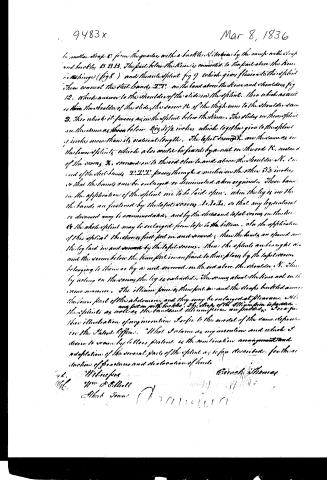
Page 3.
to another strap C from the quads, with a buckle & straps by the same with strap and buckles D D D. The part below the knee is connected to the part above the knee by hinges (fig 8) and thus the splint fig 9 which gives flexion to the splint thus connect the steel bands 2' 2' on the band above the knee and shoulders fig 12, which answers to the shoulder of the slide in the splint, then which as well as the shoulder of the slide, the screw R of the thigh runs to the shoulder screw S, thus which it passes as in the splint below the knee. The slides in these splints are the same as those below fig 10 1/2 inches which together give to the splint 1/2 inches more than its natural length. The lapel screws X are the same as in the lower splint, which also would be fixed by a nut on the rod R, instead of the screws X, screwed on to the rod close to and above the shoulder N. One end of the steel bands 2' 2' passes through a motion in the other 3 1/2 inches so that the bands can be enlarged or diminished when required. These bands in the application of the splint are to be laid open, when the leg is in the the bands are fastened by the lapel screws 1 1/2 1 1/2, so that any leg situation so desired may be accommodated, and by the slides and lapel screws on the knee the whole splint may be enlarged from top to the bottom. Also the application of this splint the shoe is first put on and screwed; then the bands are opened and the leg laid in and screwed by the lapel screws. Then the splint is brought in and the screws below the knee first in an place to their place by the lapel screws belonging to them or by a nut screwed on the rod above the shoulder N, then by acting on the screws the leg is extended. The screw about the knee acts on the same manner. The ilium piece is then put on and the straps buckled around the lower part of the abdomen, and they may be enlarged at pleasure. All any fasten with buckle. The straps of the ilium piece is padded, the splints as well as the bands and ilium pieces are padded. I do a fig. See illustration of my invention I refer to the model of the same deposited in the Patent Office. What I claim as my invention and which I desire to secure by letters patent is the combination arrangement and adaptation of the several parts of the splint as before described, for the motion of flexure and the location of limbs.
Witnesses
Wm. P. Elliott
Alfred Jones
Ezra A. Thomas
9483x
Mar 8, 1836
Published accounts: journal notice
Notice in the monthly list of patents
Journal of the Franklin Institute, new ser., vol. 17 (1836), p. 438 · View the page
175. Splint for fractures.-Enoch Thomas, New Athens, O.
Published accounts: journal notice
Notice in the monthly list of patents
Journal of the Franklin Institute, new ser., vol. 17 (1836), p. 439 · View the page
260. Churn.-Thomas Nicholson, New Market, Va.
Published accounts: journal notice
Notice in the monthly list of patents, with remarks
Journal of the Franklin Institute, new ser., vol. 18 (1836), p. 322 · View the page
35. For a Splint for reducing fractures, called a sliding metallic Splint; Enoch Thomas, New Athens, Morrison county, Ohio, March 8.
Remarks. This splint is capable of being lengthened, or shortened, to adapt it to persons of different heights. We shall not attempt to describe the particular construction of any of its individual parts, as these do not constitute any part of the claim, although they are dilated upon in the specification. The claim is to "the combination, arrangement, and adaptation of the several parts of the splint, as described." A claim, which, like the splint itself, is calculated equally well to fit every subject.
About this record
- Patentee
- DATAMP
- Date
- the Name and Date index of patents, DATAMP, USPTO records
- Invention
- DATAMP
- Listed in
- the Name and Date index of patents, DATAMP, USPTO records, Jim Shaw's X-patent list, the Journal of the Franklin Institute, Burke's List of Patents (1847)
- Burke's 1847 Patent Office list gives the same patent.