

Drawings and documents
National Archives restored drawings: drawing
Henry Hartge's Patent Drawing for a Piano Forte

National Archives, Restored Patent Drawings (Record Group 241) · Full-size scan at the National Archives · Catalog record
Show the text on the drawing Hide (86 words)
Words on the drawing as machine-read by the National Archives; not checked. Useful mainly for searching.
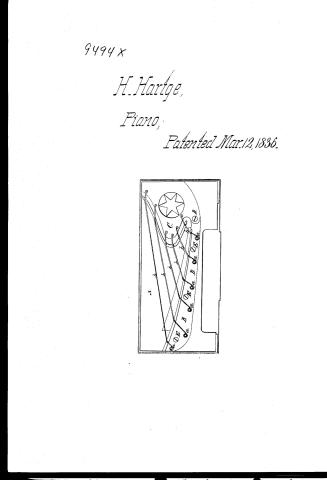
84. MUSIC. / [112] Pianos. / it Started / Piano / CLASSLUCATIO / 9494.X / DIVISION / Niamo Starte / 9494X / DE / TE / the / References / A. The sounding board. - BB The metallic plate, fastened to the tuning block. / a. The metallic plate, to which the strings are hung D Serew uniting the two / metallic plates E.E.E. Screws fastening the metallic plate to the tuning / block. wa.a.a.a.a Juning pins. 6.6.6.6 6b. Strings of the instrument. -
USPTO scan
The patent as scanned by the USPTO
-
 Page 1
-
 Page 2
-
 Page 3


U.S. Patent and Trademark Office · Google Patents
Show the transcription Hide (803 words)
Machine transcription (LightOnOCR) of the pages as scanned by the USPTO, most of them the handwritten copies made when the records were restored after the 1836 fire. Not checked; it can misread handwriting, so compare it with the scan.
Page 1.
9494X
H. Hartge,
Piano,
Patented Mar. 12, 1836.
Page 2.
Mar 12, 1836
Henry Pludge Baltimore Md
Letters Patent
The schedule referred to in these Letters Patent and making part of the same contains a description in the words of the said Henry Pludge himself, of his improvement in the Construction of Piano Fortes.
To all to whom these presents shall come, He it known that Henry Pludge of the City of Baltimore in the State of Maryland have invented a new and useful improvement in the Construction of Piano Fortes and that the following is a full and exact description of the Construction of the said improvement as invented by him. In the ordinary mode of constructing Piano Fortes the tuning pins or tuning screws the tension of the strings is increased or diminished as may be required to put the instrument in tune are inserted into a solid block of pine or like wood in the proper place. It is highly stated that the friction or adhesion of the metal or tuning pins to the wooden tuning block, as it is technically termed, is not sufficient to prevent the tuning pins from being turned by the tension of the strings which is kept exerted by it. The wood however being softer than the tuning pins and elastic in itself it often happens that the pins will not remain turned down by the tension of the strings out of its perpendicular position after the piano has been tuned whereby the tension of the strings being diminished the instrument becomes as it is called out of tune. This is the more liable to be the case the higher the key or pitch to which the piano is tuned. Defects in the solidity of the tuning block may render this inclination or giving way of the tuning pins different in different parts of the same piano. The pins in the ordinary mode of construction may often remain perpendicular in their proper position and the instrument eventually become out of tune by the whole tuning block being yielding to the tension of the strings. It is for the purpose of obviating these defects I offer as it can be done by keeping the tuning pins firm and the tuning block in its proper position that my improvement is made. I have set forth thusly in the following words. I propose a metallic plate of the length of the tuning block and of sufficient width to meet where
Page 3.
218. X9494
Another part is the tuning block (the tenon of the strings) with circular holes exactly corresponding with the holes for the tuning pins in the tuning block. The holes in the metallic plate are just large enough to permit the tuning pins turning around them, they with the least play between the pin and the metallic plate. The tuning pins are prevented from turning round (by the tenon of the strings) in this case as in any other by their friction against the wood of the tuning block and by means of the metallic plate they are prevented from being drawn out of their proper circular position and the tuning block is made from wood to resist the accumulated turns of all the strings which use of the metallic plate just described constitutes the improvement which I have invented. In the drawing which I have made with a view of testing the utility of my invention the thickness of the metallic plate has been about three eight of an inch which I have found to answer well though it may be made in different dimensions in this respect and still produce the same effect. It may also be made of brass or iron or other metal. I have heretofore used iron. The metallic plate here described is secured fast to the tuning block and is covered by a screw or other sufficient fastening to the metallic plate which is above the tuning block and upon which the strings are hung or fastened immovably. In the accompanying drawing but one construction of piano is shown. My improvement is equally applicable to any other that I claim as new and as my own invention in the above and for the use of which I ask an exclusive privilege is the metallic plate fastened to the tuning block with holes for the tuning pins to pass through furnishing additional security and permanence to such pins and giving increased firmness to the tuning block, thereby aiding to keep the instrument in tune.
Witness
Jno H. B. Locke
T. Halloran
Leroy Hodge
754 11.07
(Drawings have been made)
Drawing
Published accounts: journal notice
Notice in the monthly list of patents
Journal of the Franklin Institute, new ser., vol. 17 (1836), p. 438 · View the page
191. Piano fortes.-Henry Hartge, Baltimore, Md.
Published accounts: journal notice
Notice in the monthly list of patents
Journal of the Franklin Institute, new ser., vol. 17 (1836), p. 439 · View the page
263. Conveying water. Samuel Hart, Baltimore, Md.
Published accounts: journal notice
Notice in the monthly list of patents, with remarks
Journal of the Franklin Institute, new ser., vol. 18 (1836), p. 326 · View the page
4 51. For an improvement in Piano Fortes; Henry Hartge, city of Baltimore, March 12.
Remarks. The improvement here claimed, consists in making the tuning block of a piano forte, in part of wood, and in part of iron, in a way which we believe to be new. The wooden tuning block may be covered with an iron plate three-eighths of an inch in thickness, and the holes for the tuning pins be bored through the iron, and into the wood. The iron plate prevents the pins from being drawn out of perpendicular by the tension of the strings, whilst the pin has the advantage of being kept from turning by the elasticity of the wood. The claim is to "the metallic plate fastened to the tuning block, with holes for the tuning pins to pass through, furnishing additional security and permanency to such pins, and giving increased firmness to the tuning block, thereby aiding to keep the instrument in tune." We have no doubt of the goodness of this contrivance, or of its superiority to the devices which have preceded it in instruments where frames in part, or wholly, of iron, have been used to sustain the tension of the strings.
About this record
- Patentee
- DATAMP
- Date
- the Name and Date index of patents, DATAMP, USPTO records
- Invention
- DATAMP
- Listed in
- the Name and Date index of patents, DATAMP, USPTO records, Jim Shaw's X-patent list, the Journal of the Franklin Institute, Burke's List of Patents (1847)
- The Franklin Institute's journal spells the name differently.
- Burke's 1847 Patent Office list gives the same patent.