

Drawings and documents
National Archives restored drawings: drawing
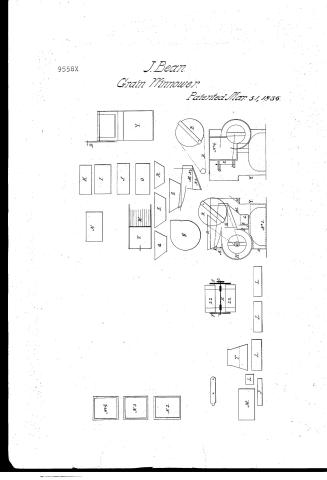
Jonathan Bean's Patent Drawing for a Winnowing Machine

National Archives, Restored Patent Drawings (Record Group 241) · Full-size scan at the National Archives · Catalog record
Show the text on the drawing Hide (54 words)
Words on the drawing as machine-read by the National Archives; not checked. Useful mainly for searching.
130. THRASHING. / Grain Separators. / irs. / tase / B. Shaking Screens. / CLASSIFICATION / Sonathan Been / 9558x / DIVISION / Winnowing Mchn / K. / 9558 / Patented March 31th 1836. / N. / is / NA / N.S. / HS / In / Niq / M.S. / N.2 / to / ZZ / of / NA / ZZ / of / th / Noi
USPTO scan
The patent as scanned by the USPTO
-
 Page 1
-
 Page 2
-
 Page 3
-
 Page 4
-
 Page 5
-
 Page 6


U.S. Patent and Trademark Office · Google Patents
Show the transcription Hide (2,179 words)
Machine transcription (LightOnOCR) of the pages as scanned by the USPTO, most of them the handwritten copies made when the records were restored after the 1836 fire. Not checked; it can misread handwriting, so compare it with the scan.
Page 1.
9558X
J. Bean
Grain Thresher
Patented Mar. 31, 1836.

Page 2.
3/31/1836 9558x
March 31, 1836 445
Jonathan Bean of Montville Maine
Letter Patent
The schedule referred to in the Letters Patent and making part of this same, containing a description in the words of the said Jonathan Bean himself of his improvement in the machine for winnowing all kinds of grain.
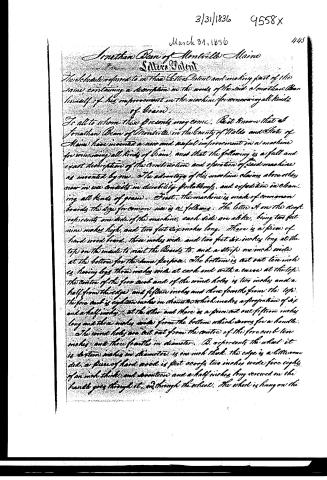
To all to whom this presents may come: Be it known that I Jonathan Bean of Montville in the County of Waldo and State of Maine have invented a new and useful improvement in a machine for winnowing all kinds of grain, and that the following is a full and exact description of the construction and operation of said machine as invented by me. The advantage of this machine claims above others now in use consists in durability for lasting, and expedition in cleaning all kinds of grain. First, the machine is made of common boards the size for common use is as follows. The letter A on the draft represents one side of the machine, each side are alike, being two feet nine inches high, and two feet six inches long. There is a piece of hard wood board, three inches wide and two feet six inches long at the top on the inside to nail the Boards to, and a strip one inch wide at the bottom for the same purpose. The bottom is cut out ten inches having legs three inches wide at each end with a cause at the top. The centre of the fore and end of the wind holes is two inches and a half from the edge and fifteen inches and three fourths from the top. The fore end is eighteen inches in diameter which makes a proportion of six and a half inches. At the other end there is a piece cut out fifteen inches long and three inches wide from the bottom which serves for a handle. The wind holes are cut out from the centre of the fore end ten inches and three fourths in diameter. B represents the wheel it is sixteen inches in diameter is one inch thick. The edge is a little rounded, a piece of hard wood is put across two inches wide five eighths of an inch thick and seventeen and a half inches long secured on the handle goes through it, and through the wheel. The wheel is hung on the
Page 3.
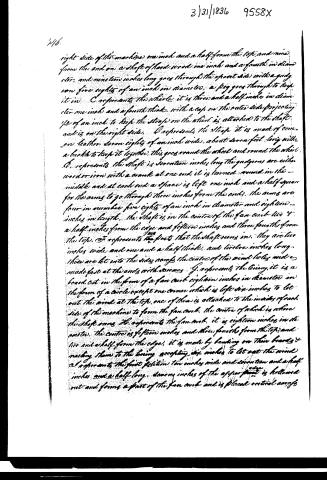
right side of the machine one inch and a half from the top, and nine from the end on a shaft of hard wood one inch and a fourth in diameter, and nineteen inches long goes through the opposite side with a gudgeon five eighths of an inch in diameter, a peg goes through to keep it in. C represents the wheel; it is three and a half inches in diameter one inch and a fourth thick, with a cap on the outer side projecting 1/2 of an inch to keep the strap on the wheel is attached to the shaft and is on the right side. D represents the strap; it is made of common leather seven eighths of an inch wide, about seven feet long with a buckle to keep it together; this goes round the wheel and round the wheel. E represents the shaft; is seventeen inches long the gudgeons are either wood or iron with a crank at one end; it is turned round in the middle and at each end a space is left one inch and a half space for the arms to go through three inches from the ends. The arms are four in number five eighths of an inch in diameter and eighteen inches in length. The shaft is in the centre of the fan and two and a half inches from the edge and fifteen inches and three fourths from the top. F represents the posts that the shaft rests in. They are two inches wide and one and a half thick, and twelve inches long. These are let into the sides across the centre of the wind holes and are made fast at the ends with screws. G represents the lining; it is a board cut in the form of a fan and eighteen inches in diameter in the form of a circle except one corner which is left six inches to let out the wind at the top, one of them is attached to the inside of each side of the machine to form the fan arch, the centre of which is where the shaft runs. H represents the fan arch; it is eighteen inches in diameter, the centre is fifteen inches and three fourths from the top, and two and a half from the edge, it is made by bending on three boards and nailing them to the lining excepting six inches to let out the wind. I represents the foot; fifteen ten inches wide and seventeen and a half inches and a half long. Seven inches of the upper part is hollowed out and forms a part of the fan arch and is placed vertical across.
Page 4.
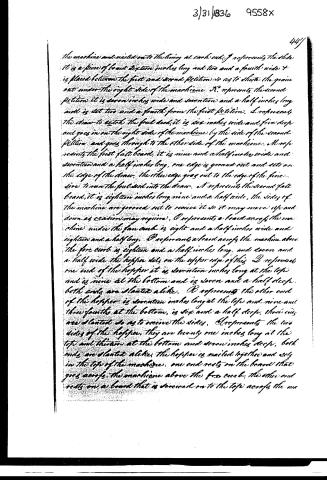
The machine and nailed on to the lining at each end. F represents the slide. It is a piece of board eighteen inches long and two and a fourth wide. It is placed between the first and second position so as to slide the grain out under the right side of the machine. R represents the second position. It is seven inches wide and seventeen and a half inches long and is set two and a fourth from the first position. L represents the draw to catch the foul end. It is six inches wide and five deep and goes in on the right side of the machine by the side of the second position and goes through to the other side of the machine. M represents the first fall board. It is nine and a half inches wide and seventeen and a half inches long. One edge is ground out and sits on the edge of the draw. The other edge goes out to the edge of the fine wire to run the foul end into the draw. N represents the second fall board. It is eighteen inches long, nine and a half wide. The sides of the machine are grooved out to receive it so it may move up and down as occasion may require. O represents a board across the machine under the fan and is eight and a half inches wide and eighteen and a half long. P represents a board across the machine above the fore curb is eighteen and a half inches long and seven and a half wide. The hopper sits on the upper edge of this. Q represents one end of the hopper. It is seventeen inches long at the top and is nine at the bottom and is seven and a half deep. Both ends are slanted alike. R represents the other end of the hopper. It is seventeen inches long at the top and nine and three fourths at the bottom, is six and a half deep. Those ends are slanted so as to receive the sides. S represents the two sides of the hopper. They are twenty-one inches long at the top and thirteen at the bottom and seven inches deep. Both ends are slanted alike. The hopper is nailed together and set in the top of the machine. One end rests on the board that goes across the machine above the fore curb. The other end rests on a board that is screwed on to the top across the ma
Page 5.
3/31/1836 9558X
1/18.
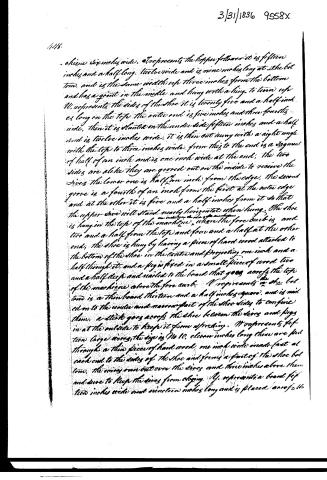
- chine six inches wide. It represents the hopper follower it is fifteen inches and a half long, twelve wide and is nine inches long at the bottom, and is the same width up three inches from the bottom and has a joint in the middle and hung with a hinge to turn up. It represents the sides of the shoe it is twenty five and a half inches long on the top the outer end is five inches and three fourths wide, then it is slanted on the under side fifteen inches and a half and is twelve inches wide, it is then cut away with a right angle with the top to three inches wide, from this to the end is a segment of half of an inch and is one inch wide at the end; the two sides are alike they are grooved out on the inside to receive the sides the lower one is half an inch from the edge, the second groove is a fourth of an inch from the first at the outer edge and at the other it is five and a half inches from it so that the upper side will stand nearly horizontal when hung. The shoe is hung in the top of the machine, where the fore curb is and two and a half from the top and four and a half at the other end; the shoe is hung by having a piece of hard wood attached to the bottom of the shoe in the centre and projecting one inch and a half through it, and a peg is fixed in a small piece of wood two and a half deep and nailed to the board that goes across the top of the machine above the fore curb. It represents the shoe bottom is a thin board thirteen and a half inches square, and is nailed on to the under and narrow part of the shoe sides to confine them, a stick goes across the shoe between the sides and pegs in at the outside to keep it from spreading. It represents fifteen large wires, the eye is No 10, eleven inches long these are put through a thin piece of hard wood, one inch wide made fast at each end to the sides of the shoe and forms a part of the shoe bottom, the wires run out over the sides and three inches above them and serve to keep the sides from closing. It represents a board fifteen inches wide and nineteen inches long and is placed across the
Page 6.
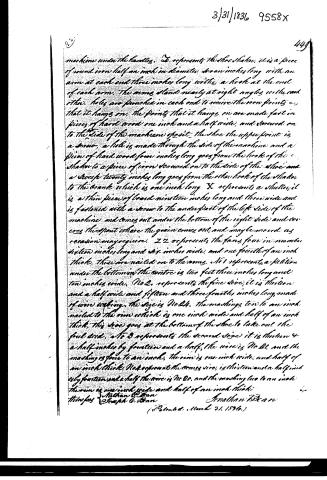
machine under the handles. X represents the shoe shaker; it is a piece of sound iron half an inch in diameter, seven inches long with an arm at each end three inches long with a hook at the end of each arm. The arms stand nearly at right angles with each other. Holes are punched in each end to receive the iron points so that it hangs on. The points that it hangs on are made fast in pieces of hard wood one inch and a half wide, and screwed on to the side of the machine opposite the shoe. The upper point is a screw, a hole is made through the side of the machine and a piece of hard wood four inches long goes from the hook of the shaker to a piece of iron screwed on to the side of the shoe and a screw twenty inches long goes from the other hook of the shaker to the crank which is one inch long. X represents a shuttle; it is a thin piece of board nineteen inches long and three wide and is fastened with a screw to the under part of the left side of the machine and comes out under the bottom of the right side and covers the spot where the grain comes out and may be moved as occasion may require. Z represents the fans four in number sixteen inches long and six inches wide, and one fourth of an inch thick. These are nailed on to the arms. No 1 represents a pelton under the bottom; the centre is two feet three inches long and ten inches wide. No 2 represents the fine sieve; it is thirteen and a half wide and fifteen and three fourths inches long, made of wire netting. The size is No 24. The mashings tied to an inch nailed to the rim which is one inch wide and half of an inch thick. This sieve goes at the bottom of the shoe to take out the foul dirt. No 3 represents the second sieve; it is thirteen and a half inches by fourteen and a half. The wire is No 21, and the meshing is four to an inch. The rim is one inch wide and half of an inch thick. No 4 represents the coarse sieve; it is thirteen and a half inches by fourteen and a half. The wire is No 20, and the meshing two to an inch. The rim is one inch wide and half of an inch thick.
Inventors: Nathan C. Barr & Joseph C. Barr
Patented March 31, 1836.
Published accounts: journal notice
Notice in the monthly list of patents
Journal of the Franklin Institute, new ser., vol. 17 (1836), p. 439 · View the page
262. Winnowing machine. Jonathan Beane, Montville, Maine.
About this record
- Patentee
- DATAMP
- Date
- the Name and Date index of patents, DATAMP, USPTO records
- Invention
- DATAMP
- Listed in
- the Name and Date index of patents, DATAMP, USPTO records, Jim Shaw's X-patent list, the Journal of the Franklin Institute, Burke's List of Patents (1847)
- Burke's 1847 Patent Office list gives the same patent.