

Drawings and documents
National Archives restored drawings: drawing
R. Boston and T. Bryan's Patent Drawing for a Soda Fountain

National Archives, Restored Patent Drawings (Record Group 241) · Full-size scan at the National Archives · Catalog record
Show the text on the drawing Hide (46 words)
Words on the drawing as machine-read by the National Archives; not checked. Useful mainly for searching.
109 / 220. Metallic Shipping & Storing Vessels, / fl / Casits, Sodes Water. / 109 / R.BOSTON 8 T.BRYAN'S / 116 / Patentedali / Stotal Sountain / DIVISION. / mg / any / 9579- / 9579X / (i / Scale 1/2 inch to an inch from model.
USPTO scan
The patent as scanned by the USPTO
-
 Page 1
-
 Page 2
-
 Page 3
-
 Page 4


U.S. Patent and Trademark Office · Google Patents
Show the transcription Hide (851 words)
Machine transcription (LightOnOCR) of the pages as scanned by the USPTO, most of them the handwritten copies made when the records were restored after the 1836 fire. Not checked; it can misread handwriting, so compare it with the scan.
Page 1.
9579X
No Printed Specification Available
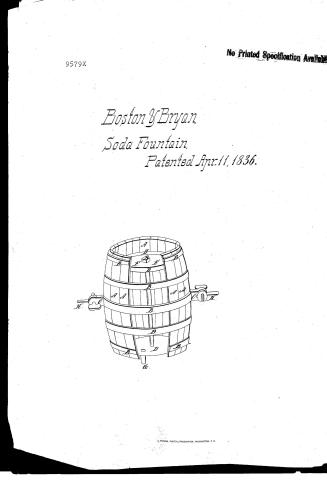
Boston & Bryan,
Soda Fountain,
Patented Apr. 11, 1836.

Page 2.
9579 X
april 11, 1896
Robert Boston and Thomas Bryan, New York.
Letters Patent.
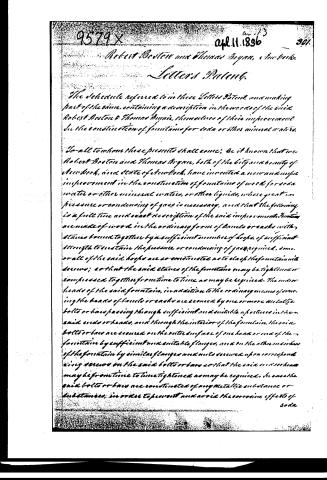
The schedule referred to in these Letters Patent, and making part of the same, containing a description in the words of the said Robert Boston & Thomas Bryan, themselves of their improvement in the construction of fountains for soda or other mineral waters.
To all to whom these presents shall come: Be it known that we Robert Boston and Thomas Bryan, both of the city and county of New York, and state of New York, have invented a new and unique improvement in the construction of fountains of wood for soda water or other mineral waters, or other liquids, whose great or pressure or condensing of gas is necessary, and that the following is a full, true and exact description of the said improvement. Fountains are made of wood in the ordinary form of barrels or casks with staves bound together by a sufficient number of hoops, of sufficient strength to sustain the pressure or condensing of gas required, some or all of the said hoops are so constructed as to clamp the fountain with screws; so that the said staves of the fountain may be tightened or compressed together from time to time as may be required. The upper heads of the said fountain, in addition to the ordinary means of securing the heads of barrels or casks are secured by one or more metallic bolts or bars passing through sufficient and suitable apertures in the said ends or heads, and through the interior of the fountain, the said bolts or bars are secured on the outside surface of one head or end of the fountain by sufficient and suitable flanges, and on the other end or head of the fountain by similar flanges and nuts screwed upon corresponding screws on the said bolts or bars so that the said ends or heads may be from time to time tightened as may be required, because the said bolts or bars are constructed of any metallic substance or substances, in order to prevent and avoid the corrosive effects of soda.
Page 3.
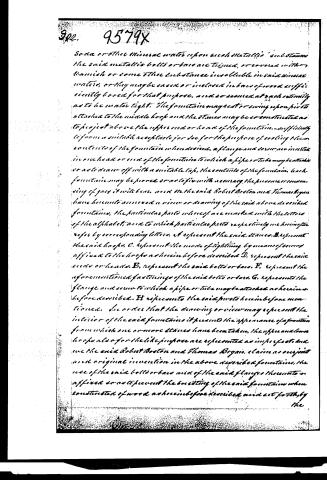
Soda or other mineral waters upon such metallic substances the said metallic bolts or bars are turned, or covered with, tarnish or some other substance insoluble in said mineral waters, or they may be boxed or enclosed in boxes of wood sufficiently bored for that purpose, and so secured at each extremity as to be water tight. The fountain may rest or swing upon pivots attached to the mineral hoop and the stems may be so constructed as to project above the upper end or head of the fountain, sufficiently to form a suitable receptacle for use for the purpose of cooling the contents of the fountain when desired, a flange and screw are inserted in one head or end of the fountain to which a pipe or tube may be attached so as to draw off with a suitable tap, the contents of the fountain. Each fountain may be proved or so to fix with accuracy the pressure or remaining of gas it will bear, and the said Robert Boston and Thomas Bryan have herewith annexed a view or drawing of the said above described fountains, the particular parts whereof are marked with the letters of the alphabet, and to which particular parts respectively we hereinafter refer by corresponding letters. A represents the said stems. B represents the said hoops. C represents the mode of tightening by means of screws applied to the hoops as herein before described. D represents the said ends or heads. E, represents the said bolts or bars. F, represents the aforementioned fastenings of the said bolts or bars. G, represents the flange and screw to which a pipe or tube may be attached as herein before described. H represents the said pivots herein before mentioned. In order that the drawing or view may represent the interior of the said fountains it presents the appearance of a fountain from which one or more stems have been taken, the upper and lower hoops also for the like purpose are represented as imperfect, and we the said Robert Boston and Thomas Bryan, claim as our joint and original invention in the above described fountains, the use of the said bolts or bars and of the said flange or stem to be affixed so as to prevent the bursting of the said fountains when constructed of wood as herein before described and act forth by the
Page 4.
95794
The presence or consenting of greater therein. And we have therefore hereunto set our hands the thirtyeth day of January in the year one thousand eight hundred and thirty six.
Witnesses
A. Tucker
R. Fisk
R. Boston
Wm. Bryan
855 n.b.3'
Gracious
903
C.C
Cijll.
Published accounts: journal notice
Notice in the monthly list of patents
Journal of the Franklin Institute, new ser., vol. 18 (1836), p. 71 · View the page
321. Smut machine. William B. Ryan, Mount Morris, N. Y.
About this record
- Patentee
- DATAMP
- Date
- the Name and Date index of patents, DATAMP, USPTO records
- Invention
- DATAMP
- Listed in
- the Name and Date index of patents, DATAMP, USPTO records, Jim Shaw's X-patent list, the Journal of the Franklin Institute, Burke's List of Patents (1847)
- Burke's 1847 Patent Office list gives the same patent.