

Drawings and documents
National Archives restored drawings: drawing
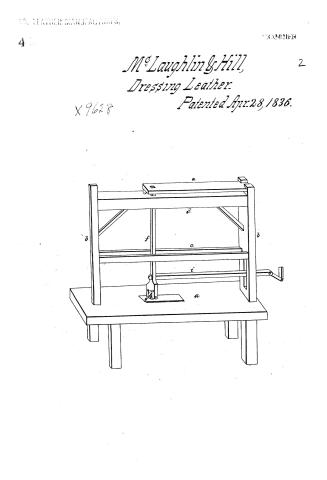
I. McGlaughlin and H. Hill's Patent Drawing for a Machine for Rolling Leather

National Archives, Restored Patent Drawings (Record Group 241) · Full-size scan at the National Archives · Catalog record
Show the text on the drawing Hide (39 words)
Words on the drawing as machine-read by the National Archives; not checked. Useful mainly for searching.
149. Hides, Skins / 18. Rt Rooking Frames: Dools, Not inis buig / I. M:CLAUCHLIN KH.HILL'S / 9.628. x / DIVISION. / Macchine for rolling / 9628 X / Pateneed April 2836 / 18
USPTO scan
The patent as scanned by the USPTO
-
 Page 1
-
 Page 2
-
 Page 3


U.S. Patent and Trademark Office · Google Patents
Show the transcription Hide (721 words)
Machine transcription (LightOnOCR) of the pages as scanned by the USPTO, most of them the handwritten copies made when the records were restored after the 1836 fire. Not checked; it can misread handwriting, so compare it with the scan.
Page 1.
CO. LEATHER MANUFACTURERS,
4
EXAMINER
McLaughlin & Hill,
Dressing Leather.
Patented Apr. 28, 1836.
X 9628
2

Page 2.
The schedule referred to in these Letters Patent and making of the same containing a description in the words of the said Ira M. Laughlin & Horam Hill themselves of their improvement in the Machine for Rolling Leather.
To all persons to whom these presents shall come. Be it known that we Ira M. Laughlin & Horam Hill both of Sunderland, County of Bennington and state of Vermont have jointly invented a new and useful improvement in the common pendulum rolling machine, used for rolling leather which improvement or invention we specify and describe in manner following viz To show the nature, proprieties and extent of our improvement we here describe a machine for a size suitable for rolling leather. The drawing exhibits a perspective view of the machine here described and references are made to the same in the description. In the construction of the machine some kind of hard wood should be used. The table or platform (a) is sixteen feet long, four feet wide and four inches thick raised three feet from the floor and resting on firm supports. To this table is firmly framed two upright perpendicular posts (b, b) eight feet in length, four inches wide and eight inches thick resting one foot from the front, and six inches from the ends of the table. To each side of these posts and two feet six inches distance from the table or base are fitted or framed two cross pieces or girts (c) fifteen feet long six inches wide and two inches thick. Also to the posts six feet and six inches from the table is framed a beam (d) sixteen feet long and one foot square. To the post standing on the right end of the table and three inches below the top of the same is attached by a movable joint a weight beam (e) nine feet long one foot wide and six inches thick on this beam is placed the weight necessary for the operation.
Page 3.
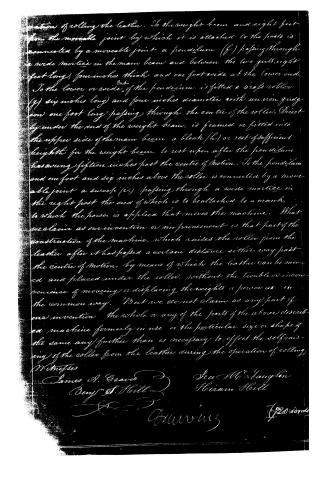
motion of rolling the leather. To the weight beam and eight feet from the moveable joint by which it is attached to the posts is connected by a moveable joint a pendulum (f) passing through a wide mortice in the main beam and between the two girts, eight feet long, four inches thick and one foot wide at the lower end. To the lower or wide end of the pendulum is fitted a brass roller (g) six inches long and four inches diameter with an iron gudgeon one foot long passing through the centre of the roller. Directly under the end of the weight beam, is framed or fitted into the upper side of the main beam a block (h) or rest of sufficient height for the weight beam to rest upon after the pendulum has swung fifteen inches past the centre of motion. To the pendulum and one foot and six inches above the roller is connected by a moveable joint a sweep (i) passing through a wide mortice in the right post the end of which is to be attached to a crank, to which the power is applied that moves the machine. What we claim as our invention or improvement is that part of the construction of the machine, which raises the roller from the leather after it has passed a certain distance either way past the centre of motion, by means of which the leather can be moved and placed under the roller, without the trouble or inconvenience of moving or displacing the weights or power as in the common way. But we do not claim as any part of our invention the whole or any of the parts of the above described machine formerly in use or the particular size or shape of the same any further than is necessary to effect the self-raising of the roller from the leather during the operation of rolling.
Witnesses
James A. Graves
Benj. S. Hill
Isa. McLaughlin
Hiram Hill
Drawing
[20 words]
Published accounts: journal notice
Notice in the monthly list of patents
Journal of the Franklin Institute, new ser., vol. 18 (1836), p. 71 · View the page
330. Leather rolling machine.-J. McLaughling and H. Hill, Sunderland, Vt.
About this record
- Patentee
- DATAMP
- Date
- the Name and Date index of patents, DATAMP, USPTO records
- Invention
- DATAMP
- Listed in
- the Name and Date index of patents, DATAMP, USPTO records, Jim Shaw's X-patent list, the Journal of the Franklin Institute, Burke's List of Patents (1847)
- Burke's 1847 Patent Office list gives the same patent.