

Drawings and documents
National Archives restored drawings: drawing
Elihu Smith's Patent Drawing for a Machine for Cutting and Making Laths

National Archives, Restored Patent Drawings (Record Group 241) · Full-size scan at the National Archives · Catalog record
Show the text on the drawing Hide (112 words)
Words on the drawing as machine-read by the National Archives; not checked. Useful mainly for searching.
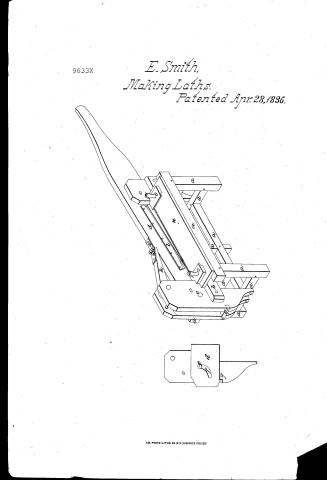
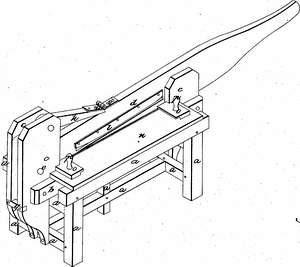
144. WOOD WORKING MACHINES. / Slicers, Rotary & Oscillating. / CLASSIFICATION / 9633.4 / DIV ISION. / 9633 / Machine for cutting and making Laths / Patented: 2 1836 / References. / a Frame / br. Beams / c upright planks / d Lever / e Rolling pivot / f. / Quarter circle for the lever to play in / I Square piece for the lever to rest upon / h Brace or reach. / to / Hinge for the brace / K Rolling pivot for the brace / l knife / m Piece of common bandiron / n Platform / v bleats / p. Hand-screws / Patent Office 23 April 1839 / Made under the direction of the Commitioner of Patents in / conformity with act 3d March 1837 / MLS Mirrorth
USPTO scan
The patent as scanned by the USPTO
-
 Page 1
-
 Page 2
-
 Page 3


U.S. Patent and Trademark Office · Google Patents
Show the transcription Hide (813 words)
Machine transcription (LightOnOCR) of the pages as scanned by the USPTO, most of them the handwritten copies made when the records were restored after the 1836 fire. Not checked; it can misread handwriting, so compare it with the scan.
Page 1.
9633X
E. Smith,
Making Laths.
Patented Apr. 28, 1836.

AM. PHOTO-LITHO. CO. N.Y. (OSBORNE'S PROCESS)
Page 2.
Apr 16
Apr 28 1896
205.
9633X Elisha Smith, of Ithaca, N.Y.
Letter Patent
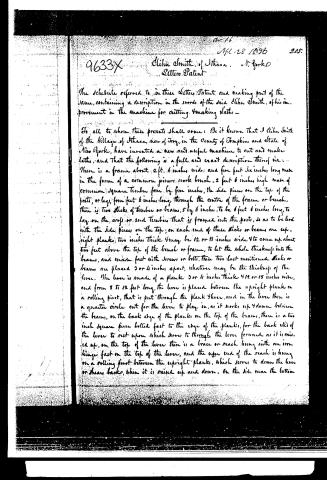
The schedule referred to in these Letters Patent and making part of the same, containing a description in the words of the said Elisha Smith, of his improvement in the machine for cutting & making laths—
To all to whom these presents shall come: Be it known that I Elisha Smith of the Village of Ithaca, now of Troy, in the County of Tompkins and State of New York, have invented a new and useful machine to cut and make laths, and that the following is a full and exact description thereof.
There is a frame about 2 ft. 6 inches wide and five feet six inches long made in the form of a common joiner's work bench, 2 feet 6 inches high made of common square timber four by five inches, the side pieces on the top of the feet, or legs, four feet 6 inches long, through the centre of the frame or bench, there is two sticks of timber or beams, 5 by 6 inches, to be 6 feet 6 inches long, to lay on the cross or end timber that is framed into the feet, so as to be level with the side pieces on the top; on each end of these sticks or beams are upright planks, two inches thick, may be 12 or 15 inches wide & to come up about two feet above the top of the bench or frame, to let the whole thickness into the beams, and made fast with screws or bolts, these two last mentioned sticks or beams are placed 3 or 4 inches apart, whatever may be the thickness of the laths. The lever is made of a plank 3 or 4 inches thick, 12 or 15 inches wide, and from 8 to 12 feet long, the lever is placed between the upright planks on a rolling pivot, that is put through the plank & lever, and in the lever there is a quarter circle cut for the lever to play in, as it works up & down between the beams, on the back edge of the planks on the top of the beams, there is a two inch square piece bolted fast to the edge of the planks, for the back end of the lever to rest upon which serves to through the lever formed as it is raised up, on the top of the lever there is a brace or reach hinged with an iron hinge fast on the top of the lever, and the upper end of the reach is hinged on a rolling pivot between the upright planks, which serves to draw the lever or beam back, when it is raised up and down. On the side near the bottom
Page 3.
206. 9633X
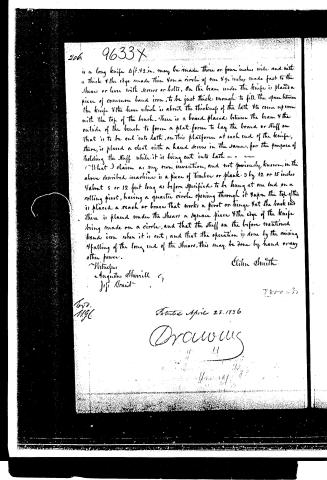
is a long knife 4 ft. 42 in. may be made three or four inches wide and with a thick & the edge made thin & on a circle of one 4 1/2 inches made fast to the shears or lever with screws or bolts. On the beam under the knife is placed a piece of common band iron, to be just thick enough to fill the space between the knife & the lever which is about the thickness of the lath & to come up even with the top of the bench. There is a board placed between the beam & the outside of the bench to form a platform to lay the board or stuff on that is to be cut into lath, on this platform at each end of the knife, there is placed a cleat with a hand screw in the same, for the purpose of holding the stuff while it is being cut into lath.
What I claim as my own invention, and not previously known, in the above described machine is a piece of timber or plank 5 by 12 or 15 inches & about 5 or 12 feet long as before specified, to be hung at one end on a rolling pivot, having a quarter circle opening through it & upon the top of this is placed a reach or brace that works a pivot or hinge & at the back end there is placed under the shears a square piece & the edge of the knife being made on a circle, and that the stuff on the before mentioned band iron when it is cut; and that the operation is done by the raising & falling of the long end of the shears, this may be done by hand or any other power.
Witnesses
Augustus Shurill
J. Grant
Elisha Smith
Patented April 28, 1856
Drowus
780-0 115
To 2. 1196
DATAMP: illustration
Illustrations from DATAMP

DATAMP (Directory of American Tool and Machinery Patents), via the Internet Archive · Archived DATAMP page
About this record
- Patentee
- DATAMP
- Date
- the Name and Date index of patents, DATAMP, USPTO records
- Invention
- DATAMP
- Listed in
- the Name and Date index of patents, DATAMP, USPTO records, Jim Shaw's X-patent list, Burke's List of Patents (1847)
- Burke's 1847 Patent Office list gives the same patent.