

Drawings and documents
USPTO scan
The patent as scanned by the USPTO
-
 Page 1
-
 Page 2
-
 Page 3
-
 Page 4
-
 Page 5


U.S. Patent and Trademark Office · Google Patents
Show the transcription Hide (1,587 words)
Machine transcription (LightOnOCR) of the pages as scanned by the USPTO, most of them the handwritten copies made when the records were restored after the 1836 fire. Not checked; it can misread handwriting, so compare it with the scan.
Page 2.
United States Patent
Patent No.: X9636
Nicholas Goldborough, Talbot, Maryland
Letters Patent
The invention referred to in these Letters Patent and making part of the same containing a description in the words of the said Nicholas Goldborough himself of his improvements in the machine for threshing and shelling corn at one operation.
To all whom these presents shall come, Be it known that I, Nicholas Goldborough of the County of Talbot and State of Maryland have invented a new and useful improvement in a machine for threshing and shelling corn at one operation, and that the following is a full and exact description of the construction and operation of the said machine, as it exists and improved by me.
The Machine consists of a frame Cylinder, both concave and feeding spoon. First, the Frame is constructed of substantial timbers sufficiently large to receive the other machinery hereinafter described; it is composed of four upright posts to set the front and the back posts joined together by side rails and cross bars the upper rails being lowered into the middle joints of the front posts and into the back posts near their upper ends forming the bearings of the Cylinder shape. The front posts are made considerably longer than the back posts and are united at their ends by a cross piece mortised in the front as also by a cap piece which upper piece of the front posts is attached by means of iron bolts and nuts so as to admit of being removed. Near the middle of the frame are two other strong posts of the same height as the front posts fastened into the inner sides of the top rails and having their ends lowered into the lower rails. The front faces of these posts are grooved to receive the side pieces of the concave to be assembled their inner faces being likewise furnished with grooves into the top into which a slide plank is fixed which together with a front concave. The feed resting on the top edge of the sides of the concave forms the turning or Cylinder bed. Since the Cylinder is made of solid wood located at the ends having iron or steel guides which are in suitable boxes secured on the top of the side rails midway between the front and middle posts and projecting from the rails are furnished with curved feedings differing in size so as to lay the kernels the
Page 3.
United States Patent
Patent No.: X9636
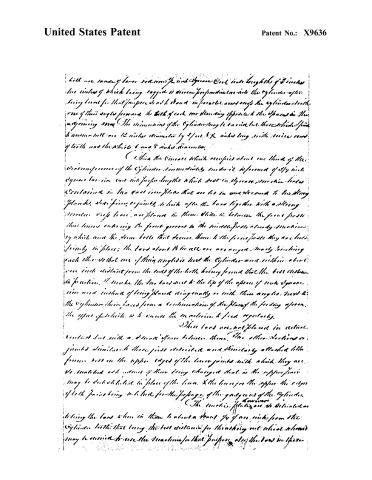
With one row of bars, each 1/4 inch by 1/4 inch, and 1/4 inch long, 1/4 inch thick, being supported in a row perpendicular to the cylinder after being bent so that they are at a stand in parallel, and only the cylinder with one of their angles formed the base of each row standing opposite to the space in the adjoining row. The dimensions of the cylinder may be varied but those which I find have a total of 12 inches diameter by 2 feet 3/4 inches long, with 1/4 inch rows of teeth and the whole 6 and 8 inches diameter.
Within the cylinder which occupies about one third of the circumference of the cylinder, immediately under it is formed of 1/4 inch square bars, one inch long, which rest in square, and are fastened in the case in such that are to be in one stream to the long cylinder, which are joined, which after the bars together with a strong screw, very loose, are placed in them. Slide is between the front parts their turns entering the front grooves to the inside parts already mentioned, by which and the same bolts that secure them to the front parts they are held firmly in place; the bars about 1/4 inch are arranged nearly touching each other so that one of their angles is near the cylinder and within about one inch distant from the end of the teeth being formed that the best distance in practice. I make the two bars next to the tip of the space of each square, one and instead of being placed diagonally so with their angles next to the cylinder their faces form a continuation of the plane of the facing square, the effect of which is to cause the motion to feed regularly.
These bars are not placed in actual contact but with a small space between them. The other sections are joined similarly to those just described, and similarly attached to the frame, rest on the upper edges of the lower joints with which they are so matched and means of them being arranged that in the upper part may be substituted in place of the bars. If the bars are the upper the edges of both parts being notched for the passage of the grooves of the cylinder.
The motion plates are so situated as to bring the bars when in them to about a stand 1/4 of an inch from the cylinder, both that being the best distance for the shaking out which should may be carried to use the machine for that purpose, also the bars in place.
Page 4.
United States Patent
Patent No.: X9636
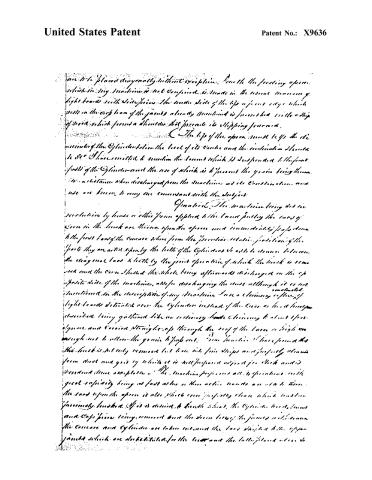
are to be placed generally without exception. In the the feeding opera-
which in my machine is not confined to made in the usual manner of
light bands with side pieces the under side of the top of front edge which
rests in the edge bar of the joints already mentioned is furnished with a strip
of wood which forms a shoulder that prevents its slipping forward.
The top of the opera must be so the
working of the Cylinder below the level of its center and the inclination should
be 8° I have omitted to mention the board which is suspended to the front
part of the Cylinder and the use of which is to prevent the grain being thrown
to a distance when discharged from the machine as its construction and
use are known to any one conversant with the subject.
Operation. The machine being set in
revolution by hand or other power applied to the band partly the ears of
corn in the hand are thrown upon the opera and immediately propelled
to the first part of the concave where from the peculiar relative position of the
parts they are acted upon by the teeth of the Cylinder so as to be thrown between
the string and bar & teeth by the joint operation of which the husk is remo-
ved and the corn shelled the whole being afterwards discharged on the op-
posite side of the machine, also for discharging the corn although it is not
mentioned in the description of my machine I use a cleaning cylinder of
light bands detached over the cylinder instead of the ears or head lines
described being gathered like an ordinary hand cleaning to clean the
grains and corn. Straight up through the top of the bars is high en
enough not to allow the grain to jump out. In practice I have found that
the husk is not only removed but torn into fine strips and properly cleaned
from dust and grit by which it is well prepared to feed for stock and is
considered more acceptable. The machine performs all its operations with
great rapidity being as fast as two or three active hands are able to throw
the corn upon the opera it also shreds corn perfectly clean which tends to
previously husked. If it is desired to thresh wheat the Cylinder, head, beam
and Caps piece being removed and the same being of the joints with which
the concave and Cylinder are taken out and the bars shifted to the upper
joints which are substituted for the lower and the latter placed where to
Page 5.
United States Patent
Patent No.: X9636
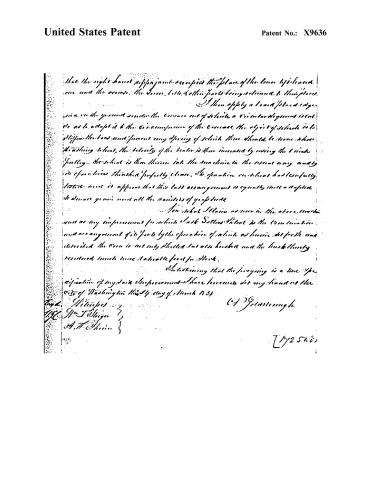
that the right hand apparatus occupies the place of the lower left hand one and the reverse, the lower left and other parts being returned to their places.
I then apply a broad placed edge on the ground under the canvas out of which a circular segment is cut so as to adapt it to the circumference of the canvas. The object of which is to stiffen the bow and prevent any spring of which there should be none when the string is bent, the elasticity of the leather is then increased by using the thick pulley... the wheel is then thrown into the machine in the usual way and by its operation the wheel perfectly cleans. The operation on which has been fully tested and it appears that this last arrangement is equally well adapted to draw yarn and all the varieties of goods.
I have what I claim as new in the above machine and as my improvement for which I ask Letters Patent is the combination and arrangement of its parts by the operation of which as herein set forth and described the yarn is not only shelled but also brushed and the brush thereby rendered much more suitable for its work.
I testify that the foregoing is a true specification of my said improvement. I have hereunto set my hand at the City of Washington this 24 day of March 1854.
C. J. Glastonbridge
Signed:
- W. H. H. H.
- W. J. Shiga
- A. H. Shiga
[172520]
Published accounts: journal notice
Notice in the monthly list of patents
Journal of the Franklin Institute, new ser., vol. 18 (1836), p. 143 · View the page
340. Thrashing and shelling machine.-Nicholas Goldsborough, Easton, Md.
About this record
- Patentee
- DATAMP
- Date
- the Name and Date index of patents, DATAMP, USPTO records
- Invention
- DATAMP
- Listed in
- the Name and Date index of patents, DATAMP, USPTO records, Jim Shaw's X-patent list, the Journal of the Franklin Institute, Burke's List of Patents (1847)
- Burke's 1847 Patent Office list gives the same patent.