

Drawings and documents
National Archives restored drawings: drawing
James P. Parke's Patent Drawing for An Alarm Bell for Fire Engines

National Archives, Restored Patent Drawings (Record Group 241) · Full-size scan at the National Archives · Catalog record
Show the text on the drawing Hide (81 words)
Words on the drawing as machine-read by the National Archives; not checked. Useful mainly for searching.
fr. / 16. SIGNALS. / DIV. V. / James P. Parke / [158] Alarms. / Patenter / CLASSIFICATION / Alarm Bell for fire Engines. / 965X / Val.2. ng.26g. / DIVISION. / July. / oiR / Jy.2. / Puferences. Jig.1. abell / Patent office Feb 24th 1845 / of / 30 / affixed to the apparate / Inave under the Instin of the Commipions / Niy.2. a, standard. 6. bell. e lever / of Patents in conformits with / Innon 1837 / d spring with ball. e horisontal 20 ). / Mengh Elemorth / Carrect / of Patents
USPTO scan
The patent as scanned by the USPTO
-
 Page 1
-
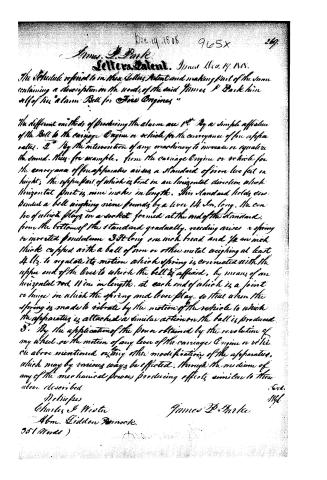 Page 2


U.S. Patent and Trademark Office · Google Patents
Show the transcription Hide (398 words)
Machine transcription (LightOnOCR) of the pages as scanned by the USPTO, most of them the handwritten copies made when the records were restored after the 1836 fire. Not checked; it can misread handwriting, so compare it with the scan.
Page 1.
965X
J. P. PARKE.
ALARM BELL FOR FIRE ENGINES.
Patented Dec. 19, 1808
NO PRINTED SPECIFICATION AVAILABLE
Fig. 1.
Fig. 2.
Page 2.
Dec. 19, 1808 965x 269
James D. Burke
Letters Patent. Spced Nov. 19, 1808.
The Schedule referred to in these Letters Patent and making part of the same containing a description in the words of the said James D Burke himself of his "alarm Bell for Fire Engines."
The different methods of producing the alarm are 1st. By a simple affixation of the Bell to the carriage Engine or vehicle for the conveyance of fire apparatus. 2nd. By the intervention of any machinery to increase or equalize the sound. Thus, for example, from the carriage Engine or vehicle for the conveyance of fire apparatus arises a standard of iron two feet in height; the upper part of which is bent in an horizontal direction which horizontal part is nine inches in length. This standard holds suspended a bell weighing nine pounds by a lever 14 in. long. The cone of which plays in a socket formed at the end of the standard. From the bottom of the standard gradually, needing arises a spring or inverted pendulum 3 ft long one inch broad and 1/2 an inch thick capped with a ball of iron or other metal weighing at least 4 lbs. to regulate its motion which spring is connected with the upper end of the lever to which the bell is affixed, by means of an horizontal rod 11 in. in length, at each end of which is a joint or hinge in which the spring and lever play, so that when the spring is made to vibrate by the motion of the vehicle to which the apparatus is attached a similar action on the ball is produced. 3rd. By the application of the power obtained by the revolution of any wheel, or the motion of any lever of the carriage Engine or vehicle above mentioned or any other modification of the apparatus, which may by various ways be effected, through the medium of any of the mechanical powers producing effects similar to those above described.
Notices
Charles J. Wistar
Abm. Liddon Darnocke.
351 Words
James D. Burke
N.Y.
DATAMP: illustration
Illustrations from DATAMP


DATAMP (Directory of American Tool and Machinery Patents), via the Internet Archive · Archived DATAMP page
About this record
- Patentee
- DATAMP
- Date
- the Name and Date index of patents, DATAMP, Burke's List of Patents (1847)
- Invention
- DATAMP
- Listed in
- the Name and Date index of patents, DATAMP, USPTO records, Jim Shaw's X-patent list, S. A. Elliot's printed list of patents, Burke's List of Patents (1847)
- The sources give different dates; the date shown is the one most of them agree on.
- S. A. Elliot's printed list of patents gives the same name and date.
- Burke's 1847 Patent Office list gives the same patent.