

Drawings and documents
USPTO scan
The patent as scanned by the USPTO
-
 Page 1
-
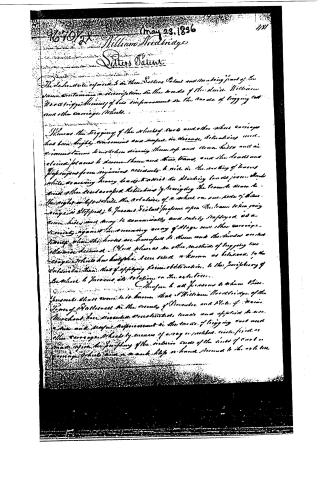 Page 2
-
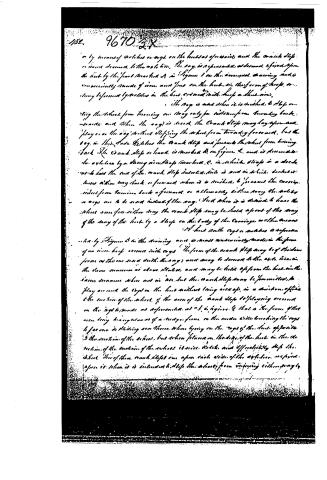 Page 3
-
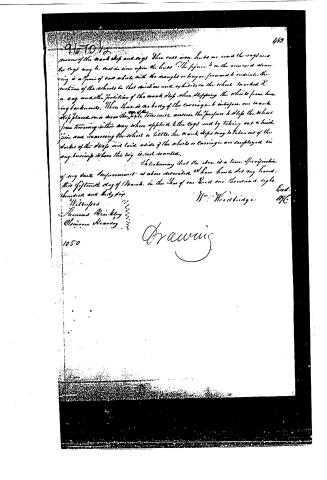 Page 4


U.S. Patent and Trademark Office · Google Patents
Show the transcription Hide (1,076 words)
Machine transcription (LightOnOCR) of the pages as scanned by the USPTO, most of them the handwritten copies made when the records were restored after the 1836 fire. Not checked; it can misread handwriting, so compare it with the scan.
Page 1.
9670½X
W. WOODBRIDGE.
Trigging Vehicle-Wheels.
Patented May 23, 1836.
Fig. 5.
Fig. 2.
Fig. 1.
Fig. 4.
Fig. 3.
H. PETERS, PHOTO-LITHOGRAPHER, WASHINGTON, D.C.
Page 2.
May 23, 1836
William Woodbridge
Letters Patent
The Schedule referred to in these Letters Patent and making part of the same, contains a description in the words of the said William Woodbridge himself of his improvement on the mode of lugging out and other carriage wheels.
Whereas the lugging of the wheels of carts and other wheel carriages has been highly inconvenient and unsafe in descent, descending steep circumstances to prevent them going them up and down hills and inclined planes to secure them and their loads, and the loads and passengers from injurious accidents to arise in the working of horses while drawing heavy loads, to avoid the working loads from their ends, other than a rapid rotation of bringing the teams to stand in the right or left while the rotation of a wheel on one side of those carriages is stopped; to prevent violent pressure upon the teams when going down hills, and may be conveniently and safely employed as a security against the running away of stage and other carriages, except when the horses are harnessed to them and the teams are otherwise secured. (And whereas no other method of lugging carriages wheels has hitherto been used or known as believed, to the contrary to the contrary of applying some obstruction to the periphery of the wheel to prevent its rotation on the axle tree.
Therefore to all persons to whom these presents shall come, it is known that William Woodbridge, of the Town of Waltham, in the county of Middlesex, and State of Massachusetts, Merchant has invented certain new and useful improvements in the mode of lugging out and other carriage wheels by means of a stay or rod, rods fixed or made upon the periphery of the various ends of the sides of cart or carriage wheels, and a crank, stop or handle secured to the axle tree.
Page 3.
or by means of notches or cogs on the harness of wheels and the crank step is never secured to the axle box. The cog is represented as being fixed upon the hub by the joint marked A in Figure 1 on the innermost drawing and is necessarily made of iron and fast on the hub in the form of hoops or simply formed by notches in the hub covered with hoop or sheet iron.
The cog is used when it is wished to stop or stop the wheel from turning on the way only for a distance from turning back towards and when the cog is used, the crank step may lay upon and play on the way without stopping the wheel from turning forward, but the cog in this case utilizes the crank step and prevents the wheel from turning back. The crank step or head is marked B in Figure 2, and is secured to the axle box by a strong iron strap (marked C, in which straps is a slot to have the end of the crank step inserted, and is used in which brackets turns either way back or forward when it is wished to prevent the carriage either from turning back or forward, or alternately either way the notches or cogs are to be used instead of the cog. And when it is desired to have the wheel move forward, either way the crank step may be held apart of the way of the way of the hub by a drop on the body of the carriage or the means of the hub with cogs or notches as represented.
As by Figure 3 in the drawing and is most universally made in the form of an iron hoop covered with cogs. The form of the crank step may be of various forms as shown and with the cogs may be secured to the axle box in the same manner as above stated, and may be held up from the hub in the same manner when not in use, but the crank step may be permitted to play around the cogs on the hub without being at all up in a direction opposite to the motion of the wheel, if the arm of the crank step is playing around on the way is made as represented at a, b, in Figure 4 that is the form of that arm being hinged near as of a hinge from on the motion while touching the cogs by at one is sliding over them, when lying on the cogs of the hub opposite to the motion of the wheel, but when placed on the edge of the hub in the direction of the motion of the wheel it rises, notches and effectively stop the wheel. One of these crank steps runs upon each side of the axle box, as shown, and when it is intended to stop the wheel from turning either way by
Page 4.
means of the crank step and cogs. Then cast iron. In so we need the cogs and the cogs may be cast in iron upon the hubs. The figure 3 on the annexed drawing is a pair of cast wheels with the cogs or long as forward to indicate the motion of the wheels in that direction and exhibits on the wheel marked it a cog and the position of the crank step when stopping the wheels from turning backwards. When there is no body of the carriage to interfere one crank step placed on a tree or the axle tree will answer the purpose to stop the wheel from turning either way when applied to the cogs and by taking out a link pin and removing the wheel or letting the crank steps may be taken out of the sockets of the steps and laid aside if the wheels or carriages are employed in any business where this trip is not wanted.
I take liberty that the above is a true specification of my said improvement as above described & have hereunto set my hand this fifteenth day of March in the Year of our Lord one thousand eight hundred and thirty six.
Wm Woodbridge
Witnesses
Thomas Ainsley
Oliverson Harding
1050
Drawing
End.
About this record
- Patentee
- the Name and Date index of patents
- Date
- the Name and Date index of patents, USPTO records
- Invention
- the Name and Date index of patents
- Listed in
- the Name and Date index of patents, USPTO records
- The index's second listing was used.