

Drawings and documents
National Archives restored drawings: drawing
E.G. Currier's Patent Drawing for a Stove

National Archives, Restored Patent Drawings (Record Group 241) · Full-size scan at the National Archives · Catalog record
Show the text on the drawing Hide (69 words)
Words on the drawing as machine-read by the National Archives; not checked. Useful mainly for searching.
$5- / U. STOVIS de 5 ORNACES / [154] Cooking Stoves. / 9.690.X / Signature / DIVISION / Move / 9690X / Not / pollented 2 lune 1830. / Section. / References. / Top plate to close store / Mange to support the plate on the jamb / Patent office april 24th 2538. / Made under direction of the commisioner of patents in Conformity / with the act of 3d March 1837 / Commissioner of Patents
USPTO scan
The patent as scanned by the USPTO
-
 Page 1
-
 Page 2
-
 Page 3
-
 Page 4
-
 Page 5


U.S. Patent and Trademark Office · Google Patents
Show the transcription Hide (1,507 words)
Machine transcription (LightOnOCR) of the pages as scanned by the USPTO, most of them the handwritten copies made when the records were restored after the 1836 fire. Not checked; it can misread handwriting, so compare it with the scan.
Page 1.
9690X
E. G. CURRIER.
COOKING STOVE.
Patented June 2, 1836.
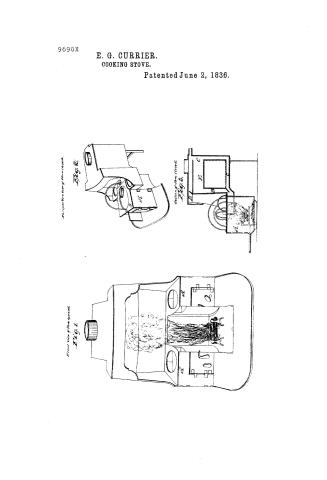
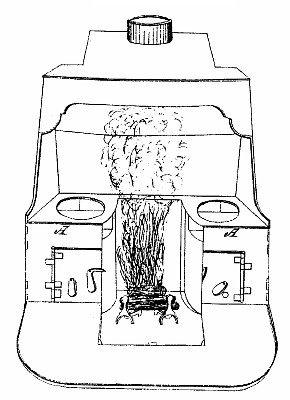
Fig. 1.
Front View of Stove Opened.
Fig. 2.
Perspective View of Stove Closed.
Fig. 3.
Section of Stove Closed.
Page 2.
No 16X June 2, 1836 265
Ezekiel S. Burrier of Warner State of New Hampshire
Letters Patent. No. 1
The schedule referred to in these Letters Patent and making part of the same containing a description in the words of the said Ezekiel S. Burrier himself of his improvement on the open and close looking stove No. 1.
To all to whom these presents shall come,
Be it known that I, Ezekiel S. Burrier of Warner, in the county of Merrimack and State of New Hampshire, have invented a new and useful improvement in the "Open and Close Stove," designated as No. 1. By the manner of arrangement and construction of which combination I produce either an open or a close stove, as circumstances may require, in a manner better suited to domestic conveniences than has heretofore been done. It presents in appearance the front of the ordinary Franklin open stove, having the panels on each side extended or widened horizontally, from that part intended to contain the fire, and to form the body of the close stove, and on a line with what may be the desired height thereof. These extensions are to serve for the support of a cooling vessel on each side, and for that purpose have a circular hole on the top and are made hollow, with a flue communicating with the interior or body of the stove, so that the draught from it passes under the stove & out at the back of the bottom thereof, into an apartment at the back of the Franklin, which reaches from the horizontal line of the extensions at the side, to the top of the Franklin; and also comes as far as desired backwards, thereby forming a square enclosure inside as to surround the same, which is formed of four other plates constituting the top, bottom, and side of it, leaving of course a space between them, & the corresponding ones of the apartment described, for the circulation or draught of heat & smoke around it; the ends of the oven are framed by the sides of the apartment & are not double, one containing the door to it. The aperture for the draught from the back of the bottom opens at the side, leading
Page 3.
into the apartment, is furnished with a damper, to each, so fastened to the lower angle of the oven bottom, as to close up the space left between it, & the bottom of the apartment, or that between the back of the Franklin & the adjoining side of the oven, according to which over direction the rotation of the axis of the damper is conducted, by means of a handle which is placed for that purpose, projecting conveniently through that side of the apartment, and thus the draught can be managed, as to throw the heat either under the oven and up the back side thereof into the escape pipe for the smoke (at the top of the apartment,) or by closing that opening beneath the oven, to conduct it up the space behind the Franklin & thence over the top of the oven, to the said escape pipes. The heat may also be divided equally in its distribution by opening different apertures, so as to send a portion of the heat above and another below the oven, as may be found most expedient. Above the oven, and between it & the top of the apartment, are placed two other plates in a horizontal position; the upper one extending from the draught opening of the Franklin, to about the center of a circular opening in the top plate of the apartment, which is intended to receive a vessel for heating water, &c. & is made with a rim around it, on which to set the vessel; & also to receive the pipe by which the smoke is to escape; for which reason said rim & hole, are placed as far back, on the top plate as is practicable, and the upper plate turns up by a perpendicular edge so as to meet it, & thus bring all the heat from the Franklin or open stove under said vessel when the close one is not wanted to be used.
The plate beneath the upper one, is extended from one side of the apartment to the other, leaving a space open only between it, & the back of the Franklin, & between it & the back of the apartment, for containing the draught; and these openings are each furnished with a damper, so as to regulate it, for it will be seen that on opening the damper just described, behind the hollow spaces, by closing that beneath the oven, the draught will rise behind the Franklin to the damper at the plate last described, above the oven, where it may be allowed to pass, and continue on to the orifice of water & finally escape, or the damper placed there, may be closed on the plate, & thus send the draught up, over the
Page 4.
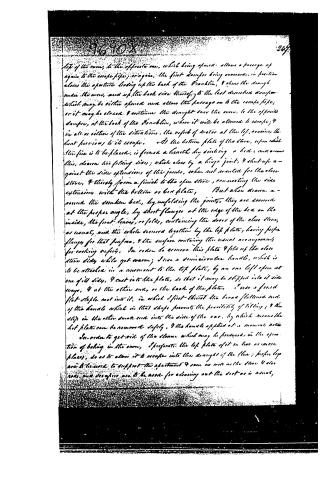
top of the oven, to the opposite one, which being opened, allows a passage up again to the escape pipe; or again, the first damper being removed, in position closes the aperture leading up the back of the Franklin, & opens the draught under the oven, and up the back side thereof, to the last described damper which may be either opened and allow the passage on to the escape pipe, or it may be closed & continue the draught over the oven, to the opposite damper, at the back of the Franklin, where it will be allowed to escape; & in all or either of the situations, the effect of water at the top, occasions the heat previous to its escape.
At the bottom plate of the stove, upon which the fire is to be placed, is formed a hearth by existing a bed; more or less, drawn two folding sides; which alone by a hinge joint, & shut up against the side extensions of the jambs, when not wanted for the close stove, & thereby form a finish to the open stove, connecting the side extensions with the bottom or bed plate.
But when drawn around the wooden bed, by unfolding the joints, they are secured at the proper angle, by short flanges at the edge of the bed on the inside, the front leaves, or folds, containing the doors of the close stove, as usual, and the whole secured together by the top plate, having proper flanges for that purpose, & the surface containing the usual arrangement for cooking purposes. In order to remove this plate & fire up the close stove sidey while yet warm; I use a semicircular handle, which is to be attached in a moment to the top plate, by an ear left open at one of its sides, & cast into the plate, so that it may be slipped into it sideways, & at the other end, or the back of the plate. I use a forced flat staple cast into it, in which I first thrust the broad flattened end of the handle which in that shape prevents the possibility of lifting; & then slip in the other small end into the side of the ear, by which means the hot plate can be removed safely, & the handle applied at a moment notice.
In order to get rid of the steam which may be produced in the operation of baking in the oven, I perforate the top plate of it in two or more places, so as to allow it to escape into the draught of the flue; proper legs are to be used to support the apartment & save as well as the stove. I also need such nozzles are to be used for cleaning out the duct as is usual.
Page 5.
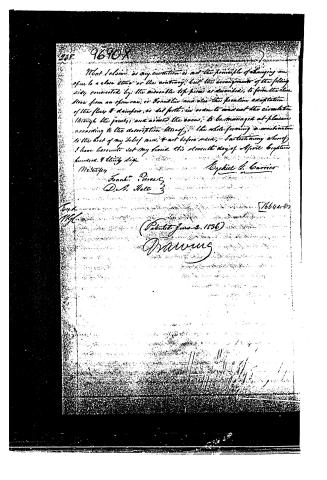
What I claim as my invention is not the principle of changing an open to a close stove or the contrary, but the arrangement of the folding sides connected by the movable top piece as described, to form the close stove from an open one, or from the and also the peculiar adaptation of the flues & dampers, as set forth, in order to conduct the circulation through the joints and around the oven, to be managed at pleasure according to the description thereof. The whole forming a combination to the best of my belief now, & not before used. In testimony whereof I have hereunto set my hand this eleventh day of April eighteen hundred & thirty six.
Cyprian S. Carrier
Witness
Frank Pierce
D. A. Hale
(Patented June 2, 1836)
Drawing
DATAMP: illustration
Illustrations from DATAMP

DATAMP (Directory of American Tool and Machinery Patents), via the Internet Archive · Archived DATAMP page
About this record
- Patentee
- DATAMP
- Date
- the Name and Date index of patents, DATAMP, USPTO records
- Invention
- DATAMP
- Listed in
- the Name and Date index of patents, DATAMP, USPTO records, Jim Shaw's X-patent list, Burke's List of Patents (1847)
- Burke's 1847 Patent Office list gives the same patent.