

Drawings and documents
National Archives restored drawings: drawing
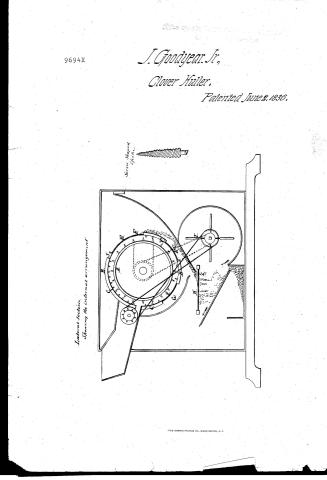
John Goodyear, Jr.'s Patent Drawing for a Machine for Cleaning and Thrashing Clover Seed

National Archives, Restored Patent Drawings (Record Group 241) · Full-size scan at the National Archives · Catalog record
Show the text on the drawing Hide (73 words)
Words on the drawing as machine-read by the National Archives; not checked. Useful mainly for searching.
CLASSFICATION / Extra / 9.694.x / Palented 2 net June 3836 / DIVISION / 9694 cleaning & charting closs seed / Laceral section, showing the internal arrangements / Co / Screw shaped spike / References. / The Cylinder with serew teeth. / staves of the concare armed with / screw tooth / Screw teeth on the cylinder / E: / Wire sicres / Conductor / It / Wire sifter / Fan / space for air. / copied by ch. L Fleischmann 1836.
USPTO scan
The patent as scanned by the USPTO
-
 Page 1
-
 Page 2
-
 Page 3


U.S. Patent and Trademark Office · Google Patents
Show the transcription Hide (644 words)
Machine transcription (LightOnOCR) of the pages as scanned by the USPTO, most of them the handwritten copies made when the records were restored after the 1836 fire. Not checked; it can misread handwriting, so compare it with the scan.
Page 1.
J. Goodyear Jr.
Clover Miller.
Patented June 2, 1836.

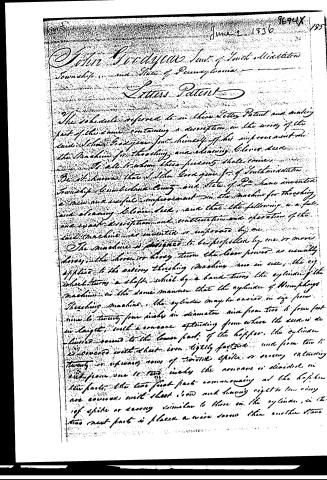
Page 2.
June 2, 1836
John Birdyane, Jr. of South Middletown Township, and State of Pennsylvania
Letters Patent
The schedule referred to in these Letters Patent and making part of this issue, containing a description in the words of the said John Birdyane, Jr. himself, of his improvement in the Machine for threshing and cleaning Clover seed.
To all to whom these presents shall come,
Be it known that I, John Birdyane, Jr. of South Middletown Township, Cumberland County, and State of Pa., have invented a new and useful improvement in the machine for threshing and cleaning Clover seed, and that the following is a full and exact description and construction and operation of the said machine as invented or improved by me.
The machine is designed to be propelled by one or more horses, the horse or horses turn the lever power as usually applied to the ordinary threshing machines now in use, the cylinder turns a shaft, which by a band turns the cylinder of the machine in the same manner that the cylinder of Humphrey’s Threshing machine, the cylinder may be varied in size from nine to twenty-four inches in diameter and from two to four feet in length, with a concave extending from where the seed is delivered round to the lower part of the hopper, the cylinder is covered with sheet iron tightly fastened and from two to twenty or eighteen rows of twisted spikes or screws extending and from one to two inches, the concave is divided in two parts, the two front parts commencing at the hopper are covered with sheet iron and having eight or ten rows of spikes or screws similar to those in the cylinder, in the two next parts is placed a wire screen than another stone
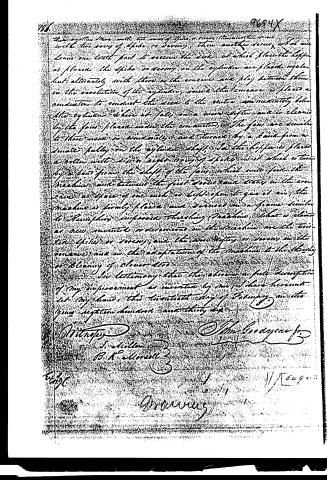
Page 3.
have another stone with two rows of spikes or serrings, the same as the first, with two rows of spikes or serrings, then another serrings which will leave one tenth part to receive the seed at which place the hoppers as placed, the spikes or serrings on the cylinder are placed regular but alternately with those in the concave and play between them in the revolution of the cylinder, round the concave is placed a conductor to conduct the seed to the outlet immediately below the cylinder where it falls on a moveable table and is cleaned by the fans placed under the conductor, the fans are similar to those used in winnowing and turned by a band from a small pulley on the cylinder shaft, so the hopper is placed a roller with six or eight rows of spikes in it which is turned by a band from the shaft of the fans which will feed the machine and between the first rollers and table in the concave a space of one inch is left open to give it air, the machine is firmly placed and secured on a frame similar to Humphrey's improved threshing machine, what is claimed as new invented or discovered in the machine are the two rows of spikes or serrings, and the moveable table or screen in the concave and in the adaptation of the machine to the threshing or cleaning of clover seed.
In testimony that the above is a full description of my improvement as invented by me, I have hereunto set my hand, this twentieth day of February in the year eighteen hundred and thirty six.
Witnesses:
J. Millen
B. R. Morrell
John Gardener
Drawing
Filed June 11, 1836
Published accounts: journal notice
Notice in the monthly list of patents
Journal of the Franklin Institute, new ser., vol. 18 (1836), p. 215 · View the page
396. Clover cleaning.-John Goodyear, South Middleton, Penn.
About this record
- Patentee
- DATAMP
- Date
- the Name and Date index of patents, DATAMP, USPTO records
- Invention
- DATAMP
- Listed in
- the Name and Date index of patents, DATAMP, USPTO records, Jim Shaw's X-patent list, the Journal of the Franklin Institute, Burke's List of Patents (1847)
- Burke's 1847 Patent Office list gives the same patent.