

Drawings and documents
USPTO scan
The patent as scanned by the USPTO
-
 Page 1
-
 Page 2
-
 Page 3


U.S. Patent and Trademark Office · Google Patents
Show the transcription Hide (628 words)
Machine transcription (LightOnOCR) of the pages as scanned by the USPTO, most of them the handwritten copies made when the records were restored after the 1836 fire. Not checked; it can misread handwriting, so compare it with the scan.
Page 1.
9723X
L. E. Babcock,
Mortising Machine.
Patented June 16, 1836.

A.M. PHOTO-LITHO. CO. N.Y. (OSBORNE'S PROCESS)
Page 2.
6/16/1836 9723X
June 16, 1836
Samuel E. Babcock
Letters Patent
The whole referred to in these Letters Patent and making part of the same containing a description in the words of the said Samuel E. Babcock himself of his improvement in the machine for mortising timber.
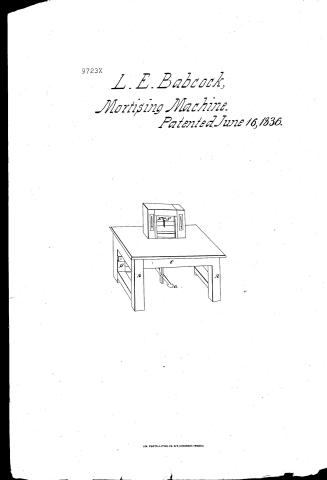
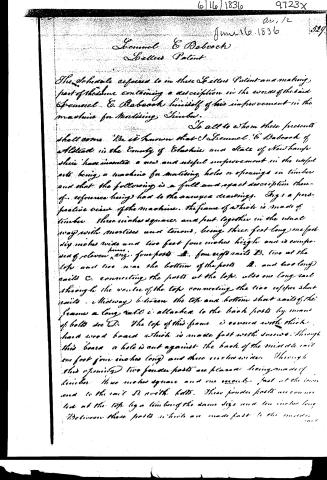
To all to whom these presents shall come: Be it known that I Samuel E. Babcock of Alstead in the County of Essex and State of New Hampshire have invented a new and useful improvement in the useful arts being a machine for mortising holes or openings in timber and that the following is a full and exact description thereof, reference being had to the annexed drawings. Fig. 1 a perspective view of the machine. The frame of which is made of timber three inches square and put together in the usual way with mortises and tenons, being three feet long one foot deep inches wide and two feet four inches high and is composed of eleven pieces, viz: four posts A, four eight nails B, two at the top and two near the bottom of the posts A, and two long nails C, connecting the posts at the top, also one long nail through the centre of the top connecting the two eight short nails, (Midway) between the top and bottom short nails of the frame a long nail is attached to the back posts by means of bolts see D. The top of this frame is covered with thick hard wood board which is made fast with screws. Through this board a hole is cut against the back of the middle nail one foot four inches long and three inches wide. Through this opening two finder posts are placed being made of timber three inches square and one inch fast at the lower end to the nail D with bolts. These finder posts are connected at the top by a timber of the same size and ten inches long. Between these posts which are made fast to the middle nail
Page 3.
6/16/1836 9723x
530
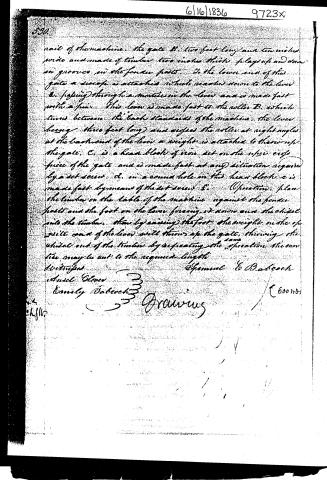
nail of the machine. The gate B, two feet long and ten inches wide and made of timber two inches thick, plays up and down in grooves in the fence posts. To the lower end of this gate a sweep is attached which reaches down to the lever D, passing through a mortise in the lever and is made fast with a pin. This lever is made fast to the roller B, which turns between the back standards of the machine. The lever being three feet long and opposes the roller at right angles at the back end of the lever a weight is attached to throw up the gate. C, is a head block of iron set on the upper edge piece of the gate and is made fast at any situation required by a set screw. D, in a round hole in this head block e is made fast by means of the set screw F. Operation: Place the timber on the table of the machine against the fence posts and the foot on the lever forcing it down and the chisel into the timber. Then by raising the foot the weight on the opposite end of the lever will throw up the gate, throwing the chisel out of the timber. By repeating the operation the timber may be cut to the required length.
Witnessed
E. D. Babcock
(600 n-8)
Drawing
Published accounts: journal notice
Notice in the monthly list of patents
Journal of the Franklin Institute, new ser., vol. 18 (1836), p. 215 · View the page
435. Mortising timber.-Samuel E. Babcock, Alstead, N. H.
DATAMP: illustration
Illustrations from DATAMP

DATAMP (Directory of American Tool and Machinery Patents), via the Internet Archive · Archived DATAMP page
About this record
- Patentee
- DATAMP
- Date
- the Name and Date index of patents, DATAMP, USPTO records
- Invention
- DATAMP
- Listed in
- the Name and Date index of patents, DATAMP, USPTO records, Jim Shaw's X-patent list, the Journal of the Franklin Institute, Burke's List of Patents (1847)
- Burke's 1847 Patent Office list gives the same patent.