

Drawings and documents
National Archives restored drawings: drawing
Ezra Barrett's Patent Drawing for a Scythe

National Archives, Restored Patent Drawings (Record Group 241) · Full-size scan at the National Archives · Catalog record
Show the text on the drawing Hide (59 words)
Words on the drawing as machine-read by the National Archives; not checked. Useful mainly for searching.
Cradles. / 9.725.x / DEVISION. / 9725x / Service / Systes / patented 16thle 7236 / References / A. Blade. B.Shank- C.Claw. / D. Curve of Blade at heel. / Patent office april 24th1838 / Made under direction? the commissions of Patricls / in comformity with the bet of 3" larch 1537 / Nensyh elmorth / Commissions
USPTO scan
The patent as scanned by the USPTO
-
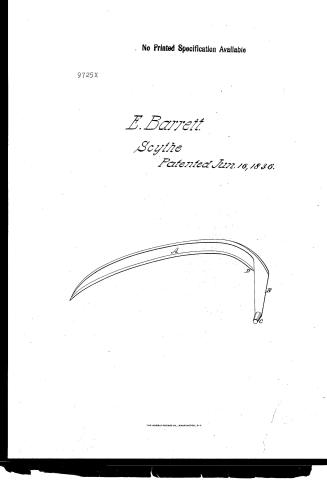 Page 1
-
 Page 2
-
 Page 3


U.S. Patent and Trademark Office · Google Patents
Show the transcription Hide (752 words)
Machine transcription (LightOnOCR) of the pages as scanned by the USPTO, most of them the handwritten copies made when the records were restored after the 1836 fire. Not checked; it can misread handwriting, so compare it with the scan.
Page 1.
No Printed Specification Available
9725X
E. Barrett
Scythe
Patented Jun. 16, 1836.

THE NORRIS PETERS CO., WASHINGTON, D.C.
Page 2.
June 16, 1836
Ezra Barnett of Warner county of Merrimack, State of New Hampshire
Letters Patent
The schedule referred to in these Letters Patent, and making part of the same, containing a description in the words of the said Ezra Barnett himself of his improvement on the Sythe.
To all, to whom these Presents shall come
Be it known, that I Ezra Barnett of Warner, in the county of Merrimack, and state of New Hampshire, have invented a new and useful improvement on sythes, as it respects a crook in the blade from 8 to 10 inch at the heel and extending the edge of the sythe at the heel to the wing, and in the shape and length of the shank, and shape of the claw, the following is a full and exact description thereof.
A crook in the blade of the sythe from 8 to 10 inch at the heel, similar to the gathering part of a sickle, so as to cut the grass clean and easy as it gathers at the heel; with this crook at the heel of the sythe, the principle part of the grass is cut from the middle to the heel, exactly reverse to that of the common straight heel sythe.
The edge of the sythe is also extended at the heel to the wing so as to prevent the grass escaping around the shank.
The shank from the heel of the sythe to the claw, is from 1.2 to 5 inch long, flat on the upper side and an oval round upon the under side similar to what is called a flat half round file, with a regular taper from the heel to the claw, as it respects both the width and thickness, so as to admit the wing to pass over the shank to the heel without the necessity of cutting away the shank to injure it, the shank being thus formed will exactly fill the space made upon the shank to receive it, and thereby completely fill the wing so as not to admit or require a wedge to make it perfectly tight and firm upon the shank, thus the wing and heel of the shank are both preserved from injury by the driving and pressure of a wedge.
The shank being of the length above described, requires but a small claw, which is about one quarter of an inch in diameter, half
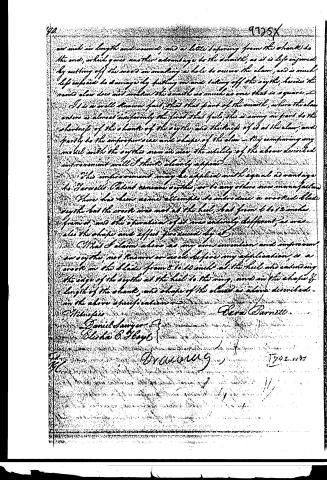
Page 3.
as much in length and round, and a little tapering from the shank to the end, which gives another advantage to the smith, as it is less injured by cutting off the wood in making a hole to receive the claw, and is much less exposed to damage by putting on and taking off the scythe, besides the round claw does not weaken the smith as much as one that is square.
It is a well known fact, that that part of the smith, where the claw enters is almost invariably the first that fails; this is owing in part to the shortness of the shank of the scythe, and thickness of it at the claw, and partly to the improper size and shape of the claw. By comparing any model with the scythe now in use, the utility of the above described improvement will I think clearly appear.
This improvement may be applied with equal advantage to Barnell's Patent cane scythe, or to any others now manufactured. There has been some attempt to introduce a crooked blade scythe but the crook was not at the heel, but from 6 to 12 inches from it, and the operation of it was entirely different, as was also the shape and effect produced by it.
That I claim above as my own invention and improvement on scythe, not known or used before my application, is a crook in the blade from 8 to 10 inches at the heel and extending the edge of the scythe at the heel to the ring, and in the shape & length of the shank, and shape of the claw as above described in the above specification.
Witnesses
Daniel Sawyer
Elisha B. Hoyt
Leon Barnell
Draconing
1742. 1887
Published accounts: journal notice
Notice in the monthly list of patents
Journal of the Franklin Institute, new ser., vol. 18 (1836), p. 215 · View the page
423. Scythe. Ezra Barnett, Warner, N. H.
About this record
- Patentee
- DATAMP
- Date
- the Name and Date index of patents, DATAMP, USPTO records
- Invention
- DATAMP
- Listed in
- the Name and Date index of patents, DATAMP, USPTO records, Jim Shaw's X-patent list, the Journal of the Franklin Institute, Burke's List of Patents (1847)
- Burke's 1847 Patent Office list gives the same patent.