

Drawings and documents
National Archives restored drawings: drawing
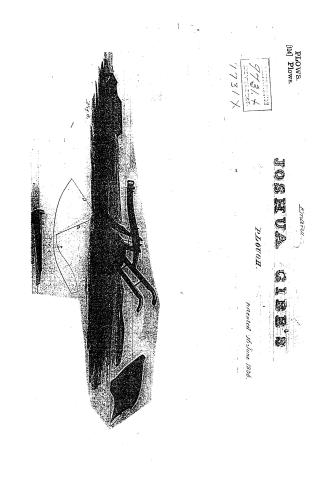
Joshua Gibb's Patent Drawing for a Plough

National Archives, Restored Patent Drawings (Record Group 241) · Full-size scan at the National Archives · Catalog record
Show the text on the drawing Hide (31 words)
Words on the drawing as machine-read by the National Archives; not checked. Useful mainly for searching.
7 b2,I / X LIELb / gool nearge provide / NOISLAIC / H9MOTd / +1846 / Permin VAHSOR / "SMOTI / SMOTd
USPTO scan
The patent as scanned by the USPTO
-
 Page 1
-
 Page 2
-
 Page 3


U.S. Patent and Trademark Office · Google Patents
Show the transcription Hide (507 words)
Machine transcription (LightOnOCR) of the pages as scanned by the USPTO, most of them the handwritten copies made when the records were restored after the 1836 fire. Not checked; it can misread handwriting, so compare it with the scan.
Page 1.
PLOWS.
[14] PLOWS.
9731.4
1731X
JOSUA GIBB'S
PLOUGH.
Patented 16 June 1836.
Page 2.
9731x
June 16, 1856
Joshua Gibbs.
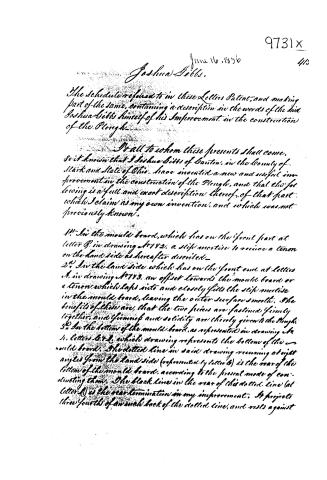
The schedule referred to in these Letters Patent, and making part of the same, containing a description in the words of the said Joshua Gibbs himself of his Improvement in the construction of the Plough.
To all to whom these presents shall come,
So it known that I Joshua Gibbs of Canton, in the County of Stark and State of Ohio, have invented a new and useful improvement in the construction of the Plough, and that the following is a full and exact description thereof, of that part which I claim as my own invention, and which was not previously known.
1st. In the mould board, which has on the front part at letter P in drawing No 112, a slip mortise to receive a tenon on the land side as hereafter described.
2nd. In the land side which has on the front end at letters A, in drawing No 113, an offset towards the mould board or a tenon which laps into and closely fills the slip mortise in the mould board, leaving the outer surface smooth. The benefits of these are, that the two pieces are fastened firmly together, and firmness and solidity are thereby given to the Plough.
3rd. In the bottom of the mould board, as represented in drawing No 11, letters B & C, which drawing represents the bottom of the mould board. The dotted line in said drawing running at right angles from the land side (represented by letter B) is the rear of the bottom of the mould board, according to the present mode of constructing them. The black line in the rear of the dotted line (at letter C) is the rear termination in my improvement. It projects three fourths of an inch back of the dotted line, and rests against
Page 3.
6/16/1836 9731X
4/14.
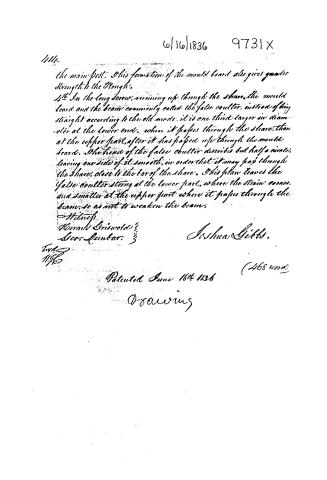
the main post. This formation of the mould board also gives greater strength to the Plough.
4th In the long screw, running up through the share, the mould board and the beam commonly called the false coulter, instead of being straight according to the old mode, it is one third larger in diameter at the lower end, when it passes through the share, than at the upper part, after it has passed up through the mould board. The head of the false coulter describes but half a circle, leaving one side of it smooth, in order that it may pass through the share, close to the bar of the share. This plan leaves the false coulter strong at the lower part, where the strain comes, and smaller at the upper part where it passes through the beam, so as not to weaken the beam.
Witness
Horatio Griswold;
Geo. Quinbar.
Joshua Gibbs.
Patented June 16th 1836
Drawing
(468 words)
Published accounts: journal notice
Notice in the monthly list of patents
Journal of the Franklin Institute, new ser., vol. 18 (1836), p. 215 · View the page
426. Plough.-Joshua Gibbs, Canton, Ohio,
About this record
- Patentee
- DATAMP
- Date
- the Name and Date index of patents, DATAMP, USPTO records
- Invention
- DATAMP
- Listed in
- the Name and Date index of patents, DATAMP, USPTO records, Jim Shaw's X-patent list, the Journal of the Franklin Institute, Burke's List of Patents (1847)
- Burke's 1847 Patent Office list gives the same patent.