

Drawings and documents
National Archives restored drawings: drawing
T.C. Harrison's Patent Drawing for a Revolving Lancet

National Archives, Restored Patent Drawings (Record Group 241) · Full-size scan at the National Archives · Catalog record
Show the text on the drawing Hide (17 words)
Words on the drawing as machine-read by the National Archives; not checked. Useful mainly for searching.
19 / OR
USPTO scan
The patent as scanned by the USPTO
-
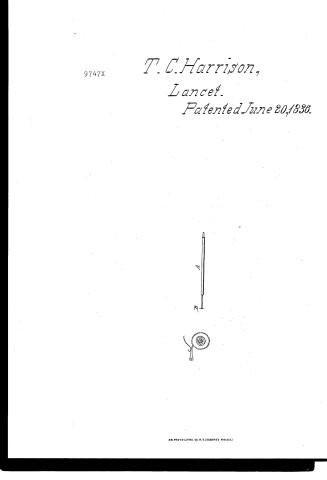 Page 1
-
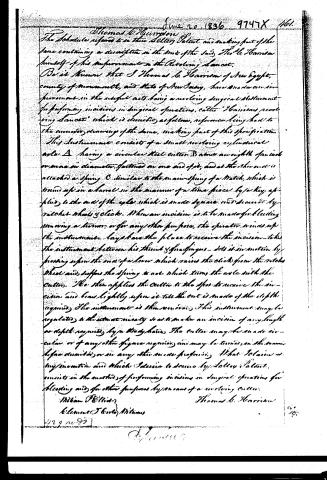 Page 2


U.S. Patent and Trademark Office · Google Patents
Show the transcription Hide (451 words)
Machine transcription (LightOnOCR) of the pages as scanned by the USPTO, most of them the handwritten copies made when the records were restored after the 1836 fire. Not checked; it can misread handwriting, so compare it with the scan.
Page 1.
9747X
T. C. Harrison,
Lancet.
Patented June 20, 1836.

AM. PHOTO-LITHO. CO. N.Y. (OSBORNE'S PROCESS.)
Page 2.
June 20, 1836 9747X 461
Thomas L. Harrison
The Schedule referred to in this Letter Patent and making part of the same containing a description in the words of the said Thos. L. Harrison himself of his improvement in the Revolving Lancet.
Be it known that I Thomas L. Harrison of New Egypt, county of Monmouth, and State of New Jersey, have made an improvement in the useful arts being a revolving surgical instrument for performing incisions in surgical operations, called "Harrison's revolving Lancet" which is described as follows, reference being had to the annexed drawings of the same, making part of this specification.
This instrument consists of a small revolving cylindrical axle A having a circular steel cutter B about an eighth of an inch or more in diameter, fastened on one end of it, and at the other end is attached a spring C similar to the main spring of a Match, which is wound up in a barrel in the manner of a time piece by a key, applied to the end of the axle which is made square and secured by ratchet wheels & clicks. When an incision is to be made for bleeding, removing a tumor, or for any other purpose, the operator winds up the instrument, lays down the place to receive the incision, takes the instrument between his thumb & forefinger, sets it in motion by pressing upon the end of a lever which raises the click from the ratchet wheel and suffers the spring to act which turns the axle with the cutter. He then applies the cutter to the spot to receive the incision and bears lightly upon it till the cut is made of the depth required. The instrument is then removed. This instrument may be regulated to the utmost nicety so as to make an incision of any length or depth required by a steady hand. The cutter may be made circular or of any other figure required and may be turned in the manner before described or in any other more preferred. What I claim as my invention and which I desire to secure by Letter Patent, consists in the method of performing incisions in surgical operations for bleeding and for other purposes by means of a revolving cutter.
William P. Elliot
Clement J. Curtis, Witness
Thomas L. Harrison
429 no 971
[Signature]
Published accounts: journal notice
Notice in the monthly list of patents
Journal of the Franklin Institute, new ser., vol. 18 (1836), p. 215 · View the page
451. Revolving lancet.-T. C. Harrison, New Egypt, N. J.
About this record
- Patentee
- DATAMP
- Date
- the Name and Date index of patents, DATAMP, USPTO records
- Invention
- DATAMP
- Listed in
- the Name and Date index of patents, DATAMP, USPTO records, Jim Shaw's X-patent list, the Journal of the Franklin Institute, Burke's List of Patents (1847)
- Burke's 1847 Patent Office list gives the same patent.