

Drawings and documents
USPTO scan
The patent as scanned by the USPTO
-
 Page 1
-
 Page 2
-
 Page 3
-
 Page 4


U.S. Patent and Trademark Office · Google Patents
Show the transcription Hide (1,005 words)
Machine transcription (LightOnOCR) of the pages as scanned by the USPTO, most of them the handwritten copies made when the records were restored after the 1836 fire. Not checked; it can misread handwriting, so compare it with the scan.
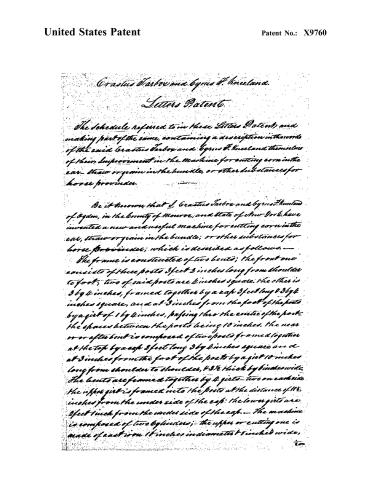
Page 2.
United States Patent
Patent No.: X9760
Crastus Tarbox and byrus H. Kneeland
Letters Patent.
The Schedule referred to in these Letters Patent, and making part of the same, containing a description in the words of the said Crastus Tarbox and byrus H. Kneeland themselves of their Improvement in the Machine for cutting corn in the ear, straw or grain in the bundle, or other substances for horse provisions.
Be it known that I, Crastus Tarbox and byrus H. Kneeland of Ogdan, in the County of Monroe, and State of New York, have invented a new and useful machine for cutting corn in the ear, straw or grain in the bundle; or other substances for horse provisions; which is described as follows.
The frame is constructed of two beuts; the front one consists of three posts 3 feet 3 inches long from shoulder to foot; two of said posts are 8 inches square. The other is 3 by 4 inches, framed together by a eap 3 feet long 3 by 4 inches square, and at 3 inches from the foot of the posts by a girt of 1 by 4 inches, passing thro the centre of the post. The spaces between the posts being 10 inches. The rear or after beut is composed of two posts framed together at the top by a eap 3 feet long 3 by 4 inches square and at 3 inches from the foot of the posts by a girt 10 inches long from shoulder to shoulder, 4 3/4 thick by 6 inches wide. The beuts are framed together by 4 girts—two on each side. The upper girt is framed into the posts at the distance of 11 1/2 inches from the under side of the eap. The lower girts are 3 feet 1 inch from the under side of the eap. The machine is composed of two byliners; the upper or cutting one is made of cast iron 16 inches in diameter 8 inches wide,
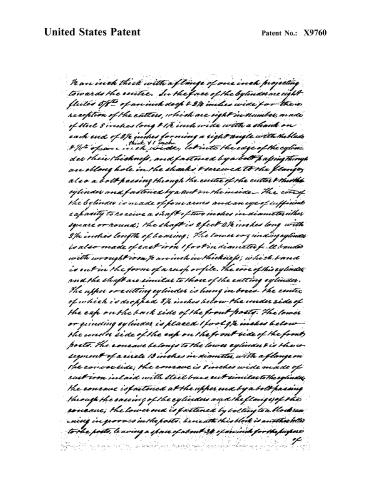
Page 3.
United States Patent
Patent No.: X9760
Two iron inch thick with a flange of one inch projecting towards the centre. In the face of the cylinder are eight flutes 8/8" of an inch deep & 3/4 inches wide for the reception of the cutters, which are eight in number, made of steel 8 inches long & 1/4 inch wide with a shank on each end of 3/4 inches forming a right angle with the blade & 1/4" of an inch wide, let into the edge of the cylinder their thickness, and fastened by a bolt passing through an oblong hole in the shanks & screwed to the flange, also a bolt passing through the centre of the cutter & the cylinder and fastened by a nut on the inside. The core of the cylinder is made of four arms and an eye of sufficient capacity to receive a shaft of two inches in diameter either square or round; the shaft is 2 feet 4 1/2 inches long with 3/4 inches length of bearing; The lower or grinding cylinder is also made of cast iron 1 foot in diameter & 1/4 inch thick, which band is cut in the form of a rasp or file. The core of this cylinder and the shaft are similar to those of the cutting cylinder. The upper or cutting cylinder is hung in boxes the center of which is dropped 8 1/4 inches below the under side of the cap on the back side of the front posts. The lower or grinding cylinder is placed 1 foot 9 1/2 inches below the under side of the cap on the front side of the front posts. The concave belongs to the lower cylinder & is the segment of a circle 13 inches in diameter, with a flange on the convex side; the concave is 8 inches wide made of cast iron inlaid with steel bars cut similar to the cylinder. The concave is fastened at the upper end by a bolt passing through the casing of the cylinder and the flange of the concave; the lower end is fastened by bolting to a block running in grooves in the posts. Beneath this block is another block to the posts, leaving a space of about 3/4 of an inch for the purpose of
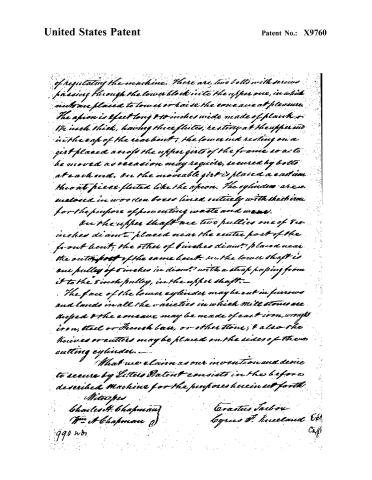
Page 4.
United States Patent
Patent No.: X9760
of regulating the machine. There are two bolts with screws passing through the lower block into the upper one, in which nuts are placed to lower or raise the cone as at pleasure. The apron is 2 feet long & 10 inches wide made of plank or 1½ inch thick, having three flutes, resting at the upper end in the ear of the rear bent; the lower end resting on a girder placed across the upper girts of the frame so as to be moved as occasion may require, secured by bolts at each end. On the movable girder is placed a cast iron throat piece fluted like the apron. The cylinders are enclosed in wooden boxes lined entirely with sheet iron for the purpose of preventing waste and wear.
On the upper shaft are two pulleys one of 8 inches diameter placed near the center post of the front bent; the other of 6 inches diameter placed near the outer post of the same bent. On the lower shaft is one pulley of 5 inches in diameter with a strap passing from it to the 8 inch pulley, in the upper shaft.
The face of the lower cylinder may be cut in furrows and lands in all the varieties in which Mill Stones are shaped & the cone may be made of cast iron, wrought iron, steel or French bar, or other stone; & also the knives or cutters may be placed on the sides of the cutting cylinder.
What we claim as our invention and desire to secure by Letters Patent consists in the before described Machine for the purposes herein set forth.
Witnesses
Charles H. Chapman
Wm. A. Chapman
Trasitus Talbot
Loyne & H. H. H. H.
990 wd.
C. H.
Published accounts: journal notice
Notice in the monthly list of patents
Journal of the Franklin Institute, new ser., vol. 18 (1836), p. 287 · View the page
457. Straw, corn, &c. cutting.-E. Tarbox and C. F. Kneeland, Ogden, N. Y.
About this record
- Patentee
- the Journal of the Franklin Institute, Journal
- Date
- the Name and Date index of patents, DATAMP, USPTO records
- Invention
- DATAMP
- Listed in
- the Name and Date index of patents, DATAMP, USPTO records, Jim Shaw's X-patent list, the Journal of the Franklin Institute, Burke's List of Patents (1847)
- The patentee's full name comes from the Franklin Institute's journal.
- Burke's 1847 Patent Office list gives the same patent.