

Drawings and documents
National Archives restored drawings: drawing
T. Shaw's Patent Drawing for a Stove

National Archives, Restored Patent Drawings (Record Group 241) · Full-size scan at the National Archives · Catalog record
Show the text on the drawing Hide (63 words)
Words on the drawing as machine-read by the National Archives; not checked. Useful mainly for searching.
so. / STOVE &PURNACMS / [154] / Cooking Stoves. / CLASSITICATION / 9776.4 / II O SHAW / DIVISIONT / Store / 9776x / patented / A: oven / B. Boilers / C. Furme/ / D.Grary / Damber / Patent office June 17th 1839 / Made under the dinction of the com rog polective Couformity / Strickland / Del / with act of 3 d March 1837 / Misualth / Commissions, patents
USPTO scan
The patent as scanned by the USPTO
-
 Page 1
-
 Page 2


U.S. Patent and Trademark Office · Google Patents
Show the transcription Hide (428 words)
Machine transcription (LightOnOCR) of the pages as scanned by the USPTO, most of them the handwritten copies made when the records were restored after the 1836 fire. Not checked; it can misread handwriting, so compare it with the scan.
Page 1.
9776X
T. Shaw,
Cook Stove.
Patented June 25, 1836.

Page 2.
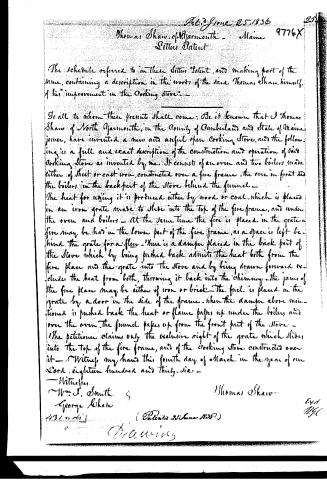
Pat. of June 25, 1836
Thomas Shaw, of Yarmouth - Maine 9776X
Letters Patent
The schedule referred to in these Letters Patent, and making part of the same, containing a description in the words of the said Thomas Shaw, himself, of his "improvement in the Cooking Store":
To all to whom these presents shall come: Be it known that I Thomas Shaw of North Yarmouth, in the County of Cumberland and State of Maine, joiner, have invented a new and useful open Cooking Store, and the following is a full and exact description of the construction and operation of said Cooking Store as invented by me. It consists of an oven and two boilers made either of sheet or cast iron, constructed over a fire frame, the oven in front and the boilers in the back part of the Store behind the funnel.
The heat for using it is produced either by wood or coal, which is placed in an iron grate made to slide into the top of the fire frame, and under the oven and boilers. At the same time the fire is placed in the grate a fire may be had in the lower part of the fire frame, as a space is left behind the grate for a fire. There is a damper placed in the back part of the Store which by being pushed back admits the heat both from the fire place and the grate into the Store and by being drawn forward excludes the heat from both, throwing it back into the chimney. The jams of the fire place may be either of iron or brick. The fuel is placed in the grate by a door in the side of the frame. When the damper above mentioned is pushed back the heat or flame passes up under the boilers and over the oven. The funnel passes up from the front part of the Store.
The petitioner claims only the exclusive right of the grate which slides into the top of the fire frame, and of the cooking stove constructed over it.
Witness my hand this fourth day of March in the year of our Lord eighteen hundred and thirty-six.
—Witnesses—
Wm. J. Smith
George Whate
Thomas Shaw
(Patentee Witness 1836)
Drawings
Exd
1196
Published accounts: journal notice
Notice in the monthly list of patents
Journal of the Franklin Institute, new ser., vol. 18 (1836), p. 287 · View the page
471. Cooking stove.-Thomas Shaw, North Yarmouth, Maine,
About this record
- Patentee
- DATAMP
- Date
- the Name and Date index of patents, DATAMP, USPTO records
- Invention
- DATAMP
- Listed in
- the Name and Date index of patents, DATAMP, USPTO records, Jim Shaw's X-patent list, the Journal of the Franklin Institute, Burke's List of Patents (1847)
- Burke's 1847 Patent Office list gives the same patent.