

Drawings and documents
National Archives restored drawings: drawing
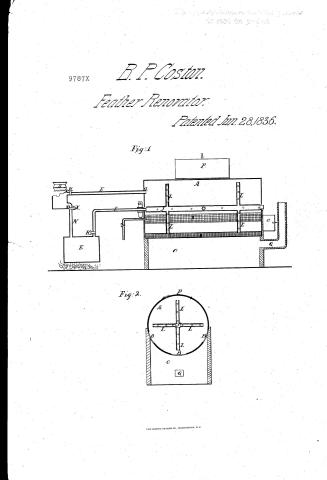
Benton P. Coston's Patent Drawing for a Feather Renovator

National Archives, Restored Patent Drawings (Record Group 241) · Full-size scan at the National Archives · Catalog record
Show the text on the drawing Hide (49 words)
Words on the drawing as machine-read by the National Archives; not checked. Useful mainly for searching.
34. DRIERS. / Cylinder-Internal, / Sta. Horizontal. / BENTON P.COSTOVS / Stering a / seather Mecnovator: / Mayne Ca La / 9787.7 / Patented Jisme 28th 1830. / birton. / 9787X / tig b. / Section / vellow / JE / IVE- / Berry / Transuerse Seclion. / T, / 7. / A.L. / 1/ Entire Del.
USPTO scan
The patent as scanned by the USPTO
-
 Page 1
-
 Page 2
-
 Page 3
-
 Page 4
-
 Page 5


U.S. Patent and Trademark Office · Google Patents
Show the transcription Hide (1,240 words)
Machine transcription (LightOnOCR) of the pages as scanned by the USPTO, most of them the handwritten copies made when the records were restored after the 1836 fire. Not checked; it can misread handwriting, so compare it with the scan.
Page 1.
9787X
B. P. Coston.
Feather Renovator.
Patented Jun. 28, 1836.
Fig. 1

Fig. 2

THE NORRIS PETERS CO., WASHINGTON, D.C.
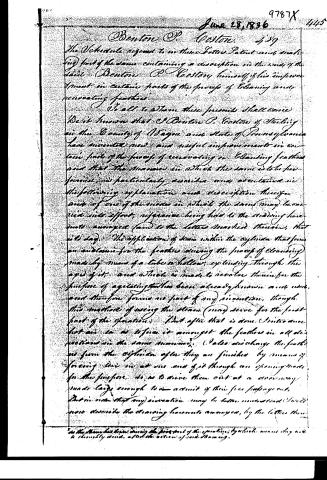
Page 2.
June 28, 1836
Benton P. Coston. 439
The Schedule referred to in these Letters Patent and making part of the same containing a description in the words of the said Benton P. Coston himself of his "improvement in certain parts of the process of cleaning and renovating feathers."
To all to whom these presents shall come
Be it known that I Benton P. Coston of Sterling in the County of Wayne and state of Pennsylvania have invented new and useful improvements in certain parts of the process of renovating or cleaning feathers and that the manner in which the same is to be performed, is particularly described and ascertained in the following explanation and description thereon, one of the modes in which the same may be carried into effect, reference being had to the existing drawings annexed (and to the letters marked thereon, that is to say) The application of steam within the cylinder that forms an enclosure for the feathers during the process of cleaning, made by means of a tube or hollow, extending through the axis of it, and which is made to revolve therein for the purpose of agitating the feathers has been already known and used, and therefore forms no part of my invention, though this method of using the steam may serve for the first part of the operation. But after that is done I introduce but air so as to force it amongst the feathers in all directions in the same manner. (I also discharge the feathers from the cylinder after they are finished by means of forcing them in at one end of it through an opening made for the purpose, so as to drive them out at a doorway made large enough to admit of their free passage out. But in order that my invention may be better understood I will now describe the cleaning apparatus annexed, by the letters thereon.
*In the steam has been during the first part of the operation, by which means they are thoroughly dried, after the action of said steaming.
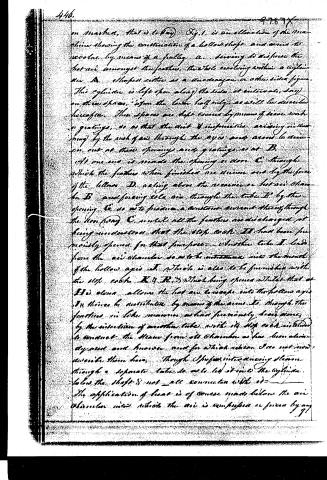
Page 3.
on marked, that is to say) Fig. 1. is an elevation of the machine showing the construction of a hollow shaft and means to revolve by means of a pulley a... serving to diffuse the hot air amongst the feathers, the whole revolving within a cylinder or A shaped either as a diodeagon or other similar figure. This cylinder is left open along the sides at intervals, say on three spaces, "upon the lower half only, as will be described hereafter. These spaces are left covered by means of seams with a grating, so as that the dust & impurities arising in the body by the rush of air through the axis and around the same can exit at these openings and gratings as at B. At one end is made the opening or door C through which the feathers when finished are drawn out by the force of the letters D, acting above the receiver or hot air chamber B and forcing cold air through the tube E by the opening G, so as to produce a constant current through the door or way C, until all the feathers are discharged yet being in condition that the stop cock H had been previously opened for that purpose. Another tube I leads from the air chamber so as to be intermediate into the mouth of the hollow axis J. This is also to be furnished with the stop cocks K & R, D which being opened whilst that at H is closed, allows the hot air to escape into the hollow axis J & thence be distributed by means of the arms Ii through the feathers in like manner as had previously been done, by the introduction of another tube with its stop cock indicated to connect the steam from its chamber as has been already noted and known and for which reason I do not need describe them here. Though I prefer introducing steam through a separate tube so as to let it into the cylinder below the shaft S not all connected with it. The application of heat is of course made below the air chamber into which the air is compressed or forced by any
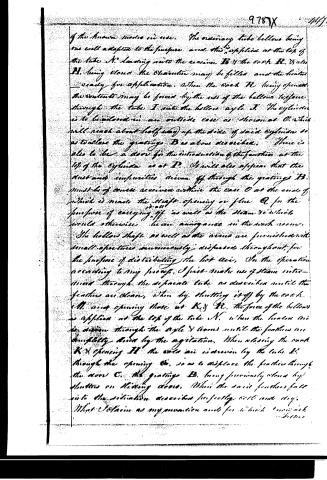
Page 4.
of the known modes in use. The ordinary tube bellows being one well adapted to the purpose, and this applied at the top of the tube A, leading into the receiver B, by the cock R, valve H, being closed, the chamber may be filled and the heater ready for application. When the cock R being opened, the contents may be forced by the use of the bellows to flow through the tube I into the hollow axle J. The cylinder is to be enclosed in an outside case as shown at O, this will reach about half way up the side of said cylinder so as to close the gratings B as above described. There is also to be a door for the introduction of the feathers at the top of the cylinder as at P. It will also appear that the dust and impurities driven off through the gratings B, must be of course received within the case O at the ends of which is made the draft opening or flue Q for the purpose of carrying off as well as the steam which would otherwise be an annoyance in the work room.
The hollow shaft, as well as the arms are furnished with small apertures numerously dispersed throughout, for the purpose of distributing the hot air. On the operation according to my process, I first make use of steam introduced through the separate tube as described until the feathers are clean, then by shutting it off by the cock M, and opening those at K & R, the force of the bellows is applied at the top of the tube A, when the heated air is driven through the axle J round until the feathers are completely dried by the agitation. When closing the cock K & opening H, the arms are driven by the tube L through the opening O, so as to displace the feathers through the arms C, the gratings B, being previously closed by shutters on hinging arms. When the said feathers fall into the situation described perfectly, work and dry.
What I claim as my invention and for which I would
Page 5.
448. 9787X
Latter Patent is the improvement in the process of removing feathers by introducing hot air to dry them (and blow off the impurities after they have been cleansed by steam in the ordinary way). According to the above description thereof. Also for cooling and discharging them by the forcing air of cold air as explained. & for employing any for that purpose any apparatus substantially the same as that herein before mentioned and set forth.
In testimony that the above is a full description I have hereunto set my hand.
Witnesses:
B. H. Marshall
Wm. Cooper
Antonio P. Gaston
Drawn
[118042]
Fork
M.C.
Published accounts: journal notice
Notice in the monthly list of patents
Journal of the Franklin Institute, new ser., vol. 18 (1836), p. 287 · View the page
489. Feathers, dressing.-Benton P. Coston, Philadelphia,
About this record
- Patentee
- DATAMP
- Date
- the Name and Date index of patents, DATAMP, USPTO records
- Invention
- DATAMP
- Listed in
- the Name and Date index of patents, DATAMP, USPTO records, Jim Shaw's X-patent list, the Journal of the Franklin Institute, Burke's List of Patents (1847)
- Burke's 1847 Patent Office list gives the same patent.