

Drawings and documents
National Archives restored drawings: drawing
Edmund Richards' Patent Drawing for a Concave Drawing-knife

National Archives, Restored Patent Drawings (Record Group 241) · Full-size scan at the National Archives · Catalog record
Show the text on the drawing Hide (42 words)
Words on the drawing as machine-read by the National Archives; not checked. Useful mainly for searching.
145. WOOD WORKING. / 4. TOOLS. / [29] Spoke Shaves. / ff / Look / as / #1 / THIS LON / 9.796. x / DIVISION. / 9796 X / Edmond / locucare Drawing-triple. / Vatented: 28th June: 1836 / of / 1 boncave. / B. Edge / T.Benne.del:
USPTO scan
The patent as scanned by the USPTO
-
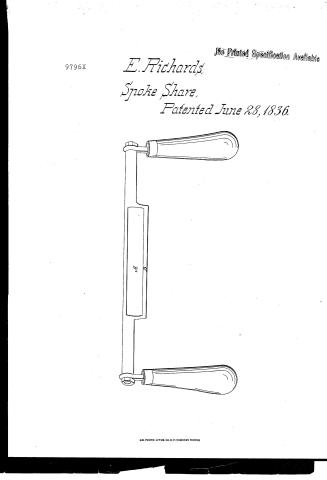 Page 1
-
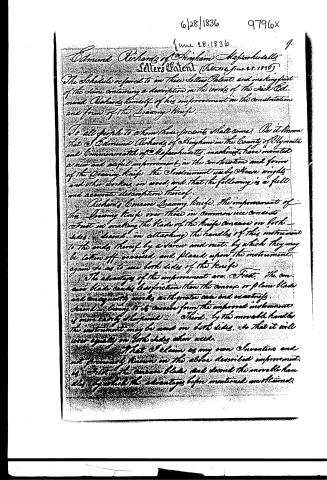 Page 2
-
 Page 3


U.S. Patent and Trademark Office · Google Patents
Show the transcription Hide (373 words)
Machine transcription (LightOnOCR) of the pages as scanned by the USPTO, most of them the handwritten copies made when the records were restored after the 1836 fire. Not checked; it can misread handwriting, so compare it with the scan.
Page 1.
9796X
E. Richards,
Spoke Share,
Patented June 28, 1836.
No Printed Specification Available
A.M. PHOTO-LITHO. CO. N.Y. (OSBORNE'S PROCESS)
Page 2.
June 28, 1836
Edmund Richards of Hingham Massachusetts
Letters Patent (Patented June 28, 1836)
The Schedule referred to in these Letters Patent, and making part of the same containing a description in the words of the said Edmund Richards himself of his improvement in the construction and form of the Drawing Knife.
To all people to whom these presents shall come, Be it known that I, Edmund Richards of Hingham in the County of Plymouth and Commonwealth of Massachusetts, machinist, have invented a new and useful improvement in the construction and form of the Drawing Knife, the Instrument used by Housewrights and other workers in wood, and that the following is a full and accurate description thereof.
Richards' Concave Drawing Knife. The improvement of this Drawing Knife over those in common use consists first in making the blade of the knife concave on both sides, second, in attaching the handles of this instrument to the ends thereof by a screw and nut, by which they may be taken off, removed and placed upon the instrument again so as to use both sides of the knife.
The advantages of the improvement are: First, The concave blade causes less friction than the convex or plane blade and consequently works with greater ease and exactness. Second, owing to its concave form, the improved instrument is more easily sharpened. Third, by the movable handles the instrument may be used on both sides, so that it will wear equally on both sides when used.
That I claim as my own invention and not previously known in the above described improvement, is First, the concave blade, and second, the movable handles, by which the advantages before mentioned are obtained.
Page 3.
Dated at Hingham aforesaid this sixteenth day of May in the year One thousand Eight hundred and thirty six
Witnesses
Edmund Richards
Olivia Cushing
Solomon Lincoln
(Patented 28 June 1836)
(238 and 2)
(Re-Recorded anew July 7, 1838)
(Drawing)
Published accounts: journal notice
Notice in the monthly list of patents
Journal of the Franklin Institute, new ser., vol. 18 (1836), p. 287 · View the page
490. Drawing knife. -Edmund Richards, Hingham, Mass.
DATAMP: illustration
Illustrations from DATAMP
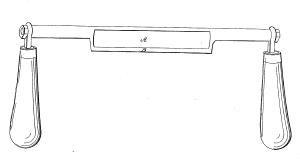

DATAMP (Directory of American Tool and Machinery Patents), via the Internet Archive · Archived DATAMP page
About this record
- Patentee
- DATAMP
- Date
- the Name and Date index of patents, DATAMP, USPTO records
- Invention
- DATAMP
- Listed in
- the Name and Date index of patents, DATAMP, USPTO records, Jim Shaw's X-patent list, the Journal of the Franklin Institute, Burke's List of Patents (1847)
- Burke's 1847 Patent Office list gives the same patent.