

Drawings and documents
National Archives restored drawings: drawing
Seth Boyden's Patent Drawing for a Splitting Hides and Shaving Leather


National Archives, Restored Patent Drawings (Record Group 241) · Full-size scan at the National Archives · Catalog record
Show the text on the drawing Hide (308 words)
Words on the drawing as machine-read by the National Archives; not checked. Useful mainly for searching.
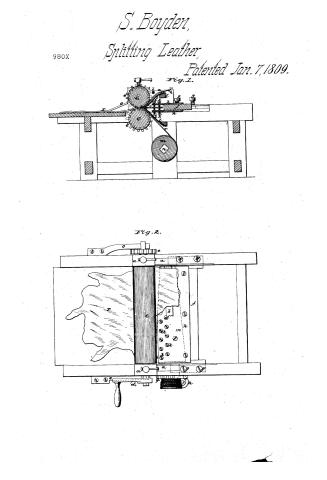
Sheet 1. 69. LEATHER. / [92] Splitting, / Teth I Scyden. / 7. 1809 / Vol.2. py.324 / CLASSIFICATION / 95 980 X / Splitting Hides shaving Leather / DIVISION / fa / References / Sig 1. Section / 2. Topriew. / a.a. the metallic frame. / 6.6. bars. / c.c. iron cylinder. / d. crank. / e. l. cogwheels. / Jig.2 / of sliding frame / 9.9 gg. serios to faster of / h horizontal plates. / i. the knife / Kh K K. al. servis to seare / the knife. / f. metallic gage / m the Conical roller. / h. its square axis. / N. / 0.0 p.strap α / B. / ratchet. / Even / Z hide / Dr / Protont affie. April / Mad wash che direction of ch Commisioner / Correct / of Patents in conformity w its act of Ass Ma / Henryh Elbworth / Commition of Patents
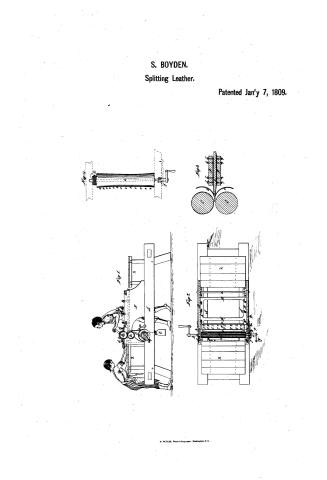
Sheet 2. Seth Boydens maching for Hites & shaving Leather. / Satented Jary 1809 / 329. / V5C2A329 / LASSIFICATION / Fight / DI 980 x ISTON / !mm' / Fig. 1. / Side view. / DO / Reference / is / Fight. A. wooden. frame / sides of the / cutting machinery. / connecting bar; / metallic cylinders c,fig 2, upper roller roller engraved in lines / Fig.2. 2. / Top view. / square gudgeon or shank; / Figh) screw pins for regulating / Fig. / 3. / Cross section of plates knife. / (Fig.1.o2,) two cog wheels - / 5 times the size represented / ,C,oci figh. horizontal frame. / in Figs 1.82.- / 0,0, figh. guides or ledes / пр,яс.(fig 2.81) screws / F,F, 203.) horizontal plates / x, 0 Do Knife / Do set screws / and / S,S, / metallic gauges; / u, wooden roller, / for Fig.2. pins / Patent Office / June 22m 1845. / y, (fig:1.02) ratchet wheel / m, Io - pall i, fig 1.92. square axis / q Do - crank; / made under the direction of the Commifrier / pp, De springs- / of Patents in Conformity with the act of / Z.Z, Do tables / 3rd of march 1837 / t, (fig.1.) weight / Fig: 4, a, wooden roller for sheep &r calf skins. / Henry H.Sylvezter / puns / t. weight it cord, / y'i ratch & pall / At. Comminical of Pater / square axis,
USPTO scan
The patent as scanned by the USPTO
-
 Page 1
-
 Page 2
-
 Page 3
-
 Page 4
-
 Page 5
-
 Page 6


U.S. Patent and Trademark Office · Google Patents
Show the transcription Hide (1,664 words)
Machine transcription (LightOnOCR) of the pages as scanned by the USPTO, most of them the handwritten copies made when the records were restored after the 1836 fire. Not checked; it can misread handwriting, so compare it with the scan.
Page 1.
S. Boyden,
Splitting Leather,
Patented Jan. 7, 1809.
980X
Fig. 1.
Fig. 2.
Page 2.
S. BOYDEN.
Splitting Leather.
Patented Jan'y 7, 1809.

N. PETERS. Photo-Lithographer. Washington, D.C.
Page 3.
Feb. 7, 1809
Cl. 177
970x
339
Clath Boyden
Letters Patent Spd. Jan. 7, 1809.
The Schedule referred to in these Letters Patent and making part of the same containing a description in the words of the said Clath Boyden himself of his machine for splitting Hides & shaving Leather.
The wooden frame of this machine consists of two parallel pieces of timber framed together at the ends & supported by four legs. From this frame rises the two sides of the cutting machinery, made of iron or other metal & connected together by one or more metallic bars extending from side to side on the top. Within these sides in front are two iron or other sufficiently hard metallic cylinders, one above the other, their pivot and resting on the inside placed proportionately one each. On the end of the uppermost of these rollers or cylinders is a square yoke or a shank projecting beyond the side for the purpose of receiving the work by which they are turned. This uppermost roller is engaged in a straight line horizontally or lengthwise on its surface. This roller may be placed at any required distance from the lower one by raising the bars on which its pivots turn by means of screw joints. On the opposite end of these rollers to that on which the crank is placed are two wheels the teeth of which are not on each other, so that when the upper roller is turned communicates motion to the lower roller. Behind these metal cylinders or rollers there is an horizontal frame for the purpose of holding the knife in the proper position for cutting the leather or skin. This frame is made of metal & of such substance or thickness as not to vibrate. It slides horizontally between the right sides being guided by latches on the side plates above mentioned, so that the edge of the knife within it can be brought to the leather to cut or removed back from it for the purpose of sharpening. This frame is confined within the sides on its proper place by screws the heads of which are above the sides. This frame has two horizontal plates extending from side to side so far apart as to admit of the knife lying horizontally between them & of any required thickness. The knife being introduced & its edge advanced as far beyond the front of the frame as is thought necessary is then secured in its place by screws passing thro' the upper & lower plates of the frame pressing with their ends
Page 4.
321.
980X
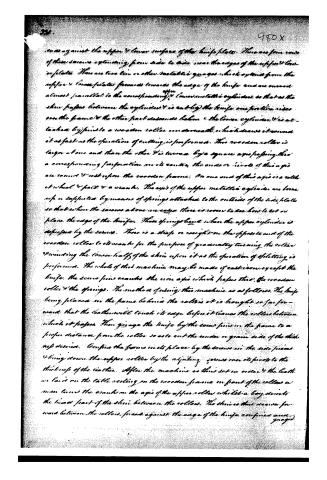
on as against the upper & lower surface of the knife plate. There are four rows of these screws extending from side to side near the edges of the upper & lower knife plates. There are two iron or other metallic gauges which extend from the upper & lower plates forward towards the edge of the knife and are almost parallel to the corresponding upper & lower metallic cylinders, so that as the thin paper between the cylinders is cut by the knife one portion rides over the frame & the other part descends below the lower cylinder, & is attached by pins to a wooden roller underneath, which draws it onward at as fast as the operation of cutting is performed. This wooden roller is larger at one end than the other & is turned by a square axis passing through a corresponding perforation on its centre, the ends or pivots of this axis are round & rest upon the wooden frame. On one end of this axis is a notch at what is called a crank. The axis of the upper metallic cylinder are borne up or supported by means of springs attached to the outside of the side plate so that when the screws above are easy there is room to see how to set or place the edge of the knife. These springs bend when the upper cylinder is depressed by the screws. There is a strap or weight on the opposite end of the wooden roller to its crank for the purpose of gradually turning the roller & winding the lower half of the skin upon it as the operation of splitting is performed. The whole of this machine may be made of cast iron except the knife. The screw pins cranks the iron axis which passes thro' the wooden roller & the springs. The method of using this machine is as follows. The knife being placed on the frame behind the roller it is brought so far forward that the leather will touch its edge before it leaves the roller between which it passes. Then gauge the knife by the screw pins in the frame to a proper distance from the roller so as to cut the under or grain side of the thick nap desired. Confine the frame in its place by the screws in the side pieces & bring down the upper roller by the adjusting screws over its pivots to the thickness of the leather. After the machine is thus set on order & the leather laid on the table resting on the wooden frame in front of the rollers a man turns the crank on the axis of the upper roller whilst a boy directs the hand part of the skin between the rollers. The skin is thus drawn forward between the rollers, forward against the edge of the knife, confined and gauged
Page 5.
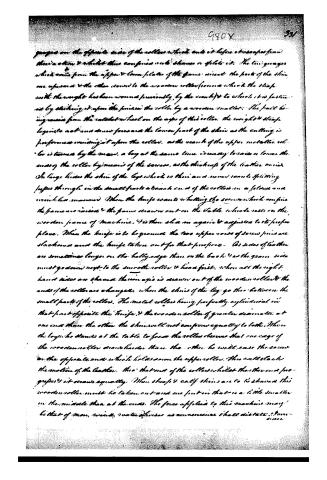
grapes on the opposite side of the roller which cuts it before it escapes from their action, & which then confines and shaves or splits it. The two grapers which come from the upper & lower plates of the frame, meet the parts of the skin, one upper & the other lower to the wooden roller from which the sheep with the weight had been wound previously, by the weight & to which it is fastened by sticking it upon the pinion the roller by a wooden matter. The part being raised from the cataract which on the axis of this roller, the weight & sheep begins to act and draw forward the lower part of the skin as the cutting is performed winding it upon the roller, as the weight of the upper metallic roller is turned by the man, a boy at the same time increases or lowers the weight of the roller by means of the screws, as the thickness of the leather varies. In large hides the skin of the legs which is thin and never wants splitting passes through in the small parts at each end of the rollers on a folded and wrinkled manner. When the knife wants whetting the screws which confine the frame are raised & the frame drawn out on the table which rests on the wooden frame of machine. It is then shaved again & adjusted to its proper place. When the knife is to be ground the two upper rows of screw pins are slackened and the knife taken out for that purpose. As sides of leather are sometimes longer on the belly edge than on the back & as the grain side must go down next to the smooth roller & head first, when all the right hand sides are shaved the iron axis is drawn out of the wooden roller & the ends of the rollers are changed, when the skins of the leg go there between the small parts of the rollers. The metal rollers being perfectly cylindrical in that part opposite the knife, & the wooden roller of greater diameter at one end than the other the skin will not conform equally to both. When the boy stands at the table to force the rollers shaves that one edge of the wooden roller draws harder than the other he will ease the screw on the opposite end which holds down the upper roller. This will slack the motion of the leather, this that end of the roller which the other end grapers & it moves equally. When sheep & calf skins are to be shaved this wooden roller must be taken out and one put in that is a little smaller in the middle than at the ends. The force applied to this machine may be that of men, wind, water & horses as convenience shall dictate. Some
Page 6.
322
940X
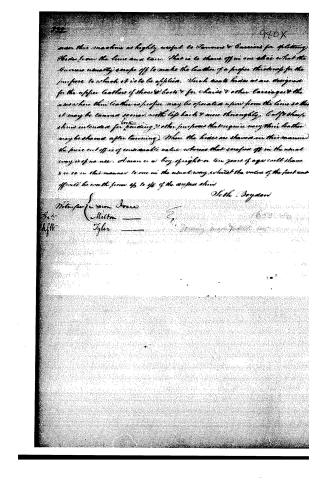
use this machine as highly useful to tanners & curriers for splitting hides from the bone and tow. That is to shave off in one blade what the tanner usually scrapes off to make the leather of a proper thickness for the purpose to which it is to be applied. Such seats hides as are designed for the upper leathers of shoes & boots & for chairs & other carriages & the manner how their leather is proper may be operated upon from the time so that it may be tanned sooner with less back & more thoroughly. Calf & sheep skins intended for tanning & other purposes that require very thin leather may be shaved after tanning. When the hides are shaved in this manner the piece cut off is of considerable value whereas that scraped off in the usual way is of no use. A man or a boy of eight or ten years of age will shave 5 or 10 in this manner to one in the usual way whilst the value of the part cut off will be worth from 45 to 50% of the surface skin.
Nathl. Boyden
Witnesses:
L. Milton —
T. Tyler —
6/22/1860
D. H. H. —
J. H. H. —
About this record
- Patentee
- DATAMP
- Date
- the Name and Date index of patents, DATAMP, USPTO records
- Invention
- DATAMP
- Listed in
- the Name and Date index of patents, DATAMP, USPTO records, Jim Shaw's X-patent list, S. A. Elliot's printed list of patents, Burke's List of Patents (1847)
- S. A. Elliot's printed list of patents gives the same name and date.
- Burke's 1847 Patent Office list gives the same patent.