

Drawings and documents
National Archives restored drawings: drawing
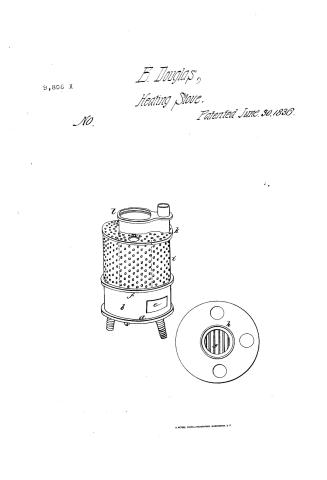
Beriah Douglas' Patent Drawing for an Ornamental Stove

National Archives, Restored Patent Drawings (Record Group 241) · Full-size scan at the National Archives · Catalog record
Show the text on the drawing Hide (30 words)
Words on the drawing as machine-read by the National Archives; not checked. Useful mainly for searching.
71- / & FURNACES, Air. / CEASERICATION / 9.806.x / Donolas / 9806X / Ornamental Store / Patented June 3041 1836 / Vol 27 16.37 / play
USPTO scan
The patent as scanned by the USPTO
-
 Page 1
-
 Page 2
-
 Page 3
-
 Page 4


U.S. Patent and Trademark Office · Google Patents
Show the transcription Hide (1,022 words)
Machine transcription (LightOnOCR) of the pages as scanned by the USPTO, most of them the handwritten copies made when the records were restored after the 1836 fire. Not checked; it can misread handwriting, so compare it with the scan.
Page 1.
9,806 X
E. Douglas,
Heating Stove.
Patented June 30, 1836.
No.

H. PETERS, PHOTO-LITHOGRAPHER, WASHINGTON, D. C.
Page 2.
1
9806x
June 30, 1836
Bereah Douglas, of Albany, New York.
Letters Patent.
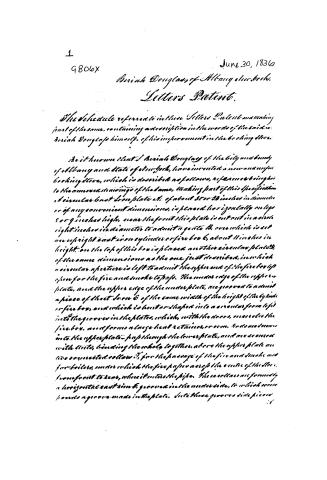
The Schedule referred to in these Letters Patent and making part of the same, containing a description in the words of the said Bereah Douglas himself, of his improvement in the cooking stove.
Be it known that I Bereah Douglas of the city and county of Albany and State of New York, have invented a new and useful cooking stove, which is described as follows, reference being had to the annexed drawings of the same, making part of this specification.
A circular cast iron plate, of about 30 or 32 inches in diameter or of any convenient dimensions, is placed horizontally on top 5 or 9 inches high, near the front this plate is cut out in a circular hole in its diameter to admit a gate B, over which is set an upright cast iron cylinder or fire box C, about 11 inches in height. On the top of this box is placed another circular plate D, of the same dimensions as the one just described, in which a circular aperture is left to admit the upper end of the fire box top open for the fire and smoke to pass. The under edge of the upper plate, and the upper edge of the under plate, are grooved to admit a piece of sheet iron E of the same width of the height of the cylinder or fire box, and which is bent or shaped into a circular form to fit into the grooves in the plates, which, with the doors, encloses the fire box, and forms a large heat retainer, or oven. It is secured into the upper plate—pass through the lower plate, and is secured with nails, binding the whole together. Above the upper plate are two connected collars F, for the passage of the fire and smoke into the boiler, under which the fire passes across the entire of the stove from front to rear, where it enters the pipe. These collars are formed by a horizontal cast iron G, grooved in the underside, to which were joined a groove made in the plate. Into these grooves side pieces
Page 3.
2
9806x
June 30, 1836
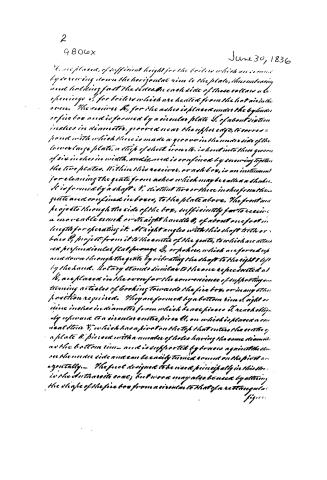
It is placed, of sufficient height for the boilers which are secured by screwing down the horizontal rim to the plate, thus containing and holding fast the sides. On each side of these collars are openings, for boilers which are heated from the heat air in the oven. The receiver B, for the ashes is placed under the cylinder or fire box and is formed by a circular plate L, of about sixteen inches in diameter, grooved near the upper edge, to correspond with which there is made a groove in the under side of the lower large plate, a strip of sheet iron is inserted into these grooves of six inches in width, and is used is confined by screwing together the two plates. Within this receiver, or ash box, is an instrument for cleaning the grate from ashes which may be called a shaker. It is formed by a shaft T, distant two or three inches from the grate and confined in boxes, to the plate above. The front arm projects through the side of the box, sufficiently far to receive a moveable crank or straight handle O, of about one foot in length for operating it. At right angles with this shaft to the or bars P, project from it to the centre of the grate, to which are attached perpendicular flat, or bars, Q, or poles, which are forced up and down through the grate by vibrating the shaft to the right or left by the hand. Rotary stands similar to the one represented at H, are placed in the oven for the convenience of supporting and turning articles of cooking towards the fire box, or in any other position required. They are formed by a bottom rim of eight or nine inches in diameter from which hence pieces D, reach obliquely upwards to a circular centre piece H, on which is placed a conical stone V, which has a pivot on the top that enters the centre of a plate B, pierced with a number of holes having the same diameter as the bottom rim, and is supported by braces against the door on the under side and can be easily turned around on the pivot as required. The fuel designed to be used principally in this stove is the Anthracite coal; but wood may also be used by altering the shape of the fire box from a circular to that of a rectangular figure.
Page 4.
3
9806x
June 30, 1836
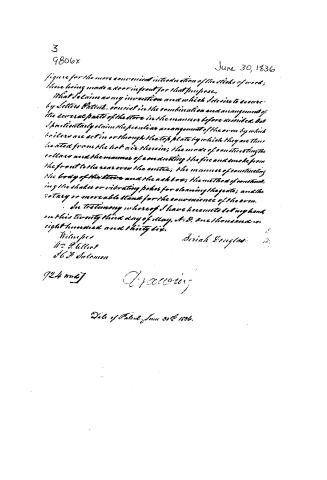
figure for the more convenient introduction of the sticks of wood;
there being made a door in front for that purpose.
What I claim as my invention and which I desire to secure
by Letters Patent, consist in the combination and arrangement of
the several parts of the stove in the manner before described. But
I particularly claim the peculiar arrangement of the oven by which
boilers are set in or through the top plate by which they are thus
heated from the hot air therein; the mode of constructing the
collars and the manner of conducting the fire and smoke from
the front to the rear over the center; the manner of constructing
the body of the stove and the ash box; the method of constructing
the shakes or vibrating poles for cleaning the grate; and the
rotary or moveable stand for the convenience of the oven.
In testimony whereof I have hereunto set my hand
on this twenty third day of May, A.D. one thousand an
eight hundred and thirty six.
Wellespes
Wm. P. Elliot
H. A. Salomon
Briah Douglas
924 mde]
Appropriating
Date of Patent June 30th 1836.
About this record
- Patentee
- Jim Shaw's X-patent list
- Date
- the Name and Date index of patents, USPTO records, Jim Shaw's X-patent list
- Invention
- the Name and Date index of patents
- Listed in
- the Name and Date index of patents, USPTO records, Jim Shaw's X-patent list, Burke's List of Patents (1847)
- Burke's 1847 Patent Office list gives the same patent.