

Drawings and documents
USPTO scan
The patent as scanned by the USPTO
-
 Page 1
-
 Page 2
-
 Page 3
-
 Page 4
-
 Page 5
-
 Page 6
-
 Page 7
-
 Page 8
-
 Page 9
-
 Page 10
-
 Page 11
-
 Page 12
-
 Page 13
-
 Page 14
-
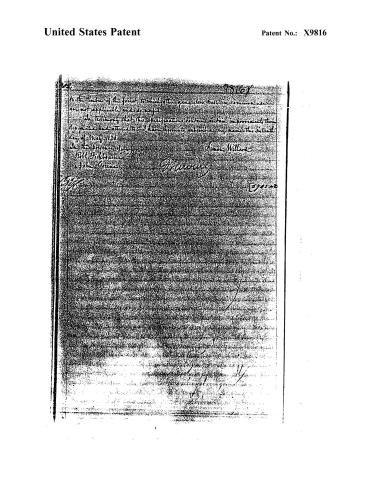 Page 15


U.S. Patent and Trademark Office · Google Patents
Show the transcription Hide (7,952 words)
Machine transcription (LightOnOCR) of the pages as scanned by the USPTO, most of them the handwritten copies made when the records were restored after the 1836 fire. Not checked; it can misread handwriting, so compare it with the scan.
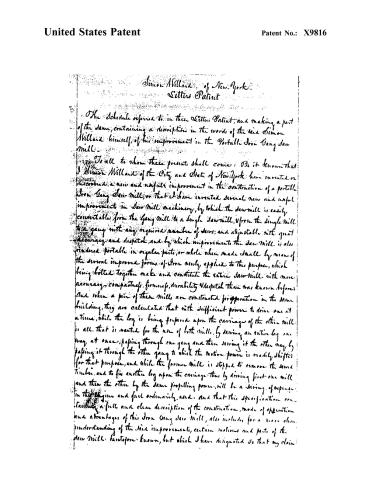
Page 2.
United States Patent
Patent No.: X9816
Simon Willard, of New-York.
Letters Patent
The Schedule referred to in these Letters Patent, and making a part of the same, containing a description in the words of the said Simon Willard himself, of his improvement in the Portable Iron Gang Saw Mill.
To all to whom these presents shall come: Be it known that I Simon Willard of the City and State of New-York have invented or discovered a new and useful improvement in the construction of a portable Iron Gang Saw Mill; or that I have invented several new and useful improvements in Saw Mill machinery, by which the saw mill is easily convertible from the Gang Mill to a single Saw mill, or from the single mill to a gang mill with any required number of saws; and adjustable with great accuracy and dispatch, and by which improvements the Saw Mill is also rendered portable in regular parts, or whole when made small by means of the several improved forms of Iron newly applied to this purpose, which being bolted together make and constitute the entire Saw Mill with more accuracy, compactness, firmness, durability and dispatch than was known before. And when a pair of these mills are constructed for operation in the same building, they are calculated that with sufficient power to drive one at a time, while the log is being prepared upon the carriage of the other mill is all that is wanted for the use of both mills, by sawing an entire log one way at once; passing through one gang and then sawing it the other way by passing it through the other gang to which the motion power is readily shifted for that purpose, and while the former mill is stopped to remove the sawed timber, and to fix another log upon the carriage; thus by driving first one mill and then the other by the same propelling power, will be a saving of expense in the engine and fuel ordinarily used, and that this specification contains a full and clear description of the construction, mode of operation and advantages of this Iron Gang Saw Mill, also includes for a more clear understanding of the said improvements, certain motions and parts of the Saw Mill heretofore known, but which I have designated so that my claim
Page 3.
United States Patent
Patent No.: X9816
an inventor of this improved and newly applied parts are clearly distinguishable from them. That by the construction and conformation of the improved parts in connection with the parts of the saw mill herebefore in use. It is made and constructed a new and useful portable saw gang saw mill. The several parts of this saw mill consist of a newly constructed iron supporting frame, an improved pair of vibrating feed posts, an improved driving crank shaft and balance pulley, a newly applied pair of pitman, an improved iron saw gate, 4 inches improved saw stirrup, and saw bolts, several pairs of improved head bolts and mill dog, a pair of improved log bearers, and an improved feeding apparatus which are hereinafter distinctly set forth. The newly constructed iron supporting frame is composed of a pair of strong upright cast iron side frames, or flanged plates about twelve feet in length, connected, near their center, with equally strong horizontal flanged parts about half their length, which together with the upright side plates, and other necessary strengthening flanges and braces required to support the journals of the operating machinery are especially connected in each of the same section castings shown in the drawings further shown, but which are varied according to the situation of mill site, and manner of applying the driving power. These two upright cast iron side frames are firmly fastened in an upright position about four feet apart by means of bolt and cross bars reaching from one to the other and by means of the horizontal parts being setted and strongly bolted upon the inner ends of a pair of large parallel carriage sills of any required length, which are also securely fastened transversely to a sufficiency of base-ments, sills, whose extremities rest upon a pair of strong side walls, of stone or timber while their middle support may depend upon posts beneath the sawing floor of the mill, and which walls are altogether sheltered by any suitable enclosure. When these saw mills are required to be of sufficiently small construction for the purpose of being the more easily moved, while for sawing logs for fencing and for other purposes, the carriage sills for driving short timber are bolted fast upon a short basement frame, which is sustained upon rollers, while drawn by sufficient teams, or otherwise from one place to another for the purpose of being continued the more conveniently to
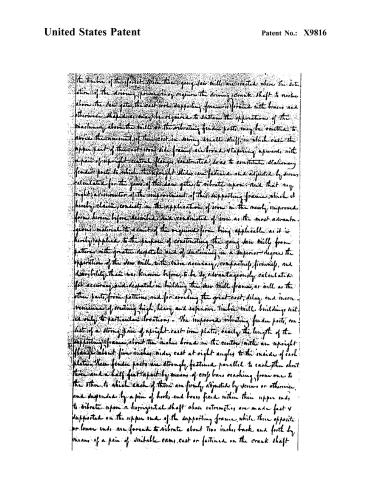
Page 4.
United States Patent
Patent No.: X9816
The timber of the forest. When these gang saw mills are erected where the situation of the driving power may require the driving crank shaft to revolve above the saw gate, the cast-iron supporting frame is formed with braces and otherwise shaped as may be required to sustain the operation of the machinery above the mill. The vibrating fender posts may be omitted to avoid the amount of the cast-iron saw mill stuff, in which case the upper part of the cast-iron side frames are broad and tapering upwards, with a pair of upright cast-iron flanges, constructed so as to constitute stationary fender posts, to which the upright slides are fastened and adjusted by screws calculated for the jaws of the saw gate, to vibrate upon. And that may right as inventor of the improvement of this supporting frame, which I hereby claim, consists in the application of iron in the newly improved form herein before described, and constructed of iron as the most advantageous material to admit of the original form being applicable as it is hereby applied to the purpose of constructing the gang saw mill from patterns, with greater despatch, and of sustaining in a superior degree the operation of the saw mill, with more accuracy, compactness, firmness, and durability than was known before, to be so advantageously calculated for accuracy and despatch in building the saw mill frames, as well as the other parts, from patterns, and for avoiding the great cost, delay, and inconvenience of erecting high, heavy and expensive timber mill buildings suited only to particular locations. The improved vibrating fender posts, consist of a strong pair of upright cast-iron plates, nearly the length of the supporting frame, about ten inches broad in the center, with an upright flange about five inches wide, cast at right angles to the inside of each plate. These fender posts are strongly fastened parallel to each other about three and a half feet apart by means of cross bars reaching from one to the other, to which each of them are firmly adjusted by screws or otherwise, and suspended by a pair of hooks and boxes fixed within their upper ends, to vibrate upon a horizontal shaft whose extremities are made fast and supported on the upper end of the supporting frame, while their opposite or lower ends are forced to vibrate about two inches back and forth by means of a pair of suitable cams, cast or fastened on the crank shaft
Page 5.
United States Patent
Patent No.: X9816
next to its main journals, which can revolve within a pair of cam grooves fastened to the lower end of the feeder posts, or they are fastened to the upper end where the driving power is applied above, so as to be opposite to the axis upon which they vibrate. The upright flanges of these feeder posts, projecting towards each other, constitute the article slides upon which the adjusted jaws of the saw gate slide up and down when the mill is in operation, or the slides are bolted to them for that purpose. The object of the vibration of these feeder posts, as just described for which I claim my right as inventor, consists in the advantage of driving power by withdrawing the saw when rising clear of the wood timber and saw dust.
The improved driving crank shaft is a strong horizontal iron shaft about five inches in diameter, four feet long, one or left with a crank in each end ten or twelve inches in length, one or left with a round wrist in each end, revolving within the bore of a pair of pitmans, the journals of this crank shaft are next to the cranks and adjusted to revolve within a pair of strong brass cast or firmly adjusted in the lower ends of the supporting frame, a large square hub, supported in cast upon the crank shaft upon which the balance pulley is fastened, a nest of aligned pulleys are also fastened or cast upon the crank shaft around which a running band is forced to drive the feeding apparatus. The cams fitted to revolve within their respective cam grooves are also cast upon the crank shaft, by which the feeder posts are forced to vibrate at every vibration of the vertical saw. The improved balance pulley, four and a half feet in diameter, one or left, is a broad rim cast iron wheel, weighing about one thousand pounds, whose eye of the hub being sufficiently large is passed over the crank, and keyed fast to the hub supports, and which is forced to revolve between one or two hundred times per minute, by means of a broad flat band, in width equal to its rim, being about eighteen inches, upon which it runs, connecting with it the motion of the power drum of any sufficient power by which the saw mill is forced into operation. A weight is cast or bolted upon that side of the balance pulley which is opposite to the crank, sufficient to balance the saw gate and other apparatus vibrating by their connection with the motion of the pitmans. The newly applied pair of pitmans are about ten feet
Page 6.
United States Patent
Patent No.: X9816
long with both ends similar to the crank ends of the common kind — the improvement of which consists in the application of an additional pitman and new places of the operation of both in relation to their connection with their iron gang saw mill, or iron saw gate. Their lower ends being fitted to turn upon the ends of the driving crank shaft while their upper ends vibrate upon similar points which project from each outside edge of the upper end of the iron saw gate, except when the driving shaft is fitted to revolve above the saw gate in order for accommodating the mill to the situation of the mill site, the lower end of the pitman then vibrates upon points projecting from the lower outside corners of the iron gang saw gate, or when the situation of the mill site in relation to the driving power whether by steam, water, wind or animal power is applied to the driving crank shaft by flat or round rope or chain, block or by cog wheels or by water buckets or friction wheels or otherwise by which this iron gang saw mill is forced to operate, require the pitman to be fitted to vibrate upon a pair of points projecting from the corners of that end of the iron saw gate which is next to the driving shaft whether it be placed to revolve above or below the saw gate in order to avoid the burden of two great a length of pitman. The advantage of these two pitman as applied to this iron saw gate consists in sawing with more or less saws on either one side or the other as occasion may require by which it is convertible from a gang mill to a single saw or double slabber, or from a single mill to a gang fly which the saw gate admits of being made narrower, therefore stronger and lighter when made of cast iron and saw a log equally large and slabbings both sides at once by running between two saws, or two sets of slabbings saws and by a pair of pitman being connected by points to the corners of the saw gate opposite to the end nearest the driving shaft almost any place is a suitable location for a low steam saw mill to give sufficient length of pitman without the high mill floors attended with great expense in providing for the elevation of the saw logs too far above the earth’s level to which the common single pitman saw mills are often necessarily subjected. I hereby claim that my right of the improvement as inventor of this
Page 7.
United States Patent
Patent No.: X9816
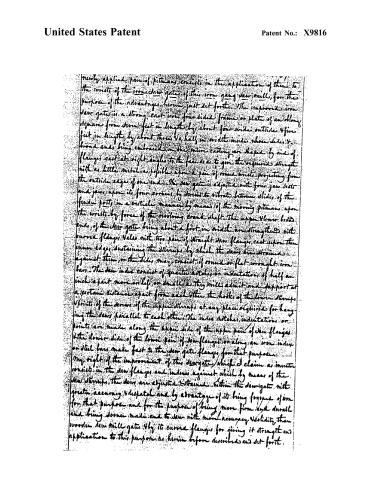
newly applied pair of pitman, consists in the application of them to the inside of the iron saw gate of this iron gang saw mill, for the purpose of the advantages herein just set forth. The improved iron saw gate is a strong cast iron four sided frame or plate of an oblong square from about a foot in length by about four sides outside & five feet in length by about three & a half in width inside whose sides & broad ends, being embraced in the outer casting are shaped by aid of flanges cast at right angles to the face so as to give the required strength with as little metal as possible a pair of round bolts projecting from the outside edge of one end. This saw gate is adjusted with four jaw seats and jaws upon its four corners by means to vibrate between slides of the fence posts in a vertical manner by means of the moving pitman upon the bolts by force of the revolving crank shaft. The upper & lower broad ends of the saw gate being about a foot in width are strengthened with curved flanges. Vales with two pair of straight saw flanges cast upon their inner edges, sustaining the straps by which the saws are strained against them, or the sides may consist of round or flat wrought iron bars. The saw index consist of quarter notches or indentations of half an inch apart more or less, or small as they will admit and support at a certain distance apart from each other the holes of the lower straps & points of the screws of the upper straps at any place required for hanging the saws parallel to each other. The index notches, indentations, or points are made along the upper side of the upper pair of saw flanges & the lower side of the lower pair of saw flanges or along an iron index or steel bars made fast to the saw gate flanges for that purpose. My right of the improvement of this saw gate which I claim as inventor consists in the saw flanges and indexes against which by means of the saw straps, the saws are adjusted & strained within the saw gate with greater accuracy & dispatch and by advantage of its being forged of iron for that purpose and for the purpose of being more firm & durable and being sooner made and to saw with more accuracy & solidity than wooden saw mill gates. By its curved flanges for giving it strength and application to this purpose as herein before described and set forth.
Page 8.
United States Patent
Patent No.: X9816
The improved saw strapping consists of one pair for straining each saw. The upper one being a screw strapping and the lower a hooked strapping. These strappings are made of strong cast or wrought iron whose outside is about six by four inches, and whose interior openings about three by four inches square, about one inch and three eighths thick, with openings between the screws and the hooks of the strappings about three fourths of an inch wide, or just wide enough to admit the thickness of the broad ends of the saw gate and to slide along upon the saw flanges, also another nicely adjusted narrow opening is made just wide enough to admit the thickness of the saw and saw bolt so that when each saw is straining it is directed in the course it is to saw, for the purpose of dispensing with the ordinary need in adjusting saw mill saws, a pair of strong three quarter upright screws pass through the upper parts of the screw strappings with a square end to each by which they are turned by a socket wrench on each side of the saw gate above the flanges and forcing them nicely rounded steel points upon the inside above while the hooks of the lower strapping press up against the lower inside by which the saws are strained within the saw gate as required for use. The drawing and references further explain the form of these strappings. I hereby claim my right as inventor of these new and useful saw strappings, as constructed and applied to this purpose herein set forth, being of superior advantage in adjusting and straining one or more or all the saws along the inside of the saw gate flanges with great accuracy and dispatch. The improved saw bolts are of an ell form as the drawing shows about three fourths of an inch in diameter, and the same in length. One or more are riveted fast in each end of the saw with the elbow or other part extending back to reach against the inside back part of the strapping by which the saws are hung over as required. The advantage of these right angled bolts is in their form and application to this iron gang saw mill, so that the saws can be taken out and put in without taking the bolts out of the saws, by which the saws are adjusted with dispatch. The improved head blocks consisting of two pairs of different construction calculated for holding fast the mill dogs by which the logs or large timbers are securely held while driving into
Page 9.
United States Patent
Patent No.: X9816
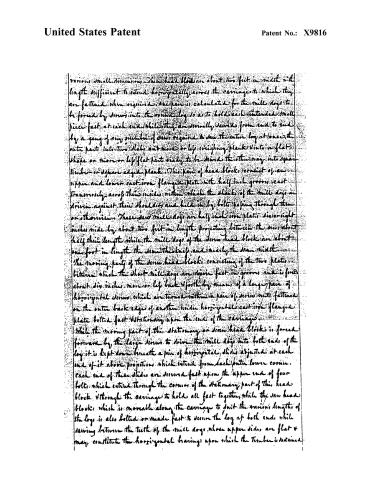
various small dimensions. These head blocks are about two feet in width with length sufficient to extend horizontally across the carriage to which they are fastened when required. The span is calculated for the mill dogs to be forced by screws into the round log so as to hold each intended small piece fast at each end while they are normally serrated from end to end by a gang of any number of saws required to saw the entire log at once into parts into two slabs and more or less weighing planks into a flat shape or more or less flat part ready to be divided the other way into square timber or square edged plank. This pair of head blocks consist of an upper and lower cast iron flanged plate with half inch grooves cast transversely across them inside, within which the cheeks of the mill dogs are driven against their shoulders and held in by bolts passing through them or otherwise. These saw mill dogs are half inch iron plates, six or eight inches wide by about two feet in length projecting between the saws about half their length while the mill dogs of the screw head block are about one foot in length the same thickness and nearly the same width.
The moving part of the screw head blocks consisting of the two plates between which the short mill dogs are driven fast in grooves and is forced about six inches more or less back and forth by means of a large pair of horizontal screws which are turned within a pair of screw nuts fastened on the outer back edges of another under horizontal cast iron flanged plate bolted fast stationary upon the end of the carriage.
While the moving part of this stationary or screw head blocks is forced forward by the large screws to drive the mill dogs into both ends of the log it is kept down beneath a pair of horizontal slides adjusted at each end of it above projections which extend from each outer lower corner. Each end of these slides are secured fast upon the upper end of four bolts which extend through the corners of the stationary part of this head block through the carriage to hold all fast together while the saw head blocks which is movable along the carriage to suit the various lengths of the log is also bolted or made fast to secure the log at both ends while sawing between the teeth of the mill dogs whose upper sides are flat and may constitute the horizontal bearings upon which the timber is sustained.
Page 10.
United States Patent
Patent No.: X9816
while sawing. Another pair of these head blocks, which are also calculated for supporting the log while sawing by this gang mill, are both constructed for the purpose of sawing the timber previously flattened upon the other mill, while the ends of the log rest upon the ends of hard seasoned wooden bearings projecting forward. While from within square apertures or pigeon holes cast in them. They consist of two plates somewhat like those described in the first head blocks, cast with the partitions by which they are connected in the same casting together with a pair of upright flanges with suitable holes made through them, through which horizontal mill dogs are driven by the mill bar into the ends of the log by which it is held till sawed. These mill dogs are round with a sharp round hollow in the ends of sufficient size, or may be squares. The other third pair of these head blocks being calculated to extend across the carriage and carry the log or timber to be divided between two sets of slitting saws, so that only one small slab, one, two, or three neighboring plates may be sawed off each side of the log at once running it through between the two sets of said saws for this purpose. The cast iron part of this pair of head blocks are thick horizontal plates about ten inches square bolted stationary upon the wood part of the head blocks. From two opposite edges of these plates a pair of upright sides about five inches with door tails for broad sliding mill dogs to slide in back forth when driven in the end of the log by the mill bar. By this form of these head blocks the timber is fastened upon the carriage which may or may not be sufficiently narrow to palp with the log being that two sets of saws for the purposes of squaring round timber. For the purpose of moving the log along the head blocks in sawing this stuff with one or more saws. The horizontal plate of these head blocks terminate at their front and back edge with a little more than a half round hollow projecting from their inner edge sufficient to keep them down while fore and by rack and pinion to slide along a pair of rounded edge sides bolted upon the timbers of the head blocks, below for that purpose, to which a rack is fixed or forend by a pinion fixed upon a transverse horizontal shaft beneath to which an index or watch wheel is attached by which by crank or lever. The log is forced to move along the head block and become accurately adjusted by the index to any required thickness of boards, or other size timber. These square stationary plates are secured fast by bolts passing downwards through them
Page 11.
United States Patent
Patent No.: X9816
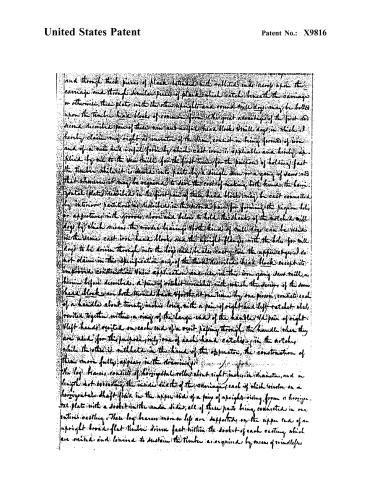
and through thick pieces of plank, attached with rabbeted ends across upon the carriage and through similar pieces of plank which catch beneath the carriage or otherwise, these plates with the other upright and round mill dogs may be bolted upon the timber head blocks of common form. The great advantage of the first and second described pair of these new and useful head blocks & mill dogs, in which I hereby claim my right as inventor of the same, consist in being formed of iron and of a new and useful form by which cast iron is applicable and hereby applied by me to the saw mills for the first time for the purpose of holding fast the timber while it is divided into parts by a single saw or a gang of saws; and that otherwise it may be required to save the cost of making both kinds, the horizontal plates described in the first pair of these head blocks may be cast connected by interior partitions as described in the second pair for forming the proper holes or apertures with grooves, above and below to hold the shanks of the notched mill dogs by which means the wooden bearings both kinds of mill dogs can be used in the same cast iron head blocks and the upright flanges with the holes for mill dogs to be driven through into the log ends, be also cast upon the upper edges and do not claim in this specification any of the third described head block except its improved construction. New application and use in this iron gang saw mill, as herein before described, a pair of notched iron wheels with which the screws of the same head block are both turned back forth at one time by one person, consist each of a handle about twenty inches long with a pair of right and left ratchet wheels riveted together within a ring of the large end of the handle & a pair of right & left hands riveted on each end of a rod passing through the handle when they are used for this purpose, only one of each hand catches in the notches while the other is withheld in the hand of the operator, the construction of these more fully appears in the drawings.
The log beams consist of horizontal rollers about eight inches in diameter, and in length not exceeding the inside width of the carriage, each of which revolves on a horizontal shaft fixed in the upper side of a pair of uprights rising from a horizontal plate with a socket in the under sides; all of these parts being connected in one entire casting. These log beams above or left are supported on the upper end of an upright broad flat timber driven fast within the socket of each casting which are riveted and lowered to sustain the timber as required by means of windlasses
Page 12.
United States Patent
Patent No.: X9816
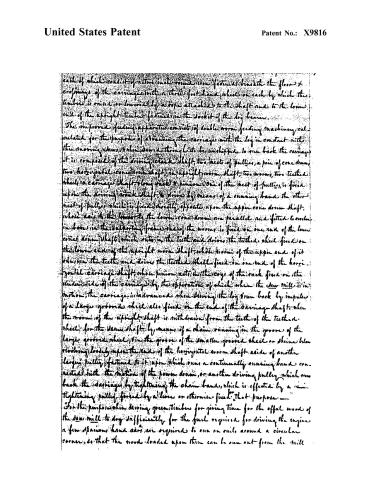
each of which consist of a timber in the ground, with fastenings beneath the floor & crossways of the carriage with a three foot hand wheel on each by which the timber is raised or lowered by a rope attached to the shaft and to the lower end of the upright timber fastened in the socket of the log beam.
The improved feeding apparatus consists of double worm feeding machinery calculated for the purpose of advancing the carriage with the log in constant with the moving chains when drawn through to be unshipped to run back the carriage it is composed of the driving crank shaft, two nests of pulleys, a pair of cone drums, two horizontal cone drum shafts, an upright worm shaft, two worms, two toothed wheels on carriage shaft along each & pinion. One of the nests of pulleys, is fixed upon the driving crank shaft to drive by means of a running band, the other nest of pulleys which is fixed directly opposite upon the upper cone drum shaft, whose axes to the lower cone drums are parallel and fitted to revolve in boxes in the supporting frames, one of the worms is fixed on one end of the lower cone drum shaft, which enters in the teeth and drives, the toothed wheel fixed on the lower end of the upright worm shaft, while the other end of it enters in the teeth, and drives the toothed wheel fixed on one end of the horizontal carriage shaft, whose pinion acts in the cogs of the rack fixed on the under side of the carriage by the operation of which when the saw mill is in motion, the carriage is advanced when driving the log from back by impulse of a large grooved wheel also fixed on the end of the carriage shaft, when the worm of the upright shaft is withdrawn from the teeth of the toothed wheel for the same shaft by means of a chain running in the groove of the large grooved wheel, in the groove of the smaller grooved wheel or sheave, then revolving loosely upon the end of the horizontal worm shaft aside of another larger pulley fastened to it upon which runs a continually running band connected with the motion of the power drum, or another driving pulley which runs back the carriage by tightening the chain band, which is effected by a winch tightening pulley, forced by a lever or otherwise fixed for that purpose.
For the purpose when driving green timber for giving time for the offal wood of the saw mill to dry sufficiently for the fuel required for driving the engine a few spacious hand cars are required to run on rails around a circular corner, so that the wood loaded upon them can be run out from the mill
Page 13.
United States Patent
Patent No.: X9816
to remain several days under shelter to dry without unloading except when water under the boilers. This iron gang saw mill is put into operation by any suitable power in any manner that it may be applicable to the driving crank shaft by hand or power drawn or by water or cog wheels by which such water, steam or animal power may be applied with their suitable additional agents, by which the pitman, connecting the revolving cranks with the vibrating saw gates of more or less saw, the timber fastened upon the carriage while advanced by running bands, connecting its motion with that of the driving crank shaft.
And for the purpose of using two of these gang mills by the advantage of steam or other power only sufficient to drive one at a time as required on that account. For this purpose a line of three shafts are constructed with four crank catches one of each of them from inner ends with the middle shaft to which the driving power is firstly applied having its journals sufficiently long to slide in its boxes when forced back and forth by means of a forked lever for the crank catches to catch in the crank catch of first one end of the other of the two outer shafts, whose drums are of suitable size to give the required motion, and are directly opposite the balance pulleys, or the connecting or disconnecting of these shafts for shifting the power at pleasure, from one mill to the other as they may be wanted to run or stop first one mill and then the other, is effected by friction connecting levers of the kind in common use.
I have described in this specification the several parts of an entire saw mill and have designated from them what I claim as inventor of the improved parts consisting of a newly constructed iron supporting frame, an improved pair of vibrating, fender posts, a newly applied pair of pitmen, an improved iron saw gate and saw in use improved saw throats, and two pair of improved head blocks and mill dogs, for which I ask Patent for the whole, of a part of them to be used in distinct mills, according to the manner of driving for which I have contemplated their several uses, and that I do not ask a patent for those other parts described in distinct paragraphs to the foot of the parts to which I annexed no claim, I therefore claim not any part of them in this specification, except as before therein after described, neither do I claim any improvement in the saws themselves, or their up and down motion, nor the horizontal movement of the carriage, except its regular advance by a double grooved
Page 14.
United States Patent
Patent No.: X9816
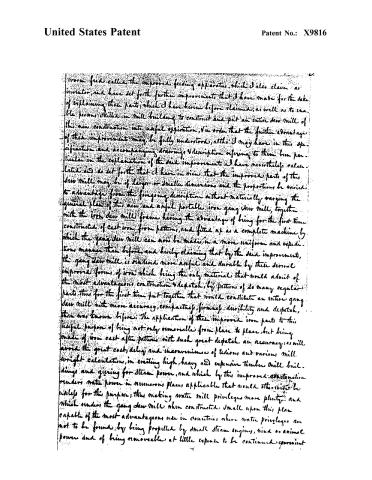
I have here called the improved feeding apparatus, which I also claim as an invention, and have set forth further improvements that I have made for the sake of explaining those parts, which I have herein before claimed, as well as to enable persons skilled in mill building to construct and put an entire saw mill of this new construction into useful operation, in order that the further advantages of these improvements may be fully understood, although I may have in this specification and accompanying drawings & description referring to them been particular in the explanation of the said improvements. I have nevertheless calculated and do set forth that I have in view that the improved parts of this saw mill may be of larger or smaller dimensions and the proportions be varied to advantage from the foregoing description without materially varying the general plan of this new and useful portable iron gang saw mill, together with the iron saw mill frame having the advantage of being for the first time constructed of cast iron from patterns, and fitted up as a complete machine by which the gang saw mill can now be made in a more uniform and expeditious manner than before, and hereby claiming that by the said improvements, the gang saw mill is rendered more useful and durable by these several improved forms of iron which being the only material that would admit of the most advantageous construction & dispatch, by patterns of so many regular parts thus for the first time put together that would constitute an entire gang saw mill with more accuracy, compactness, firmness, durability and dispatch, than was known before. The application of these improved iron parts to this useful purpose of being not only removable from place to place, but being made of iron cast after patterns with such great dispatch an accuracy, as will avoid the great cost, delay and inconvenience of tedious and various millwright calculations, in erecting high, heavy and expensive timber mill buildings and gearing for steam power, and which by this improved construction renders water power in numerous places applicable that would otherwise be useless for this purpose, thus making water mill privileges more plenty, and which renders the gang saw mill when constructed, small upon this plan capable of the most advantageous use in countries where water privileges are not to be found, by being propelled by small steam engine, wind or animal power and of being removable at little expense to be continued convenient
Page 15.
United States Patent
Patent No.: X9816
To the tune of the first to which the young man will be common use,
are not applicable and so useful.
In testimony that this specification contains certain improvements therein
described and attainable, I have hereunto set my hand this twentieth
day of May 1856.
Simon Willard
[Signature]
[Signature]
[Signature]
[Signature]
[Signature]
[Signature]
[Signature]
[Signature]
[Signature]
[Signature]
[Signature]
[Signature]
[Signature]
[Signature]
[Signature]
[Signature]
[Signature]
[Signature]
[Signature]
[Signature]
[Signature]
[Signature]
[Signature]
[Signature]
[Signature]
[Signature]
[Signature]
[Signature]
[Signature]
[Signature]
[Signature]
[Signature]
[Signature]
[Signature]
[Signature]
[Signature]
[Signature]
[Signature]
[Signature]
[Signature]
[Signature]
[Signature]
[Signature]
[Signature]
[Signature]
[Signature]
[Signature]
[Signature]
[Signature]
[Signature]
[Signature]
[Signature]
[Signature]
[Signature]
[Signature]
[Signature]
[Signature]
[Signature]
[Signature]
[Signature]
[Signature]
[Signature]
[Signature]
[Signature]
[Signature]
[Signature]
[Signature]
[Signature]
[Signature]
[Signature]
[Signature]
[Signature]
[Signature]
[Signature]
[Signature]
[Signature]
[Signature]
[Signature]
[Signature]
[Signature]
[Signature]
[Signature]
[Signature]
[Signature]
[Signature]
[Signature]
[Signature]
[Signature]
[Signature]
[Signature]
[Signature]
[Signature]
[Signature]
[Signature]
[Signature]
[Signature]
[Signature]
[Signature]
[Signature]
[Signature]
[Signature]
[Signature]
[Signature]
[Signature]
[Signature]
[Signature]
[Signature]
[Signature]
[Signature]
[Signature]
[Signature]
[Signature]
[Signature]
[Signature]
[Signature]
[Signature]
[Signature]
[Signature]
[Signature]
[Signature]
[Signature]
[Signature]
[Signature]
[Signature]
[Signature]
[Signature]
[Signature]
[Signature]
[Signature]
[Signature]
[Signature]
[Signature]
[Signature]
[Signature]
[Signature]
[Signature]
[Signature]
[Signature]
[Signature]
[Signature]
[Signature]
[Signature]
[Signature]
[Signature]
[Signature]
[Signature]
[Signature]
[Signature]
[Signature]
[Signature]
[Signature]
[Signature]
[Signature]
[Signature]
[Signature]
[Signature]
[Signature]
[Signature]
[Signature]
[Signature]
[Signature]
[Signature]
[Signature]
[Signature]
[Signature]
[Signature]
[Signature]
[Signature]
[Signature]
[Signature]
[Signature]
[Signature]
[Signature]
[Signature]
[Signature]
[Signature]
[Signature]
[Signature]
[Signature]
[Signature]
[Signature]
[Signature]
[Signature]
[Signature]
[Signature]
[Signature]
[Signature]
[Signature]
[Signature]
[Signature]
[Signature]
[Signature]
[Signature]
[Signature]
[Signature]
[Signature]
[Signature]
[Signature]
[Signature]
[Signature]
[Signature]
[Signature]
[Signature]
[Signature]
[Signature]
[Signature]
[Signature]
[Signature]
[Signature]
[Signature]
[Signature]
[Signature]
[Signature]
[Signature]
[Signature]
[Signature]
[Signature]
[Signature]
[Signature]
[Signature]
[Signature]
[Signature]
[Signature]
[Signature]
[Signature]
[Signature]
[Signature]
[Signature]
[Signature]
[Signature]
[Signature]
[Signature]
[Signature]
[Signature]
[Signature]
[Signature]
[Signature]
[Signature]
[Signature]
[Signature]
[Signature]
[Signature]
[Signature]
[Signature]
[Signature]
[Signature]
[Signature]
[Signature]
[Signature]
[Signature]
[Signature]
[Signature]
[Signature]
[Signature]
[Signature]
[Signature]
[Signature]
[Signature]
[Signature]
[Signature]
[Signature]
[Signature]
[Signature]
[Signature]
[Signature]
[Signature]
[Signature]
[Signature]
[Signature]
[Signature]
[Signature]
[Signature]
[Signature]
[Signature]
[Signature]
[Signature]
[Signature]
[Signature]
[Signature]
[Signature]
[Signature]
[Signature]
[Signature]
[Signature]
[Signature]
[Signature]
[Signature]
[Signature]
[Signature]
[Signature]
[Signature]
[Signature]
[Signature]
[Signature]
[Signature]
[Signature]
[Signature]
[Signature]
[Signature]
[Signature]
[Signature]
[Signature]
[Signature]
[Signature]
[Signature]
[Signature]
[Signature]
[Signature]
[Signature]
[Signature]
[Signature]
[Signature]
[Signature]
[Signature]
[Signature]
[Signature]
[Signature]
[Signature]
[Signature]
[Signature]
[Signature]
[Signature]
[Signature]
[Signature]
[Signature]
[Signature]
[Signature]
[Signature]
[Signature]
[Signature]
[Signature]
[Signature]
[Signature]
[Signature]
[Signature]
[Signature]
[Signature]
[Signature]
[Signature]
[Signature]
[Signature]
[Signature]
[Signature]
[Signature]
[Signature]
[Signature]
[Signature]
[Signature]
[Signature]
[Signature]
[Signature]
[Signature]
[Signature]
[Signature]
[Signature]
[Signature]
[Signature]
[Signature]
[Signature]
[Signature]
[Signature]
[Signature]
[Signature]
[Signature]
[Signature]
[Signature]
[Signature]
[Signature]
[Signature]
[Signature]
[Signature]
[Signature]
[Signature]
[Signature]
[Signature]
[Signature]
[Signature]
[Signature]
[Signature]
[Signature]
[Signature]
[Signature]
[Signature]
[Signature]
[Signature]
[Signature]
[Signature]
[Signature]
[Signature]
[Signature]
[Signature]
[Signature]
[Signature]
[Signature]
[Signature]
[Signature]
[Signature]
[Signature]
[Signature]
[Signature]
[Signature]
[Signature]
[Signature]
[Signature]
[Signature]
[Signature]
[Signature]
[Signature]
[Signature]
[Signature]
[Signature]
[Signature]
[Signature]
[Signature]
[Signature]
[Signature]
[Signature]
[Signature]
[Signature]
[Signature]
[Signature]
[Signature]
[Signature]
[Signature]
[Signature]
[Signature]
[Signature]
[Signature]
[Signature]
[Signature]
[Signature]
[Signature]
[Signature]
[Signature]
[Signature]
[Signature]
[Signature]
[Signature]
[Signature]
[Signature]
[Signature]
[Signature]
[Signature]
[Signature]
[Signature]
[Signature]
[Signature]
[Signature]
[Signature]
[Signature]
[Signature]
[Signature]
[Signature]
[Signature]
[Signature]
[Signature]
[Signature]
[Signature]
[Signature]
[Signature]
[Signature]
[Signature]
[Signature]
[Signature]
[Signature]
[Signature]
[Signature]
[Signature]
[Signature]
[Signature]
[Signature]
[Signature]
[Signature]
[Signature]
[Signature]
[Signature]
[Signature]
[Signature]
[Signature]
[Signature]
[Signature]
[Signature]
[Signature]
[Signature]
[Signature]
[Signature]
[Signature]
[Signature]
[Signature]
[Signature]
[Signature]
[Signature]
[Signature]
[Signature]
[Signature]
[Signature]
[Signature]
[Signature]
[Signature]
[Signature]
[Signature]
[Signature]
[Signature]
[Signature]
[Signature]
[Signature]
[Signature]
[Signature]
[Signature]
[Signature]
[Signature]
[Signature]
[Signature]
[Signature]
[Signature]
[Signature]
[Signature]
[Signature]
[Signature]
[Signature]
[Signature]
[Signature]
[Signature]
[Signature]
[Signature]
[Signature]
[Signature]
[Signature]
[Signature]
[Signature]
[Signature]
[Signature]
[Signature]
[Signature]
[Signature]
[Signature]
[Signature]
[Signature]
[Signature]
[Signature]
[Signature]
[Signature]
[Signature]
[Signature]
[Signature]
[Signature]
[Signature]
[Signature]
[Signature]
[Signature]
[Signature]
[Signature]
[Signature]
[Signature]
[Signature]
[Signature]
[Signature]
[Signature]
[Signature]
[Signature]
[Signature]
[Signature]
[Signature]
[Signature]
[Signature]
[Signature]
[Signature]
[Signature]
[Signature]
[Signature]
[Signature]
[Signature]
[Signature]
[Signature]
[Signature]
[Signature]
[Signature]
[Signature]
[Signature]
[Signature]
[Signature]
[Signature]
[Signature]
[Signature]
[Signature]
[Signature]
[Signature]
[Signature]
[Signature]
[Signature]
[Signature]
[Signature]
[Signature]
[Signature]
[Signature]
[Signature]
[Signature]
[Signature]
[Signature]
[Signature]
[Signature]
[Signature]
[Signature]
[Signature]
[Signature]
[Signature]
[Signature]
[Signature]
[Signature]
[Signature]
[Signature]
[Signature]
[Signature]
[Signature]
[Signature]
[Signature]
[Signature]
[Signature]
[Signature]
[Signature]
[Signature]
[Signature]
[Signature]
[Signature]
[Signature]
[Signature]
[Signature]
[Signature]
[Signature]
[Signature]
[Signature]
[Signature]
[Signature]
[Signature]
[Signature]
[Signature]
[Signature]
[Signature]
[Signature]
[Signature]
[Signature]
[Signature]
[Signature]
[Signature]
[Signature]
[Signature]
[Signature]
[Signature]
[Signature]
[Signature]
[Signature]
[Signature]
[Signature]
[Signature]
[Signature]
[Signature]
[Signature]
[Signature]
[Signature]
[Signature]
[Signature]
[Signature]
[Signature]
[Signature]
[Signature]
[Signature]
[Signature]
[Signature]
[Signature]
[Signature]
[Signature]
[Signature]
[Signature]
[Signature]
[Signature]
[Signature]
[Signature]
[Signature]
[Signature]
[Signature]
[Signature]
[Signature]
[Signature]
[Signature]
[Signature]
[Signature]
[Signature]
[Signature]
[Signature]
[Signature]
[Signature]
[Signature]
[Signature]
[Signature]
[Signature]
[Signature]
[Signature]
[Signature]
[Signature]
[Signature]
[Signature]
[Signature]
[Signature]
[Signature]
[Signature]
[Signature]
[Signature]
[Signature]
[Signature]
[Signature]
[Signature]
[Signature]
[Signature]
[Signature]
[Signature]
[Signature]
[Signature]
[Signature]
[Signature]
[Signature]
[Signature]
[Signature]
[Signature]
[Signature]
[Signature]
[Signature]
[Signature]
[Signature]
[Signature]
[Signature]
[Signature]
[Signature]
[Signature]
[Signature]
[Signature]
[Signature]
[Signature]
[Signature]
[Signature]
[Signature]
[Signature]
[Signature]
[Signature]
[Signature]
[Signature]
[Signature]
[Signature]
[Signature]
[Signature]
[Signature]
[Signature]
[Signature]
[Signature]
[Signature]
[Signature]
[Signature]
[Signature]
[Signature]
[Signature]
[Signature]
[Signature]
[Signature]
[Signature]
[Signature]
[Signature]
[Signature]
[Signature]
[Signature]
[Signature]
[Signature]
[Signature]
[Signature]
[Signature]
[Signature]
[Signature]
[Signature]
[Signature]
[Signature]
[Signature]
[Signature]
[Signature]
[Signature]
[Signature]
[Signature]
[Signature]
[Signature]
[Signature]
[Signature]
[Signature]
[Signature]
[Signature]
[Signature]
[Signature]
[Signature]
[Signature]
[Signature]
[Signature]
[Signature]
[Signature]
[Signature]
[Signature]
[Signature]
[Signature]
[Signature]
[Signature]
[Signature]
[Signature]
[Signature]
[Signature]
[Signature]
[Signature]
[Signature]
[Signature]
[Signature]
[Signature]
[Signature]
[Signature]
[Signature]
[Signature]
[Signature]
[Signature]
[Signature]
[Signature]
[Signature]
[Signature]
[Signature]
[Signature]
[Signature]
[Signature]
[Signature]
[Signature]
[Signature]
[Signature]
[Signature]
[Signature]
[Signature]
[Signature]
[Signature]
[Signature]
[Signature]
[Signature]
[Signature]
[Signature]
[Signature]
[Signature]
[Signature]
[Signature]
[Signature]
[Signature]
[Signature]
[Signature]
[Signature]
[Signature]
[Signature]
[Signature]
[Signature]
[Signature]
[Signature]
[Signature]
[Signature]
[Signature]
[Signature]
[Signature]
[Signature]
[Signature]
[Signature]
[Signature]
[Signature]
[Signature]
[Signature]
[Signature]
[Signature]
[Signature]
[Signature]
[Signature]
[Signature]
[Signature]
[Signature]
[Signature]
[Signature]
[Signature]
[Signature]
[Signature]
[Signature]
[Signature]
[Signature]
[Signature]
[Signature]
[Signature]
[Signature]
[Signature]
[Signature]
[Signature]
[Signature]
[Signature]
[Signature]
[Signature]
[Signature]
[Signature]
[Signature]
[Signature]
[Signature]
[Signature]
[Signature]
[Signature]
[Signature]
[Signature]
[Signature]
[Signature]
[Signature]
[Signature]
[Signature]
[Signature]
[Signature]
[Signature]
[Signature]
[Signature]
[Signature]
[Signature]
[Signature]
[Signature]
[Signature]
[Signature]
[Signature]
[Signature]
[Signature]
[Signature]
[Signature]
[Signature]
[Signature]
[Signature]
[Signature]
[Signature]
[Signature]
[Signature]
[Signature]
[Signature]
[Signature]
[Signature]
[Signature]
[Signature]
[Signature]
[Signature]
[Signature]
[Signature]
[Signature]
[Signature]
[Signature]
[Signature]
[Signature]
[Signature]
[Signature]
[Signature]
[Signature]
[Signature]
[Signature]
[Signature]
[Signature]
[Signature]
[Signature]
[Signature]
[Signature]
[Signature]
[Signature]
[Signature]
[Signature]
[Signature]
[Signature]
[Signature]
[Signature]
[Signature]
[Signature]
[Signature]
[Signature]
[Signature]
[Signature]
[Signature]
[Signature]
[Signature]
[Signature]
[Signature]
[Signature]
[Signature]
[Signature]
[Signature]
[Signature]
[Signature]
[Signature]
[Signature]
[Signature]
[Signature]
[Signature]
[Signature]
[Signature]
[Signature]
[Signature]
[Signature]
[Signature]
[Signature]
[Signature]
[Signature]
[Signature]
[Signature]
[Signature]
[Signature]
[Signature]
[Signature]
[Signature]
[Signature]
[Signature]
[Signature]
[Signature]
[Signature]
[Signature]
[Signature]
[Signature]
[Signature]
[Signature]
[Signature]
[Signature]
[Signature]
[Signature]
[Signature]
[Signature]
[Signature]
[Signature]
[Signature]
[Signature]
[Signature]
[Signature]
[Signature]
[Signature]
[Signature]
[Signature]
[Signature]
[Signature]
[Signature]
[Signature]
[Signature]
[Signature]
[Signature]
[Signature]
[Signature]
[Signature]
[Signature]
[Signature]
[Signature]
[Signature]
[Signature]
[Signature]
[Signature]
[Signature]
[Signature]
[Signature]
[Signature]
[Signature]
[Signature]
[Signature]
[Signature]
[Signature]
[Signature]
[Signature]
[Signature]
[Signature]
[Signature]
[Signature]
[Signature]
[Signature]
[Signature]
[Signature]
[Signature]
[Signature]
[Signature]
[Signature]
[Signature]
[Signature]
[Signature]
[Signature]
[Signature]
[Signature]
[Signature]
[Signature]
[Signature]
[Signature]
[Signature]
[Signature]
[Signature]
[Signature]
[Signature]
[Signature]
[Signature]
[Signature]
[Signature]
[Signature]
[Signature]
[Signature]
[Signature]
[Signature]
[Signature]
[Signature]
[Signature]
[Signature]
[Signature]
[Signature]
[Signature]
[Signature]
[Signature]
[Signature]
[Signature]
[Signature]
[Signature]
[Signature]
[Signature]
[Signature]
[Signature]
[Signature]
[Signature]
[Signature]
[Signature]
[Signature]
[Signature]
[Signature]
[Signature]
[Signature]
[Signature]
[Signature]
[Signature]
[Signature]
[Signature]
[Signature]
[Signature]
[Signature]
[Signature]
[Signature]
[Signature]
[Signature]
[Signature]
[Signature]
[Signature]
[Signature]
[Signature]
[Signature]
[Signature]
[Signature]
[Signature]
[Signature]
[Signature]
[Signature]
[Signature]
[Signature]
[Signature]
[Signature]
[Signature]
[Signature]
[Signature]
[Signature]
[Signature]
[Signature]
[Signature]
[Signature]
[Signature]
[Signature]
[Signature]
[Signature]
[Signature]
[Signature]
[Signature]
[Signature]
[Signature]
[Signature]
[Signature]
[Signature]
[Signature]
[Signature]
[Signature]
[Signature]
[Signature]
[Signature]
[Signature]
[Signature]
[Signature]
[Signature]
[Signature]
[Signature]
[Signature]
[Signature]
[Signature]
[Signature]
[Signature]
[Signature]
[Signature]
[Signature]
[Signature]
[Signature]
[Signature]
[Signature]
[Signature]
[Signature]
[Signature]
[Signature]
[Signature]
[Signature]
[Signature]
[Signature]
[Signature]
[Signature]
[Signature]
[Signature]
[Signature]
[Signature]
[Signature]
[Signature]
[Signature]
[Signature]
[Signature]
[Signature]
[Signature]
[Signature]
[Signature]
[Signature]
[Signature]
[Signature]
[Signature]
[Signature]
[Signature]
[Signature]
[Signature]
[Signature]
[Signature]
[Signature]
[Signature]
[Signature]
[Signature]
[Signature]
[Signature]
[Signature]
[Signature]
[Signature]
[Signature]
[Signature]
[Signature]
[Signature]
[Signature]
[Signature]
[Signature]
[Signature]
[Signature]
[Signature]
[Signature]
[Signature]
[Signature]
[Signature]
[Signature]
[Signature]
[Signature]
[Signature]
[Signature]
[Signature]
[Signature]
[Signature]
[Signature]
[Signature]
[Signature]
[Signature]
[Signature]
[Signature]
[Signature]
[Signature]
[Signature]
[Signature]
[Signature]
[Signature]
[Signature]
[Signature]
[Signature]
[Signature]
[Signature]
[Signature]
[Signature]
[Signature]
[Signature]
[Signature]
[Signature]
[Signature]
[Signature]
[Signature]
[Signature]
[Signature]
[Signature]
[Signature]
[Signature]
[Signature]
[Signature]
[Signature]
[Signature]
[Signature]
[Signature]
[Signature]
[Signature]
[Signature]
[Signature]
[Signature]
[Signature]
[Signature]
[Signature]
[Signature]
[Signature]
[Signature]
[Signature]
[Signature]
[Signature]
[Signature]
[Signature]
[Signature]
[Signature]
[Signature]
[Signature]
[Signature]
[Signature]
[Signature]
[Signature]
[Signature]
[Signature]
[Signature]
[Signature]
[Signature]
[Signature]
[Signature]
[Signature]
[Signature]
[Signature]
[Signature]
[Signature]
[Signature]
[Signature]
[Signature]
[Signature]
[Signature]
[Signature]
[Signature]
[Signature]
[Signature]
[Signature]
[Signature]
[Signature]
[Signature]
[Signature]
[Signature]
[Signature]
[Signature]
[Signature]
[Signature]
[Signature]
[Signature]
[Signature]
[Signature]
[Signature]
[Signature]
[Signature]
[Signature]
[Signature]
[Signature]
[Signature]
[Signature]
[Signature]
[Signature]
[Signature]
[Signature]
[Signature]
[Signature]
[Signature]
[Signature]
[Signature]
[Signature]
[Signature]
[Signature]
[Signature]
[Signature]
[Signature]
[Signature]
[Signature]
[Signature]
[Signature]
[Signature]
[Signature]
[Signature]
[Signature]
[Signature]
[Signature]
[Signature]
[Signature]
[Signature]
[Signature]
[Signature]
[Signature]
[Signature]
[Signature]
[Signature]
[Signature]
[Signature]
[Signature]
[Signature]
[Signature]
[Signature]
[Signature]
[Signature]
[Signature]
[Signature]
[Signature]
[Signature]
[Signature]
[Signature]
[Signature]
[Signature]
[Signature]
[Signature]
[Signature]
[Signature]
[Signature]
[Signature]
[Signature]
[Signature]
[Signature]
[Signature]
[Signature]
[Signature]
[Signature]
[Signature]
[Signature]
[Signature]
[Signature]
[Signature]
[Signature]
[Signature]
[Signature]
[Signature]
[Signature]
[Signature]
[Signature]
[Signature]
[Signature]
[Signature]
[Signature]
[Signature]
[Signature]
[Signature]
[Signature]
[Signature]
[Signature]
[Signature]
[Signature]
[Signature]
[Signature]
[Signature]
[Signature]
[Signature]
[Signature]
[Signature]
[Signature]
[Signature]
[Signature]
[Signature]
[Signature]
[Signature]
[Signature]
[Signature]
[Signature]
[Signature]
[Signature]
[Signature]
[Signature]
[Signature]
[Signature]
[Signature]
[Signature]
[Signature]
[Signature]
[Signature]
[Signature]
[Signature]
[Signature]
[Signature]
[Signature]
[Signature]
[Signature]
[Signature]
[Signature]
[Signature]
[Signature]
[Signature]
[Signature]
[Signature]
[Signature]
[Signature]
[Signature]
[Signature]
[Signature]
[Signature]
[Signature]
[Signature]
[Signature]
[Signature]
[Signature]
[Signature]
[Signature]
[Signature]
[Signature]
[Signature]
[Signature]
[Signature]
[Signature]
[Signature]
[Signature]
[Signature]
[Signature]
[Signature]
[Signature]
[Signature]
[Signature]
[Signature]
[Signature]
[Signature]
[Signature]
[Signature]
[Signature]
[Signature]
[Signature]
[Signature]
[Signature]
[Signature]
[Signature]
[Signature]
[Signature]
[Signature]
[Signature]
[Signature]
[Signature]
[Signature]
[Signature]
[Signature]
[Signature]
[Signature]
[Signature]
[Signature]
[Signature]
[Signature]
[Signature]
[Signature]
[Signature]
[Signature]
[Signature]
[Signature]
[Signature]
[Signature]
[Signature]
[Signature]
[Signature]
[Signature]
[Signature]
[Signature]
[Signature]
[Signature]
[Signature]
[Signature]
[Signature]
[Signature]
[Signature]
[Signature]
[Signature]
[Signature]
[Signature]
[Signature]
[Signature]
[Signature]
[Signature]
[Signature]
[Signature]
[Signature]
[Signature]
[Signature]
[Signature]
[Signature]
[Signature]
[Signature]
[Signature]
[Signature]
[Signature]
[Signature]
[Signature]
[Signature]
[Signature]
[Signature]
[Signature]
[Signature]
[Signature]
[Signature]
[Signature]
[Signature]
[Signature]
[Signature]
[Signature]
[Signature]
[Signature]
[Signature]
[Signature]
[Signature]
[Signature]
[Signature]
[Signature]
[Signature]
[Signature]
[Signature]
[Signature]
[Signature]
[Signature]
[Signature]
[Signature]
[Signature]
[Signature]
[Signature]
[Signature]
[Signature]
[Signature]
[Signature]
[Signature]
[Signature]
[Signature]
[Signature]
[Signature]
[Signature]
[Signature]
[Signature]
[Signature]
[Signature]
[Signature]
[Signature]
[Signature]
[Signature]
[Signature]
[Signature]
[Signature]
[Signature]
[Signature]
[Signature]
[Signature]
[Signature]
[Signature]
[Signature]
[Signature]
[Signature]
[Signature]
[Signature]
[Signature]
[Signature]
[Signature]
[Signature]
[Signature]
[Signature]
[Signature]
[Signature]
[Signature]
[Signature]
[Signature]
[Signature]
[Signature]
[Signature]
[Signature]
[Signature]
[Signature]
[Signature]
[Signature]
[Signature]
[Signature]
[Signature]
[Signature]
[Signature]
[Signature]
[Signature]
[Signature]
[Signature]
[Signature]
[Signature]
[Signature]
[Signature]
[Signature]
[Signature]
[Signature]
[Signature]
[Signature]
[Signature]
[Signature]
[Signature]
[Signature]
[Signature]
[Signature]
[Signature]
[Signature]
[Signature]
[Signature]
[Signature]
[Signature]
[Signature]
[Signature]
[Signature]
[Signature]
[Signature]
[Signature]
[Signature]
[Signature]
[Signature]
[Signature]
[Signature]
[Signature]
[Signature]
[Signature]
[Signature]
[Signature]
[Signature]
[Signature]
[Signature]
[Signature]
[Signature]
[Signature]
[Signature]
[Signature]
[Signature]
[Signature]
[Signature]
[Signature]
[Signature]
[Signature]
[Signature]
[Signature]
[Signature]
[Signature]
[Signature]
[Signature]
[Signature]
[Signature]
[Signature]
[Signature]
[Signature]
[Signature]
[Signature]
[Signature]
[Signature]
[Signature]
[Signature]
[Signature]
[Signature]
[Signature]
[Signature]
[Signature]
[Signature]
[Signature]
[Signature]
[Signature]
[Signature]
[Signature]
[Signature]
[Signature]
[Signature]
[Signature]
[Signature]
[Signature]
[Signature]
[Signature]
[Signature]
[Signature]
[Signature]
[Signature]
[Signature]
[Signature]
[Signature]
[Signature]
[Signature]
[Signature]
[Signature]
[Signature]
[Signature]
[Signature]
[Signature]
[Signature]
[Signature]
[Signature]
[Signature]
[Signature]
[Signature]
[Signature]
[Signature]
[Signature]
[Signature]
[Signature]
[Signature]
[Signature]
[Signature]
[Signature]
[Signature]
[Signature]
[Signature]
[Signature]
[Signature]
[Signature]
[Signature]
[Signature]
[Signature]
[Signature]
[Signature]
[Signature]
[Signature]
[Signature]
[Signature]
[Signature]
[Signature]
[Signature]
[Signature]
[Signature]
[Signature]
[Signature]
[Signature]
[Signature]
[Signature]
[Signature]
[Signature]
[Signature]
[Signature]
[Signature]
[Signature]
[Signature]
[Signature]
[Signature]
[Signature]
[Signature]
[Signature]
[Signature]
[Signature]
[Signature]
[Signature]
[Signature]
[Signature]
[Signature]
[Signature]
[Signature]
[Signature]
[Signature]
[Signature]
[Signature]
[Signature]
[Signature]
[Signature]
[Signature]
[Signature]
[Signature]
[Signature]
[Signature]
[Signature]
[Signature]
[Signature]
[Signature]
[Signature]
[Signature]
[Signature]
[Signature]
[Signature]
[Signature]
[Signature]
[Signature]
[Signature]
[Signature]
[Signature]
[Signature]
[Signature]
[Signature]
[Signature]
[Signature]
[Signature]
[Signature]
[Signature]
[Signature]
[Signature]
[Signature]
[Signature]
[Signature]
[Signature]
[Signature]
[Signature]
[Signature]
[Signature]
[Signature]
[Signature]
[Signature]
[Signature]
[Signature]
[Signature]
[Signature]
[Signature]
[Signature]
[Signature]
[Signature]
[Signature]
[Signature]
[Signature]
[Signature]
[Signature]
[Signature]
[Signature]
[Signature]
[Signature]
[Signature]
[Signature]
[Signature]
[Signature]
[Signature]
[Signature]
[Signature]
[Signature]
[Signature]
[Signature]
[Signature]
[Signature]
[Signature]
[Signature]
[Signature]
[Signature]
[Signature]
[Signature]
[Signature]
[Signature]
[Signature]
[Signature]
[Signature]
[Signature]
[Signature]
[Signature]
[Signature]
[Signature]
[Signature]
[Signature]
[Signature]
[Signature]
[Signature]
[Signature]
[Signature]
[Signature]
[Signature]
[Signature]
[Signature]
[Signature]
[Signature]
[Signature]
[Signature]
[Signature]
[Signature]
[Signature]
[Signature]
[Signature]
[Signature]
[Signature]
[Signature]
[Signature]
[Signature]
[Signature]
[Signature]
[Signature]
[Signature]
[Signature]
[Signature]
[Signature]
[Signature]
[Signature]
[Signature]
[Signature]
[Signature]
[Signature]
[Signature]
[Signature]
[Signature]
[Signature]
[Signature]
[Signature]
[Signature]
[Signature]
[Signature]
[Signature]
[Signature]
[Signature]
[Signature]
[Signature]
[Signature]
[Signature]
[Signature]
[Signature]
[Signature]
[Signature]
[Signature]
[Signature]
[Signature]
[Signature]
[Signature]
[Signature]
[Signature]
[Signature]
[Signature]
[Signature]
[Signature]
[Signature]
[Signature]
[Signature]
[Signature]
[Signature]
[Signature]
[Signature]
[Signature]
[Signature]
[Signature]
[Signature]
[Signature]
[Signature]
[Signature]
[Signature]
[Signature]
[Signature]
[Signature]
[Signature]
[Signature]
[Signature]
[Signature]
[Signature
About this record
- Patentee
- Jim Shaw's X-patent list
- Date
- the Name and Date index of patents, USPTO records, Jim Shaw's X-patent list
- Invention
- the Name and Date index of patents
- Listed in
- the Name and Date index of patents, USPTO records, Jim Shaw's X-patent list, Burke's List of Patents (1847)
- Burke's 1847 Patent Office list gives the same patent.