

Drawings and documents
National Archives restored drawings: drawing
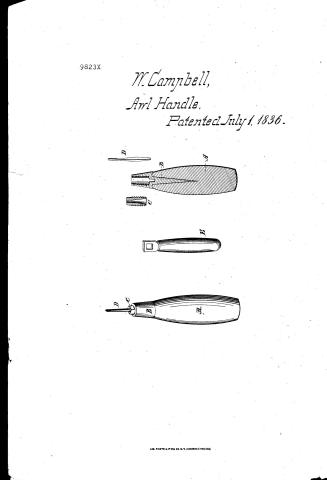
William Campbell's Patent Drawing for a Socket Shank Awl Haft

National Archives, Restored Patent Drawings (Record Group 241) · Full-size scan at the National Archives · Catalog record
Show the text on the drawing Hide (76 words)
Words on the drawing as machine-read by the National Archives; not checked. Useful mainly for searching.
145. WOOD WORKING. / 4. TOOLS. / [29 Tool Handies. / less / 145, wocd WORKING TOOLS, / #1- / Tool Handies, Socket. / WILLIAM CAMPBELL / ,Socket, Jhank / CLASSEFICA' / Awl.Haft. / Patented July 1. 1836. / 9823-4 / DIVISION. / 9823 X / 1st,1836 / Section / References. / A. the handle. / Socket shank / c nut / Patent whice May 12 1838. / and. / E The wrench. / Made under direction of the commsnouer of patents / in conformity with the act of 3.d March 1537. / MLiutworth / of
USPTO scan
The patent as scanned by the USPTO
-
 Page 1
-
 Page 2
-
 Page 3


U.S. Patent and Trademark Office · Google Patents
Show the transcription Hide (661 words)
Machine transcription (LightOnOCR) of the pages as scanned by the USPTO, most of them the handwritten copies made when the records were restored after the 1836 fire. Not checked; it can misread handwriting, so compare it with the scan.
Page 1.
9823X
W. Campbell,
Arl Handle,
Patented July 1, 1836.

A.M. PHOTO-LITHO. CO. N.Y. (OSBORNE'S PROCESS)
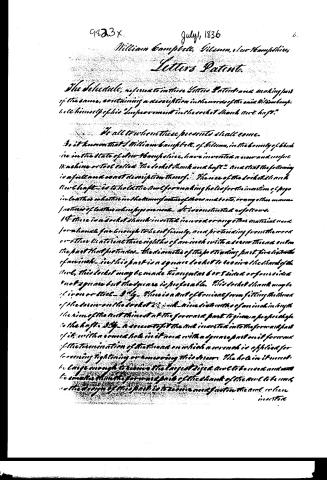
Page 2.
9423X. July 1, 1836 6.
William Campbell, Silsbee, New Hampshire
Letters Patent.
The Schedule, referred to in these Letters Patent and making part of the same, containing a description in the words of the said William Campbell himself of his "Improvement in the socket Shank Nut haft."
To all to whom these presents shall come.
Be it known that I William Campbell, of Silsbee, in the County of Grafton in the State of New Hampshire, have invented a new and useful Machine or Tool called "The Socket Shank and haft" and that the following is a full and exact description thereof. The use of the Socket Shank and haft is to hold the Nail for making holes for the insertion of pegs in leather whether in the manufacturing of shoes and boots, or any other manner of leather where pegs are used. It is constituted as follows.
1st. There is a Socket Shank inserted in wood or any other material used for a handle far enough to be set firmly, and protruding from the wood or other material three eighths of an inch with a screw thread on the part that protrudes. The diameter of the protruding part five sixteenths of an inch. In this part is a square socket to receive the Shank of the Nail, this socket may be made hexagonal or Sided or four sided but a square but the square is preferable. This Socket Shank may be of iron or steel. 2dly. There is a Nut of bronze or iron fitting the thread of the screw on the Socket 3dly. A ring with a width of an inch in length the rim of the nut thinnest at the forward part to give a proper shape to the haft. 4thly. A screw to fit the Nut inserted into the forward part of it with a round hole in it and with a square part on it forward of the termination of the thread on which a wrench is applied for turning tightening or removing this screw. The hole in it must be large enough to receive the largest sized Nail to be used and must be smaller than the forward part of the Shank of the Nail to be used so the design of this part is to be more easily inserted into the Nut when inserted.
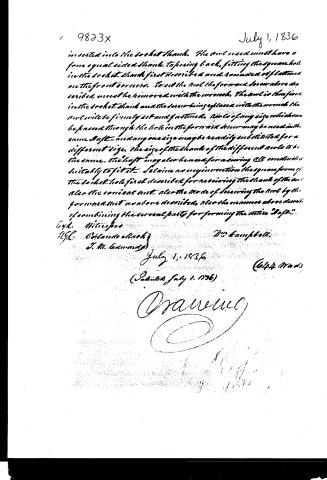
Page 3.
9823x
July 1, 1836
inserted into the socket shank. The nail used must have a four equal sided shank, tapering back, fitting the square hole in the socket shank first described and rounded or flattened on the front corners. To set the nail the forward screw above described must be honored with the wrench. The nail is then fixed in the socket shank and the screw being replaced with the wrench the nail will be firmly set and fastened. Nails of any size which can be passed through the hole in the forward screw may be used in the same shaft and any one size may be readily substituted for a different size. The size of the shank of the different nails to be the same. The shaft may also be used for sawing all constructed suitably to fit it. I claim as my invention the square form of the socket hole first described for receiving the shank of the nail also the conical nut also the mode of securing the nail by the forward screw as above described, also the manner above described of combining the several parts for forming the entire "Nail".
Exh. Witnesses
H.G. Orlando Alcock
J.M. Garroway
Wm Campbell.
July 1, 1836
(Patented July 1, 1836)
(644 words)
Drawing
Published accounts: journal notice
Notice in the monthly list of patents
Journal of the Franklin Institute, new ser., vol. 18 (1836), p. 359 · View the page
561. Awl haft. - William Campbell, Gilsum, Ν. Η.
DATAMP: illustration
Illustrations from DATAMP
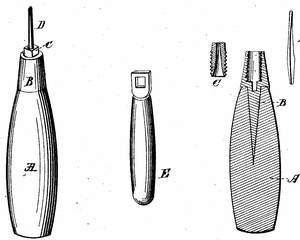

DATAMP (Directory of American Tool and Machinery Patents), via the Internet Archive · Archived DATAMP page
About this record
- Patentee
- DATAMP
- Date
- the Name and Date index of patents, DATAMP, USPTO records
- Invention
- DATAMP
- Listed in
- the Name and Date index of patents, DATAMP, USPTO records, the Journal of the Franklin Institute, Burke's List of Patents (1847)
- Burke's 1847 Patent Office list gives the same patent.