

Drawings and documents
National Archives restored drawings: drawing
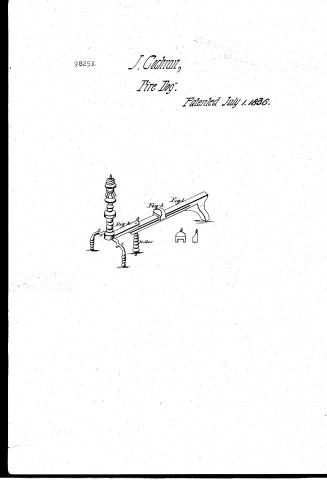
James Cochran's Patent Drawing for Andiron Bars

National Archives, Restored Patent Drawings (Record Group 241) · Full-size scan at the National Archives · Catalog record
Show the text on the drawing Hide (38 words)
Words on the drawing as machine-read by the National Archives; not checked. Useful mainly for searching.
126. ST: VER R7. VIRNACKS / [154] Fire Dogs. / CLASSITICATION / fl / 9825-t / DIVISION / 9825X / James lichran is / Patented July 1836. / Andiron Bars / Fight / Eig 3 / Fig / Hollew
USPTO scan
The patent as scanned by the USPTO
-
 Page 1
-
 Page 2
-
 Page 3


U.S. Patent and Trademark Office · Google Patents
Show the transcription Hide (454 words)
Machine transcription (LightOnOCR) of the pages as scanned by the USPTO, most of them the handwritten copies made when the records were restored after the 1836 fire. Not checked; it can misread handwriting, so compare it with the scan.
Page 1.
9825X
J. Cochran,
Fire Dog.
Patented July 1, 1836.

Page 2.
July 1, 1836
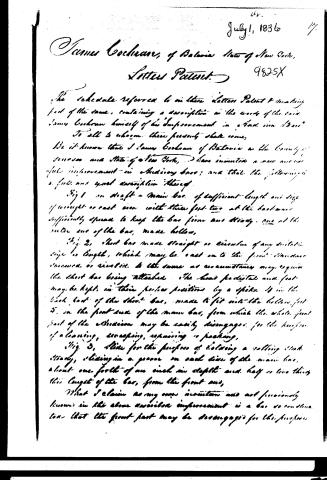
James Cochran, of Batavia, State of New York,
Letter Patent.
The schedule referred to in this Letter Patent & making
part of the same, containing a description in the words of the said
James Cochran himself of his Improvement in "Bed iron Bars"
To all to whom these presents shall come,
Be it known that I James Cochran of Batavia in the County of
Schenectady and State of New York, have invented a new and useful
improvement in Bediron bars; and that the following is
a full and exact description thereof.
Fig 1. in draft - Main bar. of sufficient length and size
if wrought or cast iron with three feet two at the back end
sufficiently spread to keep the bar firm and steady. One at the
outer end of the bar, made hollow,
Fig 2. Short bar made straight or circular of any suitable
size or length, which may be cast on to the front standard
ironed or riveted to the same as circumstances may require
the short bar being attached the head pedestal and feet
may be kept in their proper positions by a spike. If in the
back end of the short bar, made to fit into the hollow foot
D. in the front end of the main bar, from which the whole front
part of the extension may be easily disengaged for the purpose
of cleaning, scraping, repairing or packing,
Fig 3. Slides for the purpose of holding a rolling stock
steady, sliding in a groove on each side of the main bar,
about one-fourth of an inch in depth and half or two thirds
the length of the bar, from the front end,
What I claim as my own invention and not previously
known in the above described improvement is a bar so constructed
that the front part may be disengaged for the purpose
Page 3.
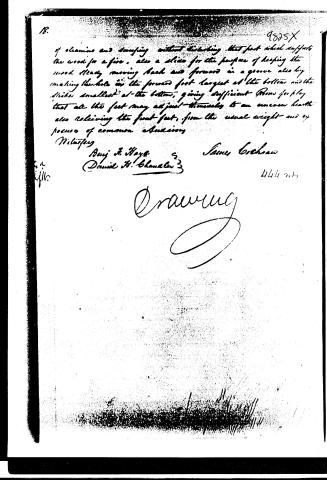
of cleaning and scraping without disturbing that part which supports the wood for a fire, also a slide for the purpose of keeping the wood steady moving back and forward in a groove also by making the hole in the forward foot largest at the bottom and the slide smallest at the bottom, giving sufficient room for play that the feet may adjust themselves to an uneven hearth also relieving the front feet from the usual weight and by means of common audacity
Witness
Benj. H. Hayes 5
Daniel H. Chandler 3
James Cochran
444 2, 87
Drawing
Published accounts: journal notice
Notice in the monthly list of patents
Journal of the Franklin Institute, new ser., vol. 18 (1836), p. 359 · View the page
549. Andiron bars.-James Cochran, Batavia, N. Y.
About this record
- Patentee
- DATAMP
- Date
- the Name and Date index of patents, DATAMP, USPTO records
- Invention
- DATAMP
- Listed in
- the Name and Date index of patents, DATAMP, USPTO records, Jim Shaw's X-patent list, the Journal of the Franklin Institute, Burke's List of Patents (1847)
- Burke's 1847 Patent Office list gives the same patent.