

Drawings and documents
National Archives restored drawings: drawing
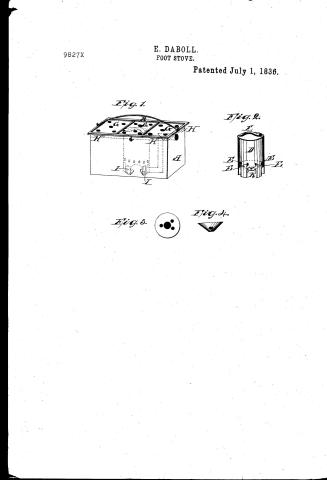
Ezekiall Daboll's Patent Drawing for a Foot Stove

National Archives, Restored Patent Drawings (Record Group 241) · Full-size scan at the National Archives · Catalog record
Show the text on the drawing Hide (134 words)
Words on the drawing as machine-read by the National Archives; not checked. Useful mainly for searching.
126. STOVES 3 FURNACKS / $ 55 / [154] Food Warmers. / 9827.4 / DDVI / 9827X / Erehull Dabell / Foot allow / Patented the 1 July 1836. / Aig. / 1. / Aig... 2. / 900000 / F. E E E Holes in the side of the furnace / His / 1. A The box of Jin or some thin metal. / G F G Holes Elliptic the top spring of the lid. / B The woccen Frame. / C Hope for admission etthes airwith the tube / H. H / of the H Ct the dotted edges. in line, shows Made the turning under down the direction of the of / Patent offer 1838, / sig 2. D The furnace. / k¹ The The conceve upsets bottom or stays. by the furnace / Stig.3 Tapoico of the concave bottom: / Patents use comformity with 3. March 1837 / Stig. 1. Jideview of the toncave bottom. / Commistrom of Patents
USPTO scan
The patent as scanned by the USPTO
-
 Page 1
-
 Page 2
-
 Page 3


U.S. Patent and Trademark Office · Google Patents
Show the transcription Hide (840 words)
Machine transcription (LightOnOCR) of the pages as scanned by the USPTO, most of them the handwritten copies made when the records were restored after the 1836 fire. Not checked; it can misread handwriting, so compare it with the scan.
Page 1.
9827X
E. DABOLL.
FOOT STOVE.
Patented July 1, 1836.
Fig. 1.
Fig. 2.
Fig. 3.
Fig. 4.
Page 2.
9827x
July 1, 1836
Enckiel Daboll. of Ganaan. State of Connecticut.
Letters Patent.
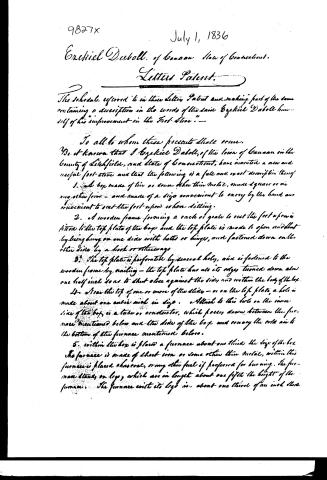
The schedule referred to in these Letters Patent and making part of the same containing a description in the words of the said Ezekiel Daboll himself of his "improvement in the Foot-Stone."
To all to whom these presents shall come.
Be it known that I Ezekiel Daboll, of the town of Ganaan in the County of Litchfield, and State of Connecticut, have invented a new and useful foot-stone and that the following is a full and exact description thereof.
1. A box made of tin or some other thin metal, square or in any other form — and made of a size convenient to carry by the hand and convenient to set the foot upon when sitting.
2. A wooden frame forming a rack or grate to rest the feet upon is fitted to the top plate of the box and the top plate is made to open and shut by being hung on one side with bolts or hinges, and fastened down on the other side by a hook or otherwise.
3. The top plate is perforated by several holes, and is fastened to the wooden frame by nailing — the top plate has all its edges turned down about one half inch so as to shut close against the sides and within the box of the box.
4. Near the top of one or more of the sides — or on the top plate, a hole is made about one entire inch in size. Attached to this hole on the inner side of the box is a tube or conductor, which passes down between the furnace mentioned below and the sides of the box and conveys the cold air to the bottom of the furnace mentioned below.
5. Within the box is placed a furnace about one third the size of the box. The furnace is made of sheet iron or some other thin metal, within this furnace is placed charcoal, or any other fuel if preferred for burning. The furnace stands on legs, which are in length about one fifth the height of the furnace. The furnace with its legs is about one third of an inch thick.
Page 3.
July 1, 1836
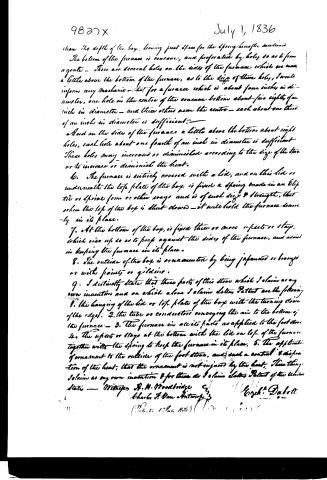
than the depth of the box, leaving just space for the spring hereafter mentioned. The bottom of the furnace is concave, and perforated by holes so as to form a grate. There are several holes on the sides of the furnace which are made a little above the bottom of the furnace, as to the size of these holes, I would inform any mechanic that for a furnace which is about four inches in diameter, one hole in the centre of the concave bottom about five-eighths of an inch in diameter, and three others near the centre, each about one-third of an inch in diameter is sufficient.
And on the sides of the furnace a little above the bottom about eight holes, each hole about one-fourth of an inch in diameter is sufficient. These holes may increase or diminish according to the size of the stove or to increase or diminish the heat.
6. The furnace is entirely covered with a lid, and on this lid or underneath the top plate of the box is fixed a spring made in an elliptic or spiral form or other ways and is of such size & strength, that when the top of the box is shut down it will hold the furnace securely in its place.
7. At the bottom of the box, is fixed three or more uprights or stays, which rise up so as to prop against the sides of the furnace, and assist in keeping the furnace in its place.
8. The outside of the box is ornamented by being japanned or bronzed or with paints or gilding.
9. I distinctly state that those parts of this stove which I claim as my own invention and on which alone I claim letters Patent are the following: 1. The hanging of the lid or top plate of the box with the turning down of the edges. 2. The tube or conductor conveying the air to the bottom of the furnace. 3. The furnace in all its parts as applied to the foot stove. 4. The uprights or stays at the bottom with the lid on top of the furnace together with the spring to keep the furnace in its place. 5. The application of ornament to the outside of the foot stove, and such a control & disposition of the heat; that the ornament is not injured by the heat. These things I claim as my own invention & for these do I claim Letters Patent of the United States.
Witness, A. H. Woodbridge
Charles H. Van Antwerp
Joseph Daboll
Published accounts: journal notice
Notice in the monthly list of patents (listed with a different spelling or date)
Journal of the Franklin Institute, new ser., vol. 18 (1836), p. 359 · View the page
Foot stove. Ezekiel Duball, Canaan, Conn.
About this record
- Patentee
- DATAMP
- Date
- the Name and Date index of patents, DATAMP, USPTO records
- Invention
- DATAMP
- Listed in
- the Name and Date index of patents, DATAMP, USPTO records, Jim Shaw's X-patent list, the Journal of the Franklin Institute, Journal, Burke's List of Patents (1847)
- Also listed in a contemporary journal or list under a different spelling or date; the record shown follows the standard lists.
- Burke's 1847 Patent Office list gives the same patent.