

Drawings and documents
National Archives restored drawings: drawing
Septimus Tucker's Patent Drawing for a Washing and Wringing Machine

National Archives, Restored Patent Drawings (Record Group 241) · Full-size scan at the National Archives · Catalog record
Show the text on the drawing Hide (102 words)
Words on the drawing as machine-read by the National Archives; not checked. Useful mainly for searching.
SEPTIMUS TUCKER / LAUNDRY. / Wash POUNCERS. ng Mach's / Hashing S Wringing. Mach / cetive Je Machine / $250 / Patented Jan-12 1809 / CLASS STATION / 983 / DIVISION. / Section through Dasher / section through pivots. / D. / part / Perspective of wringing Box, / follower, ana propsing Liever. / OIR / E' / Washing / -wringing / Patent office 14th July / or trough. / F. Box.for wringing / G Rounds of Din / Made under the direction of the Crimist / H. Prejser or Follower / at bars of Dasher serving for Hanales / I. or I / Patents in conformity with act 3 March 183 / at bottom of Dasher / Commissio
USPTO scan
The patent as scanned by the USPTO
-
 Page 1
-
 Page 2
-
 Page 3


U.S. Patent and Trademark Office · Google Patents
Show the transcription Hide (599 words)
Machine transcription (LightOnOCR) of the pages as scanned by the USPTO, most of them the handwritten copies made when the records were restored after the 1836 fire. Not checked; it can misread handwriting, so compare it with the scan.
Page 1.
983X
No Printed Specification Available
S. Tucker,
Washing Machine,
Patented Jan. 7, 1809
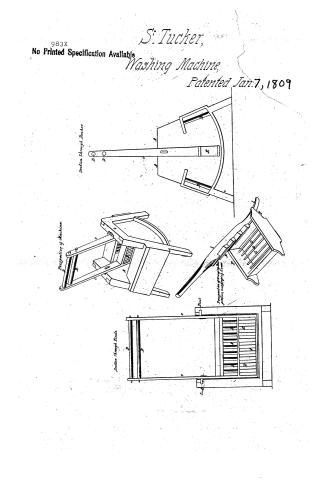
Section through Washer
Perspective of Machine
Perspective of Washing Machine, showing, and showing Lever
Section through Racks
Page 2.
June 12, 1809
Septimus Tucker
Letters Patent
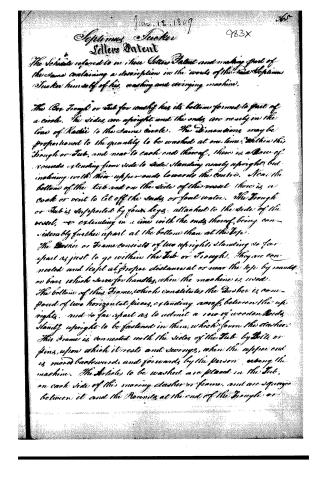
The Schedule referred to in these Letters Patent and making part of the same containing a description in the words of the said Septimus Tucker himself of his washing and wringing machine.
The Box Trough or tub for washing has its bottom formed to part of a circle. The sides are upright and the ends are nearly in the line of Radii to the same circle. The Dimensions may be proportional to the quantity to be washed at one time. Within this Trough or Tub, and near to each end thereof, there is a Row of rounds extending from side to side, standing nearly upright, but inclining with their upper ends towards the centre. Near the bottom of the tub and on the side of the vessel there is a cock or vent to let off the suds or foul water. The Trough or Tub is supported by four legs, attached to the side of the vessel, extending in a line with the ends thereof, being considerably further apart at the bottom than at the top.
The Dasher or Frame consists of two uprights standing so far apart as just to go within the Tub or Trough. They are connected and kept at proper distance at or near the top by rounds or bars, which serve for handles, when the machine is used.
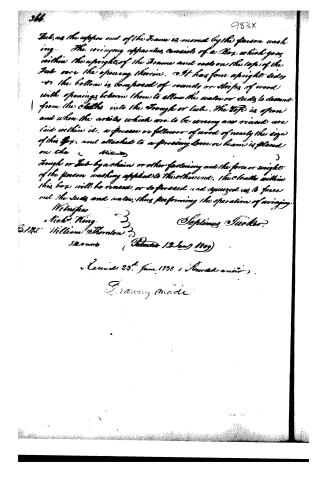
The bottom of this Frame, which constitutes the Dasher is composed of two horizontal pieces, extending across between the uprights, and so far apart as to admit a row of wooden Beads, standing upright to be fastened in them, which form the clasher. This Frame is connected with the sides of the Tub by Bolts or pins, upon which it rests and swings, when the upper end is moved backwards and forwards by the person using the machine. The Articles to be washed are placed in the Tub, on each side of the moving clasher or frame, and are squeezed between it and the Rounds at the end of the Trough or
Page 3.
366. 983X
Tub, as the upper end of the frame is moved by the person washing. The wringing apparatus consists of a Box which goes within the uprights of the frame and rests on the top of the Tub over the opening therein. It has four upright sides and the bottom is composed of rounds or strips of wood with openings between them to allow the water or suds to descend from the clothes into the Trough or tub. The top is open and when the articles which are to be wrung are rinsed are laid within it, a press or follower of wood of nearly the size of this Box, and attached to a pressing lever or beam is placed on the Trough or Tub by a chain or other fastening and the force or weight of the person washing applied to the other end, the clothes within this box will be rinsed or so pressed and squeezed as to force out the suds and water, thus performing the operation of wringing.
Witnesses
Nich. King
William Thornton
Septimus Tucker.
52 pounds (Patented 12 Jan 1809)
Recorded 23rd June 1808 & Recorded anew.
Drawing made
About this record
- Patentee
- DATAMP
- Date
- the Name and Date index of patents, DATAMP, Burke's List of Patents (1847)
- Invention
- DATAMP
- Listed in
- the Name and Date index of patents, DATAMP, USPTO records, Jim Shaw's X-patent list, S. A. Elliot's printed list of patents, Burke's List of Patents (1847)
- The sources give different dates; the date shown is the one most of them agree on.
- S. A. Elliot's printed list of patents gives the same name and date.
- Burke's 1847 Patent Office list gives the same patent.