

Drawings and documents
National Archives restored drawings: drawing
R.A. Ives Patent Drawing for a Method of Manufacturing Metallic Combs

National Archives, Restored Patent Drawings (Record Group 241) · Full-size scan at the National Archives · Catalog record
Show the text on the drawing Hide (80 words)
Words on the drawing as machine-read by the National Archives; not checked. Useful mainly for searching.
1/21 / Cambs- upapl / 132, / Combs. / RAVES / 9832.7 / DIVISION. / Manufactuning Metalic Combs / shower you guty 1836 / 9832X / Plan / A Plate Top or back of the Comb / B. Bent were forming 2 teeth / Plate closed upon / Insideor Concave surface / Showing over leeths the plate partly beut / teeth / C. / side / side / stricklands / Patent office Junw 30 1843 / are 25.1g 221 / Made under the direction of the Patent / in comformity with ach of 3' March 1837. / Commission Patrul
USPTO scan
The patent as scanned by the USPTO
-
 Page 1
-
 Page 2
-
 Page 3
-
 Page 4


U.S. Patent and Trademark Office · Google Patents
Show the transcription Hide (894 words)
Machine transcription (LightOnOCR) of the pages as scanned by the USPTO, most of them the handwritten copies made when the records were restored after the 1836 fire. Not checked; it can misread handwriting, so compare it with the scan.
Page 1.
9832X
R. A. Ives.
Comb.
Patented July 1, 1836.
No.

Page 2.
July 1, 1836 22 98327
Richard Allison, Jr., Bristol, Connecticut.
Letters Patent.
The schedule referred to in these Letters Patent, and making part of the same containing a description in the words of the said Richard Allison, Jr., himself of his improvement in the mode of manufacturing metallic combs.
To all to whom these presents shall come.
Be it known that I Richard Allison, Jr., of Bristol in the county of Hartford and state of Connecticut, have invented a new and useful improvement in the mode of making and manufacturing metallic combs, that is in the manner of placing and confining the teeth to the plate, top or back of the comb, and that the following is an exact description thereof.
Take a thin metallic plate suitable for the top or back of the comb. On that part of the plate in which the teeth are to be placed and confined, and which is to be the lower side of the back when finished, with a suitable wedge.
I make impressions for the teeth to be placed in lengthwise. These impressions or places for the teeth must be of a proper size according to the shape of the teeth so that the teeth will exactly fit in and fill the places when drawn up by that part of the plate to be turned up and clamped upon the teeth, with similar impressions as hereafter described. At suitable distances from each other and at a proper distance from the lower edge of the plate, I make a line of holes through the plate, the whole length of it, of the shape of the teeth for them to be passed through.
The teeth are made of some metallic wire of a size required, according to the shape of the comb. A piece of
Page 3.
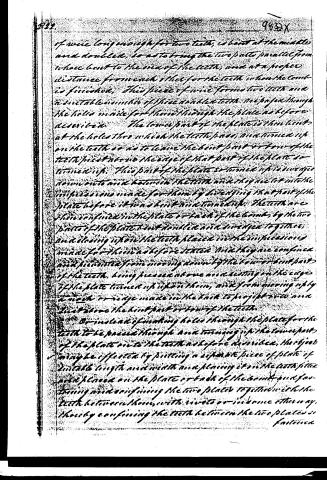
of wire long enough for two teeth, is bent at the middle and doubled, so as to bring the two parts parallel from where bent to the end of the teeth, and at a proper distance from each other for the teeth when the comb is finished. This piece of wire forms two teeth and a suitable number of fine doubled teeth. No paper through the holes made for them through the plate as before described. The lower part of the plate is then bent at the holes through which the teeth pass, and turned up on the teeth so as to leave the bent part or two of the teeth just above the edge of that part of the plate so turned up. This part of the plate so turned up is diverged down into and between the teeth and they are let into the impressions made for them by diverging that part of the plate before it was bent and turned up. The teeth are then confined in the plate or back of the comb, by the two parts of the plate bent doubled and diverged together, and closing upon the teeth placed in the impressions made for them as before stated. And they are confined and prevented from moving down by the lower bent part of the teeth, being pressed above and resting on the edge of the plate turned up upon them, and from moving up by a notch or ridge made in the back to project over and just above the bent part or two of the teeth.
Or instead of making holes through the plate for the teeth to be passed through and turning up the lower part of the plate on to the teeth as before described, the object may be effected by putting a separate piece of plate of suitable length and width and placing it in the teeth after being placed on the plate or back of the comb and fastening and confining the two plates together with the teeth between them, with wire or in some other way, thereby confining the teeth between the two plates so fastened.
Page 4.
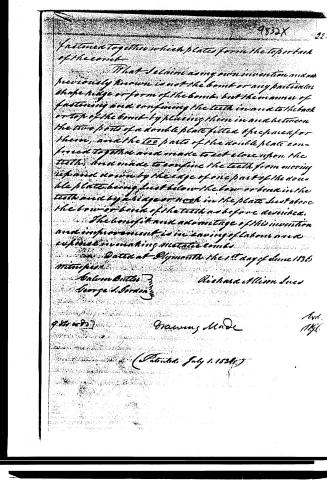
fastened together which plates form the top or back of the comb.
That I claim as my own invention and as previously known is not the comb or any particular shape, ridge or form of the comb, but the manner of fastening and confining the teeth in an arc to the back or top of the comb by placing them in and between the two parts of a double plate fitted & prepared for them, and the two parts of the double plate conjoined together and made to act close upon the teeth, and made to confine the teeth from moving upward or down by the edge of one part of the double plate being just below the base or back in the teeth and by a ridge or notch in the plate just above the base or back of the teeth as before described.
The benefit and advantage of this invention and improvement is in saving of labour and expense in making metal combs.
Dated at Plymouth the 1st day of June 1836
Witnesses:
Salmon Butler
George S. Gordon
Richard Allen Sues
Drawing Made
(Patented July 1, 1836)
About this record
- Patentee
- DATAMP
- Date
- the Name and Date index of patents, DATAMP, USPTO records
- Invention
- DATAMP
- Listed in
- the Name and Date index of patents, DATAMP, USPTO records, Jim Shaw's X-patent list, Burke's List of Patents (1847)
- Burke's 1847 Patent Office list gives the same patent.