

Drawings and documents
National Archives restored drawings: drawing
E. Smith's Patent Drawing for a Machine for Building and Making Chimneys and Ovens

National Archives, Restored Patent Drawings (Record Group 241) · Full-size scan at the National Archives · Catalog record
Show the text on the drawing Hide (60 words)
Words on the drawing as machine-read by the National Archives; not checked. Useful mainly for searching.
126, STOV s&FURNA / (154) omestic Ovens / #9845X / E' SMITH / CLASSIFICATION / Building E making chimneyseovens / 9845X / DIVISION. / day 1-1836 / A Cord articles / A Hollow since / 0 perpen dicular propers or Flues / D. Damner government the Clinic / F over / Pal / Made under the direction / with ach 734 March 1834
USPTO scan
The patent as scanned by the USPTO
-
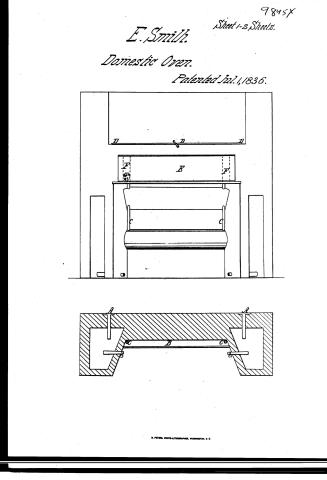 Page 1
-
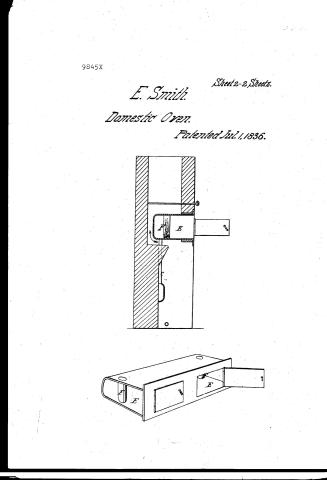 Page 2
-
 Page 3
-
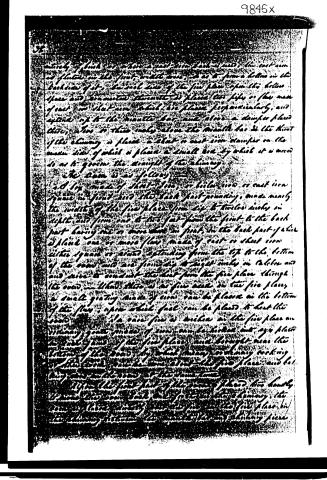 Page 4
-
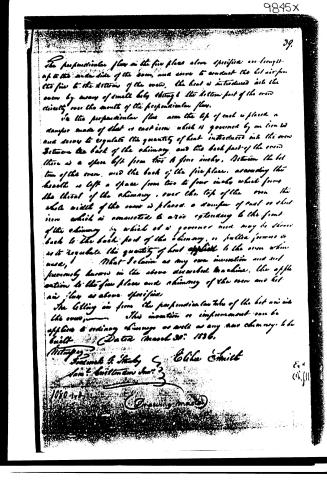 Page 5


U.S. Patent and Trademark Office · Google Patents
Show the transcription Hide (1,072 words)
Machine transcription (LightOnOCR) of the pages as scanned by the USPTO, most of them the handwritten copies made when the records were restored after the 1836 fire. Not checked; it can misread handwriting, so compare it with the scan.
Page 1.
9845X
Sheet 1-2 Sheets.
E. Smith.
Domestic Oven.
Patented Jul. 1, 1836.

R. PETERS, PHOTO-LITHOGRAPHER, WASHINGTON, D.C.
Page 2.
9845X
Sheet 2-2 Sheets.
E. Smith.
Domestic Oven.
Patented Jul. 1, 1836.

Page 3.
July 1, 1836
9845x
Oblin Smith of New York, N.Y.
Letter Patent.
The subscriber, in reference to a Letter Patent and making part of the same, containing an invention on the back of the said Letter, claims himself of the improvement in building and making Chimneys and Stoves.
To all whom these presents shall come,
Be it known that I, Oblin Smith, of the town of Sharon in the County of Ulster, in the State of New York, have invented a new and useful improvement in the building and making of Chimneys and Stoves, for home, and that the following is a full and exact description thereof:
Flues made of cast iron or some other metal, are placed between the joints and floor, where the hearth to the fire place is placed, so that the flues to the chimney are made hollow, and a small grating is placed on the outside of the house, each end of the flues, by which ends are passed, between the floor and roof, and making them the hollow joints of the fire place, in which the flues are placed, serving to create a draught of air out of the fire place by means of the flues, into the ends of the flues at the ends of the fire place and both ends, a place or grating to regulate the admission of air through the joints outside of the house, at the ends of the flues, at the ends of the flues, and the flues are placed a small iron grating, the joints of the chimney must be so hollow at the height of one foot or more according to the size of the fire place, and in the back of the fire place, so that the heat from the hearth, through the fire place and into the flues, and the heat from the flues, in which the flues are placed, is made.
Page 4.
entirely of brick or where a cast-iron back is used, the cast-iron is fluted on the front with bars, and so to form a bottom in the backside of it, but not line of the fire place upon this bottom space and connected therewith to place two pipes or flues made of cast-iron sheet-iron which are placed perpendicularly, and extend up to the mouth bar, and above a damper placed there, also so three inches above the mouth bar in the throat of the chimney is placed a sheet or cast-iron damper on the inner side of which is placed a small box by which it is moved so as to govern the draught of the chimney.
The Door is as follows:—
A box made of sheet-iron, or boiler-iron or cast-iron square in front and the back part pounding, made nearly the width of the fire place from six to twelve inches in depth and from one to two feet from the front to the back part having one or more doors in front in the back part of which is placed one or more flues made of cast- or sheet-iron either square or round extending from the top to the bottom of the oven and are from six to ten inches in caliber and are used to conduct the heat from the fire place through the oven, and when there is no fire used in the fire place, a small grating made of iron can be placed in the bottom of the flue, upon which fuel can be placed to heat the oven.
In case fire is wished in the fire place an ordinary grate made of iron can be locked out, and placed in each part of the fire place and brought near the bottom of the oven, by which means ordinary cooking or other work can be done about the fire place and baking done in the oven at the same time.
If from the front part of the oven is placed two hands it must be so arranged that one of them in the chimney, the other is placed directly over the fire in the fire place, in the chimney between the mouth bar and chimney piece
Page 5.
9845x
39.
The perpendicular flues in the fire places above specified are brought up to the under side of the oven, and serve to conduct the hot air from the fire to the bottom of the oven. The heat is introduced into the oven by means of small holes through the bottom part of the oven directly over the mouth of the perpendicular flues.
In the perpendicular flues near the top of each is placed a damper made of sheet iron or cast iron which is governed by one iron rod and serves to regulate the quantity of heat introduced into the oven. Between the back of the chimney and the back part of the oven there is a space left from two to four inches. Between the bottom of the oven and the back of the fire place, according to the height is left a space from two to four inches which forms the throat of the chimney. Over the top of the oven the whole width of the oven is placed a damper of cast or sheet iron which is connected to a rod extending to the front of the chimney in which it is governed and may be thrown back to the back part of the chimney, so that a person can so it regulate the quantity of heat applied to the oven when used.
What I claim as my own invention and not previously known in the above described machine, the application to the fire place and chimney of the oven and hot air flues as above specified.
The lifting air from the perpendicular tubes of the hot air into the oven. This invention or improvement can be applied to ordinary chimneys as well as any new chimney to be built.
Dated March 30th 1836.
Witnesses:
Samuel R. Sturdy & Elise Smith
Samuel Britton
1050 1/2
Drawing marked
64
(Ch. 11)
Published accounts: journal notice
Notice in the monthly list of patents
Journal of the Franklin Institute, new ser., vol. 18 (1836), p. 359 · View the page
564. Chimneys, ovens, &c.-Elisha Smith, Ithaca, N. Y.
About this record
- Patentee
- DATAMP
- Date
- the Name and Date index of patents, DATAMP, USPTO records
- Invention
- DATAMP
- Listed in
- the Name and Date index of patents, DATAMP, USPTO records, Jim Shaw's X-patent list, the Journal of the Franklin Institute, Burke's List of Patents (1847)
- Burke's 1847 Patent Office list gives the same patent.