

Drawings and documents
National Archives restored drawings: drawing
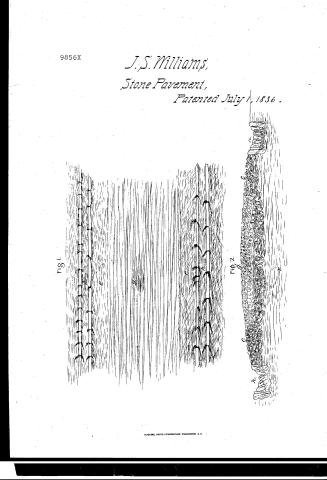
Ino L. William's Patent Drawing for a Method of Road Making

National Archives, Restored Patent Drawings (Record Group 241) · Full-size scan at the National Archives · Catalog record
Show the text on the drawing Hide (78 words)
Words on the drawing as machine-read by the National Archives; not checked. Useful mainly for searching.
94. PAVING. / (110] Stone Pavements. / DIV. 15 / pipe / 9856.4 / Stone Patented July i / 1836. / DIVISION. / 9856 x / Vel.21:14.39y. / Read making. / Aight / stis.2. / Flow / References. Aig. i improad 20ad. / Patent office has 22 1845 / Tis. 2 sectional view IV / mad. nudu th direction aftern Commitioner / e. e. the edging f. bed layer. g. the prepared stone of butents 31 march in 1807 conformity with act / i. the earth. / of / Scmanthroung - / Commission patent
USPTO scan
The patent as scanned by the USPTO
-
 Page 1
-
 Page 2
-
 Page 3


U.S. Patent and Trademark Office · Google Patents
Show the transcription Hide (652 words)
Machine transcription (LightOnOCR) of the pages as scanned by the USPTO, most of them the handwritten copies made when the records were restored after the 1836 fire. Not checked; it can misread handwriting, so compare it with the scan.
Page 1.
9856X
J. S. Williams,
Stone Pavement,
Patented July 1, 1836.
Fig. 1.
Fig. 2.
H. PETERS, PHOTO-LITHOGRAPHER, WASHINGTON D. C.
Page 2.
7/1/1836 9856X
July 1, 1836
Geo. S. Williams of Fulton Township, Ohio
Letters Patent
The Schedule referred to in these Letters Patent and making part of the same, containing a description in the words of the said Geo. S. Williams himself, of his improvement in the art of Road making:
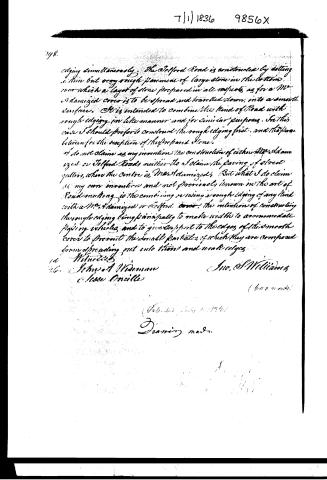
To all to whom these presents shall come. Be it known, that I, Geo. S. Williams of Fulton Township in Hamilton County and State of Ohio, have invented a new and useful improvement in the art of Road making and that the following is a full and exact description thereof. I prepare stone in the usual manner for the construction of a Macadamized cover by reducing it to particles not exceeding a specified maximum weight or size. I then prepare the bed of the Road in the usual manner by laying on the stone cover. But instead of making the Macadamized cover of the usual with the it is to be laid in a manner which an edging of rough stone or gravel is to be added to each side to make out the intended width of cover. It is not intended to confine the Road matter to any specific model of combining the smooth cover with the rough edging but the method I prefer is this. After the bed is prepared to receive the prepared stone, let a layer of it be laid, but before it is rolled or trolled let a rough edging be laid on each side thick enough to receive the full Macadamized cover after it is consolidated. For a Macadamized cover laid as soon as 8 or 9 inches of edging will be sufficient thickness which may be the same as the stone edges. If this edging is to be of common flint or solid, no further labor need be necessary. But if the edging is to be of rubble stone it will be necessary to provide it with ridges or long handled hammers, until the top stones are reduced to a convenient size, say not exceeding three inches in greatest dimensions. If the edging be of gravel it will be necessary to lay it in layers not exceeding the thickness of the layers of stone for the center cover and to roll both center and
Page 3.
7/11/1836 9856X
198.
edging simultaneously. The Telford Road is constructed by setting a thin but very rough pavement of large stone in the bottom, over which a layer of stone prepared in all respects as for a Macadamized cover is to be spread and travelled down, into a smooth surface. It is intended to combine this kind of Road with rough edging in like manner and for similar purposes. In this case I should prefer to construct the rough edging first, and the pave between for the reception of the prepared stone.
I do not claim as my invention the construction of either the old macadamized or Telford Roads, neither do I claim the paving of street gutters, where the centre is Macadamized. But what I do claim as my own invention and not previously known in the art of Road making, is the combining or using a rough edging of any kind with a Macadamized or Telford cover. The intention of constructing the rough edging being principally to make width to accommodate plying vehicles, and to give support to the edges of the smooth cover to prevent the small particles of which they are composed from spreading out into them and weak edges.
W. Williams
John A. Wideman
C. Isaac O'Neill
Jno. S. Williams
(600 words)
(Dated July 1, 1836)
Drawing made.
Published accounts: journal notice
Notice in the monthly list of patents
Journal of the Franklin Institute, new ser., vol. 18 (1836), p. 359 · View the page
546. Frieze window, &c.-William Wooley, N. Y.
About this record
- Patentee
- DATAMP
- Date
- the Name and Date index of patents, DATAMP, USPTO records
- Invention
- DATAMP
- Listed in
- the Name and Date index of patents, DATAMP, USPTO records, Jim Shaw's X-patent list, the Journal of the Franklin Institute, Burke's List of Patents (1847)
- The Franklin Institute's journal spells the name differently.
- Burke's 1847 Patent Office list gives the same patent.