

Drawings and documents
USPTO scan
The patent as scanned by the USPTO
-
 Page 1
-
 Page 2
-
 Page 3
-
 Page 4


U.S. Patent and Trademark Office · Google Patents
Show the transcription Hide (845 words)
Machine transcription (LightOnOCR) of the pages as scanned by the USPTO, most of them the handwritten copies made when the records were restored after the 1836 fire. Not checked; it can misread handwriting, so compare it with the scan.
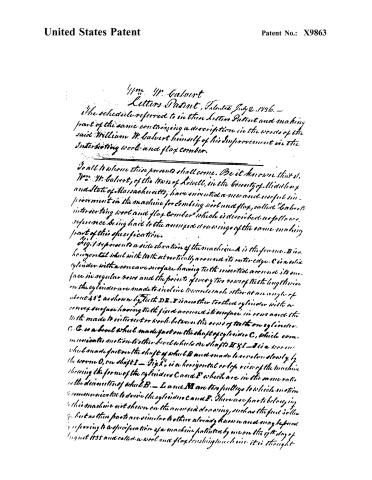
Page 2.
United States Patent
Patent No.: X9863
Wm. W. Calvert
Letters Patent, Patent July 2, 1836.
The schedule referred to in this Letters Patent and making part of the same containing a description in the words of the said William W. Calvert himself of his Improvement in the Intersecting Wool and Flax Comber.
To all to whom these presents shall come. Be it known that I, Wm. W. Calvert, of the town of Lowell, in the County of Middlesex and State of Massachusetts, have invented a new and useful improvement in the machine for combing wool and flax, called "Calvert's intersecting wool and flax Comber" which is described as follows, reference being had to the annexed drawings of the same making part of this specification.
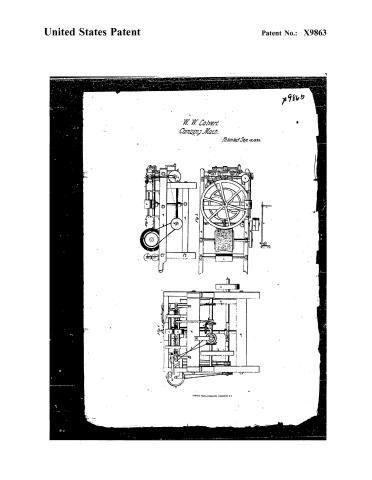
Fig. 1 represents a side elevation of the machine. A is the frame. B is a horizontal wheel with teeth set vertically around its outer edge. C is a solid cylinder with a concave surface having teeth inserted around its surface in regular rows and the points of every two rows of teeth lengthwise on the cylinder are made to incline towards each other at an angle of about 45°, as shown by Teeth DE. F is another toothed cylinder with a convex surface having teeth fixed around its surface in rows and the teeth made to intersect or work between the rows of teeth on cylinder C. G is a bevel wheel made fast on the shaft of cylinder C, which communicates motion to other bevel wheels on shafts H & I. J is a worm wheel made fast on the shaft of wheel B and made to revolve slowly by the worm O, on shaft I. Fig. 2 is a horizontal or top view of the machine showing the form of the cylinders C and F which are in the same ratio as the diameters of wheel B. L and M are two pulleys to which motion is communicated to drive the cylinders C and F. There are parts belonging to this machine not shown on the annexed drawing, such as the feed rollers, but as these parts are similar to those already known and may be found referring to a specification of a machine patented by me on the 9th day of August 1835 and called a wool and flax brushing machine, it is thought
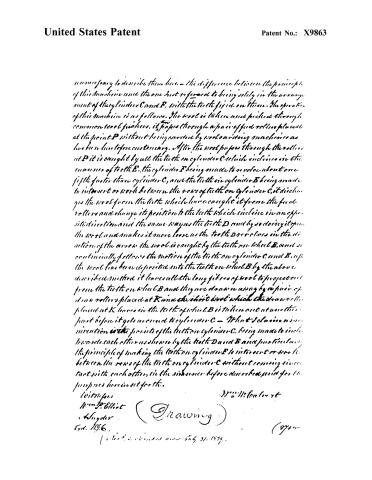
Page 3.
United States Patent
Patent No.: X9863
It is unnecessary to describe them here — the difference between the principle of this machine and the one last referred to being solely in the arrangement of the cylinders C and E, with the teeth fixed on them. The operation of this machine is as follows. The wool is taken and picked through common wool pickers, it passes through a pair of feed rollers placed at the point P without being carried by wool carding machines as has been heretofore customary. After the wool passes through the rollers at P it is caught by all the teeth on cylinder C which incline in the manner of teeth E, the cylinder E being made to revolve about one fifth faster than cylinder C, and the teeth in cylinder E being made to intervert or work between the rows of teeth on cylinder C, it discharges the wool from the teeth which have caught it from the feed rollers and change its position to the teeth which incline in an opposite direction and the same way as the teeth D and by so doing it opens the wool and makes it more loose as the teeth D revolve in the direction of the arrows the wool is caught by the teeth on wheel B, and so continually follows the motion of the teeth on cylinder C and B, until the wool has been deposited into the teeth on wheel B by the above described method it leaves all the long fibers of wool to project out from the teeth on wheel B and they are drawn away by a pair of draw rollers placed at R and the short wool which the draw rollers placed at K leaves in the teeth of wheel B is taken out at another point before it gets around to cylinder C — What I claim as my invention is the points of the teeth on cylinder C, being made to incline towards each other as shown by the teeth D and E and particularly the principle of making the teeth on cylinder E to intervert or work between the rows of the teeth on cylinder C without coming in contact with each other in the manner before described and for the purposes herein set forth.
Witnesses
Wm. P. Elliot
L. Snyder
Feb. 11, 1856.
(Drawing)
Wm. H. Calvert
(9700)
(Filed and allowed June 21, 1856.)
Page 4.
United States Patent
Patent No.: X9863
W. W. Calvert.
Combing Mach.
Patented Sept. 18, 1895.

Published accounts: journal notice
Notice in the monthly list of patents
Journal of the Franklin Institute, new ser., vol. 18 (1836), p. 359 · View the page
594. Wool and flax comber. William W. Calvert, Lowell, Mass.
About this record
- Patentee
- DATAMP
- Date
- the Name and Date index of patents, DATAMP, USPTO records
- Invention
- DATAMP
- Listed in
- the Name and Date index of patents, DATAMP, USPTO records, Jim Shaw's X-patent list, the Journal of the Franklin Institute, Burke's List of Patents (1847)
- Burke's 1847 Patent Office list gives the same patent.