

Drawings and documents
National Archives restored drawings: drawing
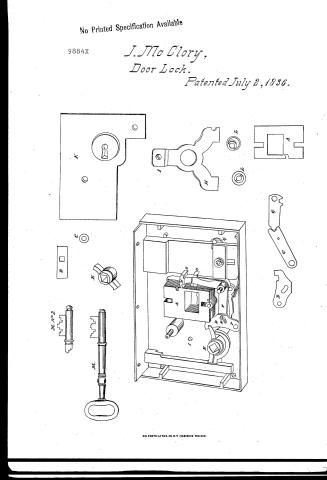
James McClory's Patent Drawing for a fornt Door Lock

National Archives, Restored Patent Drawings (Record Group 241) · Full-size scan at the National Archives · Catalog record
Show the text on the drawing Hide (43 words)
Words on the drawing as machine-read by the National Archives; not checked. Useful mainly for searching.
TCHES. / [93] Locks. / 20.10 / LATOHES, / Latches & tanton LOURD / Combined. / #2- / Looks / Combined. / 9884X JAMES / 11 / Front Door Lock / CLASSIFICATION / Ristored / 9884X / DIVISION. / Patented;" July 1836 / M.V.2 / Why / HI
USPTO scan
The patent as scanned by the USPTO
-
 Page 1
-
 Page 2
-
 Page 3
-
 Page 4


U.S. Patent and Trademark Office · Google Patents
Show the transcription Hide (696 words)
Machine transcription (LightOnOCR) of the pages as scanned by the USPTO, most of them the handwritten copies made when the records were restored after the 1836 fire. Not checked; it can misread handwriting, so compare it with the scan.
Page 1.
No Printed Specification Available
9884X
J. Mc Clory,
Door Lock.
Patented July 2, 1886.

A.M. PHOTO-LITHO. CO. N.Y. (OSBORNE'S PROCESS)
Page 2.
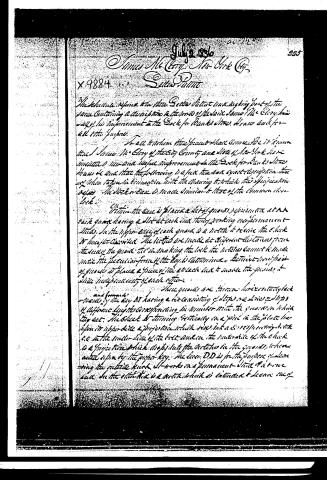
July 2, 1856
James McCloy, New York City
X 9884
Sutton Patent
The subscriber, James McCloy, of the City of New York, New York, hereby declares that he has invented a new and useful improvement in the Lock for Banks, Stores, Houses, &c., and that the following is a full and exact description thereof, which taken in connection with the drawing to which this specification refers, will enable any person skilled in the art to make and use the same.
Within the case is placed a set of guards, represented at AA, each guard having a slot at each end, thereby forming a continuous strip. In the upper edge of each guard is a notch to receive the chuck of the key. The notches are made at different distances from the ends of the guards, thereby enabling the lock to be set to different heights. The guards are made of a material which will not rust …
Page 3.
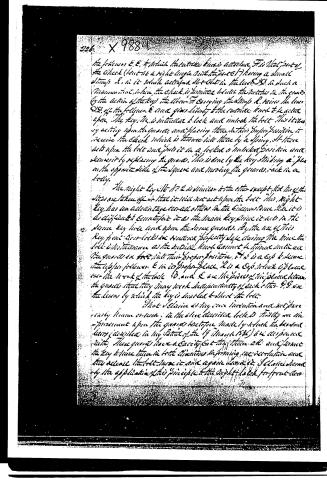
the followers E. E. to which the outside knob is attached. This that part of the clock (but at a right angle with the part of F) having a small strip L, in it which extends slot-out in the lever O. O. is such a dimension that when the clock is inverted, to enter the notches in the guards (by the action of the key) the lever F carrying the strip L, raises the lever O. O. off the follower E and gives liberty to the outside knob to be acted upon. The key, M, is inserted to lock and unlock the bolt. This is done by acting upon the guards, and placing them in their proper position to receive the clock which is thrown into them by a spring. It there acts upon the bolt and puts it in a locked or unlocked position and secures it by replacing the guards. This is done by the key striking a plate on the opposite side of the square and moving the guards back in a bodily.
The night key M' is similar to the other except that two of the slots are taken off so that it will not act upon the bolt. This night key has an advantage over all others in the circumstance that it is as difficult to counterfeit it as the main key since it acts in the same key hole and upon the same guards. By the use of this key, false door locks are rendered perfectly safe during the time the bolt is withdrawn as the outside knob cannot be turned unless the guards are first put into their proper position. It is a cap to secure the upper follower E is in proper place. It is a cap which is placed over the work of the lock B, and C are the pieces of the place between the guards that they may work independently of each other. O. O. are the levers by which the key is enabled to throw the bolt.
That I claim as my own invention and not previously known or used, is the above described lock. D. Firstly are the movements upon the guards to throw them by which the bolt is being described in my Patent of the 19 March 1856, but dispensed with. These guards have a cavity cut into them all and form the key to move them in both directions informing me revolution and then release the bolt. Thus it acts again. Second, I claimed secondly the application of this principle to the night lock for front door.
Page 4.
X79884
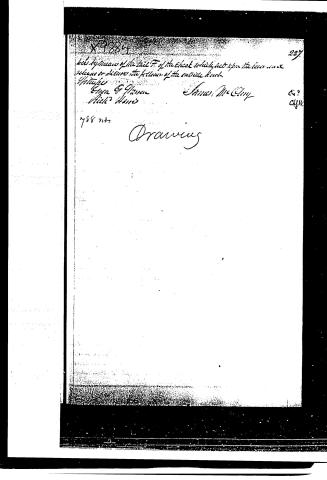
lock by means of the tail F of the block which acts upon the lever and releases or secures the follower of the outside lock.
Witnes
Evan G. Mann
Nick Harris
James McCloy
788 mbr
Drawing
227
62?
cyn
Published accounts: journal notice
Notice in the monthly list of patents
Journal of the Franklin Institute, new ser., vol. 18 (1836), p. 359 · View the page
584. Lock for doors, &c.-James McClory, N. Y.
About this record
- Patentee
- the Journal of the Franklin Institute, Journal
- Date
- the Name and Date index of patents, USPTO records, Jim Shaw's X-patent list
- Invention
- the Name and Date index of patents
- Listed in
- the Name and Date index of patents, USPTO records, Jim Shaw's X-patent list, the Journal of the Franklin Institute, Burke's List of Patents (1847)
- The patentee's full name comes from the Franklin Institute's journal.
- The residence comes from the Franklin Institute's journal.
- Burke's 1847 Patent Office list gives the same patent.