

Drawings and documents
USPTO scan
The patent as scanned by the USPTO
-
 Page 1
-
 Page 2
-
 Page 3
-
 Page 4


U.S. Patent and Trademark Office · Google Patents
Show the transcription Hide (1,329 words)
Machine transcription (LightOnOCR) of the pages as scanned by the USPTO, most of them the handwritten copies made when the records were restored after the 1836 fire. Not checked; it can misread handwriting, so compare it with the scan.
Page 2.
United States Patent
Patent No.: X9892
Jonas Pratt, of Otsego, N. York
Letters Patent
The schedule referred to in these Letters Patent and making part of the same, containing a description in the words of the said Jonas Pratt himself, of his improvement in the machine for cleaning dust and dirt from all kinds of grain —
To all whom it may concern, be it known that I Jonas Pratt of the Town of Otsego, County of Otsego, and State of New York, have invented an improved machine for cleaning dust and dirt from all kinds of grain, and I do hereby declare the following to be a full and complete description of the same —
The machine that I shall describe may of course vary in size according to the quantity of grain to be cleaned in a given time, but I shall describe one of ordinary size. I make a cast iron cylinder three and one half feet long, twenty-two inches diameter at the smallest end on the inside, and thirty-one inches diameter at the largest end, on the inside. The cylinder may consist of six or eight segments or stars, bolted together, edge to edge, by means of ears on the outside corresponding with each other, and heads of cast iron upon each end of the cylinder, bolted on the flanges on the outside of each end of the segment. The heads and segments being from one fourth to one half inch in thickness. The inside of the cylinder has from sixty to ninety ribs or projections of equal size, being more at the large end, than at the small end, distributed over the surface, running lengthwise spirally from the small end three feet toward the large end, forming a square cornered ridge of about half an inch in height with the corner pointing toward the centre of the cylinder.
These ribs gain spirally or wind about eight inches in three feet, and flaring six inches diameter in three feet, at the large end a square projection at the termination of the ribs of three inches diameter (or one and a half inches larger all around the upper or large part) and six inches in length, is of a smooth inside surface to discharge the grain through a hole of eight inches by six inches, by means of a spout on the under side, when the machine lies horizontally, the spout is perpendicular from near the centre three inches in length on one side, on the other a true square of eight inches to cover the hole to discharge the grain with an outlet of about one inch by the length of the smooth surface. There is a hole two inches square in the upper part of the second
Page 3.
United States Patent
Patent No.: X9892
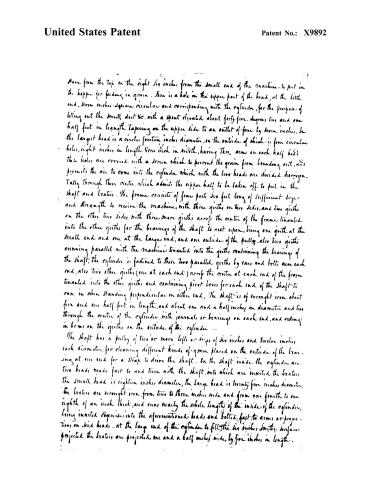
Start from the top on the right six inches from the small end of the machine to put in the hopper for feeding in grain. Here is a hole in the upper part of the head, at the little end, seven inches square circular and corresponding with the cylinder, for the purpose of letting out the dust, etc., with a spout elevated about forty-five degrees, two and one half feet in length tapering on the upper side to an outlet of four by seven inches. In the largest head is a circle fourteen inches diameter, on the outside of which is four circular holes, eight inches in length, five inches in width, having three arms on each half head. These holes are covered with a screen which to prevent the grain from sounding out, and permits the air to come into the cylinder which with the two heads are divided horizontally through their center, which admits the upper half to be taken off to put in the shaft and beaters. The frame consists of four posts six feet long of sufficient size and strength to receive the machine, with three girts on two sides, and two girts on the other two sides, with three more girts across the center of the frame tenanted into the other girts for the bearings of the shaft to rest upon, being one girt at the small end and one at the large end, and one outside of the pulley, also two girts running parallel with the machine tenanted into the girts, containing the bearings of the shaft; the cylinder is fastened to these two parallel girts by ears and bolts near each end, also two other girts (one at each end) across the center at each end of the frame tenanted into the other girts, and containing pivot boxes for each end of the shaft to run in when standing perpendicular on either end. The shaft is of wrought iron about five and one half feet in length, and about one and a half inches in diameter and lies through the center of the cylinder, with journals or bearings on each end, and riding in boxes on the girts, on the outside of the cylinder.
The shaft has a pulley of two or more left or right sizes of six inches and twelve inches each diameter, for cleaning different kinds of grain placed on the outside of the bearing at one end for a strap to drive the shaft. On the shaft inside the cylinder are two heads made fast to and turn with the shaft, into which are inserted the beaters. The small head is eighteen inches diameter, the large head is twenty-five inches diameter. The beaters are wrought iron, from two to three inches wide and from one fourth to one eighth of an inch thick, and runs nearly the whole length of the inside of the cylinder, being inserted obliquely into the aforementioned heads and bolted fast to arms or projections on said heads. At the large end of the cylinder to fill the six inches, the surface projected the beaters are projected one and a half inches wide, by five inches in length.
Page 4.
United States Patent
Patent No.: X9892
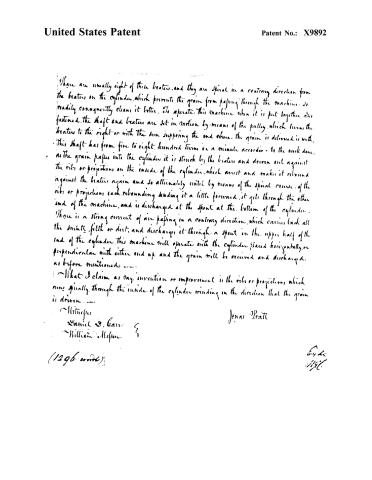
There are usually eight of these beaters, and they are spiral in a contrary direction from the beaters on the cylinder, which prevents the grain from passing through the machine, so readily consequently cleans it better. To operate this machine when it is put together and fastened, the shaft and beaters are set in motion by means of the pulley, which turns the beaters to the right or with the sun supposing the end where the grain is delivered is south. This shaft has from five to eight hundred turns in a minute according to the work done. As the grain passes into the cylinder it is struck by the beaters and driven out against the ribs or projections on the inside of the cylinder, which arrest and make it rebound against the beaters again and so alternately until by means of the spiral course of the ribs or projections, each rebounding lending it a little forward, it gets through the other end of the machine, and is discharged at the spout at the bottom of the cylinder. There is a strong current of air passing in a contrary direction, which carries back all the smuts, filth or dirt, and discharges it through a spout in the upper half of the end of the cylinder. This machine will operate with the cylinder placed horizontally or perpendicular with either end up and the grain will be received and discharged as before mentioned.
What I claim as my invention or improvement is the ribs or projections, which run spirally through the inside of the cylinder winding in the direction that the grain is driven.
Witnesses:
Daniel D. Barr
William M. Hefner
Jonas Pratt
(1296 words)
Ex. 4
1856.
Published accounts: journal notice
Notice in the monthly list of patents
Journal of the Franklin Institute, new ser., vol. 18 (1836), p. 359 · View the page
596. Smut machine. Jonas Pratt, Otsego, N. Y.
About this record
- Patentee
- the Journal of the Franklin Institute, Journal
- Date
- the Name and Date index of patents, USPTO records, Jim Shaw's X-patent list
- Invention
- the Name and Date index of patents
- Listed in
- the Name and Date index of patents, USPTO records, Jim Shaw's X-patent list, the Journal of the Franklin Institute, Burke's List of Patents (1847)
- The patentee's full name comes from the Franklin Institute's journal.
- Burke's 1847 Patent Office list gives the same patent.