

Drawings and documents
National Archives restored drawings: drawing
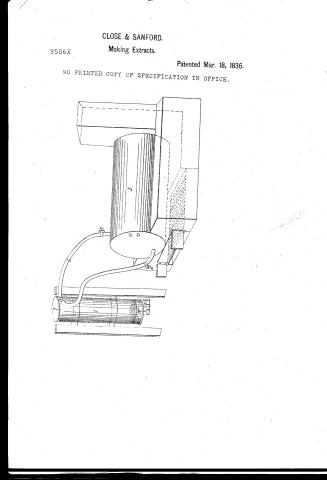
Close and Sanford's Patent Drawing for a Machine for Making Vegetable Extracts


National Archives, Restored Patent Drawings (Record Group 241) · Full-size scan at the National Archives · Catalog record
Show the text on the drawing Hide (332 words)
Words on the drawing as machine-read by the National Archives; not checked. Useful mainly for searching.
Sheet 1. 28. CHEMICALS a MEDICINES. / Nes 1 Chanbe tountain the sublance to be action. hon. / Extracts / CILUSIT and / 2, Its lick / 3. gram and water Boiler / Patented 78" March 1836. / 82 / Vegetable Oxtracts. / 4. / Whiter Jo / 5. Igam Tipo / 6.Y. yth Cooks / Pins throwhich the liquide passaspom the / Chamber / Noveable Top / 9506X / yo 10 Moreable Bottom / wath As forced from alili schurate / subplaines. when Aliann / forged from 3 til which forces hopein our ati 0 / 10 / Ats / that Close
Sheet 2. 9506X / of york k / eight hundred and thirty seven, before the subscriber a / this 27th day of April one housand / commissioned and authorized to administer oaths in the / commissioner residing in the city of newyork, duty / said Citys County personally appeared / the said City and made solemn oath that hd is interested / as the transigner of Thomas Close in a Patent for a "new / and useful improvement in the art, mode and process of / and of separating the stune from the wood and fibrous hart / extracting the soluble matter and part fregetable substances / theref issued to the said Thomas Close and / hundred and mirty dey; and that The drawing hereto attached with / and dated the Eighteenth day of March one thousand light / the referenced therele, are as he verily believes, a true delineation of / Once / as described in the said letters Patent. / me c / 2jpanne 1537 / communities / and Conveyancer, has been appointed Commis- / WM. H. MAXWELL, Attorney, Counsellor / of seen / siner for the states of Pennsylvania, New-Jer- / sey, Connecticut, Georgia, Massachusetts, New- / nevirb / York, &c. with authority to examine witnesses / under commissions emanating from the courts / of said states to take depositions, affidavits and / ers of attorney, agreements, and all instruments / the acknowledgment of deeds, mortgages, pow- / said States. / under seal to be used or recorded in either of / the laws of New-Jersey, Pennsylvania, &c. Of. / prepared according with the forms required by / Deeds Bonds, Mortgages, &c. / fice, No. 70 Liberty, 4th door east of Broadway.
USPTO scan
The patent as scanned by the USPTO
-
 Page 1
-
 Page 2
-
 Page 3
-
 Page 4
-
 Page 5


U.S. Patent and Trademark Office · Google Patents
Show the transcription Hide (1,327 words)
Machine transcription (LightOnOCR) of the pages as scanned by the USPTO, most of them the handwritten copies made when the records were restored after the 1836 fire. Not checked; it can misread handwriting, so compare it with the scan.
Page 1.
CLOSE & SANFORD.
9506X Making Extracts. Patented Mar. 18, 1836.
NO PRINTED COPY OF SPECIFICATION IN OFFICE.

Page 2.
Mar. 18, 1836.
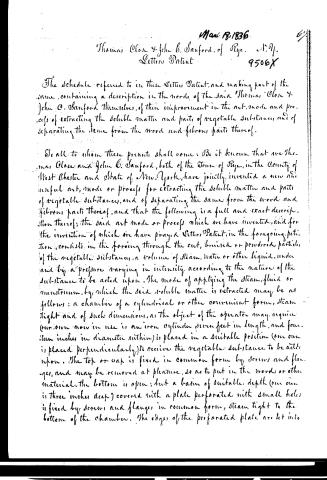
Thomas Close & John C. Sanford, of Rye, N.Y.
Letters Patent 9506X
The schedule referred to in these Letters Patent, and making part of the same, containing a description in the words of the said Thomas Close & John C. Sanford themselves, of their improvement in the art, mode and process of extracting the soluble matter and parts of vegetable substances and of separating the same from the wood and fibrous parts thereof.
To all to whom these presents shall come, Be it known that we, Thomas Close and John C. Sanford, both of the Town of Rye, in the County of West Chester and State of New York, have jointly invented a new and useful art, mode or process for extracting the soluble matter and parts of vegetable substances, and of separating the same from the wood and fibrous parts thereof; and that the following is a full and exact description thereof; the said art mode or process which we have invented, and for the invention of which we have prayed Letters Patent, in the foregoing petition, consists in the forcing through the cut, bruised or powdered particles of the vegetable substances, a volume of steam, water or other liquid, under and by a pressure varying in intensity according to the nature of the substances to be acted upon. The mode of applying the steam, fluid or menstruum, by which the said soluble matter is extracted may be as follows: a chamber of a cylindrical or other convenient form, steam tight and of such dimensions, as the object of the operator may require (our own now in use is an iron cylinder seven feet in length, and fourteen inches in diameter within) is placed in a suitable position (one own is placed perpendicularly) to receive the vegetable substances to be acted upon. The top or vop is fixed in common form by screws and flanges, and may be removed at pleasure, so as to put in the wood or other material. The bottom is open; but a basin of suitable depth (one own is three inches deep) covered with a plate perforated with small holes is fixed by screws and flanges in common form, steam tight to the bottom of the chamber. The edges of the perforated plate are let into
Page 3.
18. 9506X
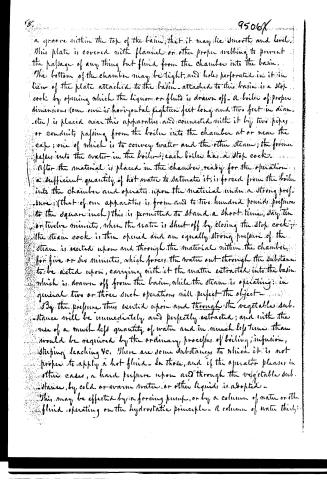
a groove within the top of the basin, that it may lie smooth and level. This plate is covered with flannel or other proper webbing to prevent the passage of any thing but fluid from the chamber into the basin. The bottom of the chamber may be tight, and holes perforated in it in lieu of the plate attached to the basin—attached to this basin is a stop cock by opening which the liquor or fluid is drawn off—a boiler of proper dimensions (one such is horizontal eighteen feet long and two feet in diameter) is placed near this apparatus and connected with it by two pipes or conduits passing from the boiler into the chamber at or near the cap; one of which is to convey water and the other steam; the former passes into the water in the boiler; each boiler has a stop cock.
After the material is placed in the chamber, ready for the operation, a sufficient quantity of hot water to saturate it, is forced from the boiler into the chamber and operates upon the material under a strong pressure; (that of our apparatus is from one to two hundred pounds pressure to the square inch) this is permitted to stand a short time, say ten or twelve minutes, when the water is shut off by closing the stop cock; the steam cock is then opened and an equally strong pressure of the steam is exerted upon and through the material within the chamber, for five or six minutes, which forces the water out through the substance to be acted upon, carrying with it the matter extracted into the basin which is drawn off from the basin, while the steam is operating; in general two or three such operations will perfect the object.
By the pressure thus exerted upon and through the vegetable substance will be immediately and perfectly extracted; and with the use of a much less quantity of water and in much less time than would be required by the ordinary process of boiling, infusion, steeping, leaching &c. There are some substances to which it is not proper to apply a hot fluid—in those, and if the operator pleases in other cases, a hard pressure upon and through the vegetable substance, by cold or warm water, or other liquids is adopted.
This may be effected by a forcing pump, or by a column of water or other fluid operating on the hydrostatic principle—a column of water thirty
Page 4.
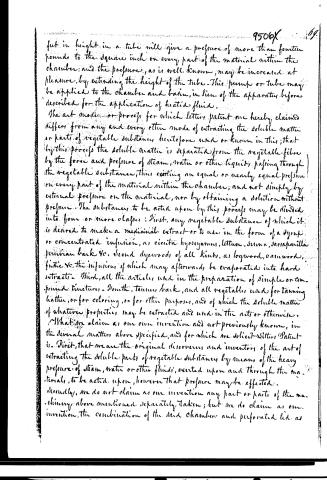
put in height in a tube will give a pressure of more than fourteen pounds to the square inch on every part of the material within the chamber; and the pressure, as is well known, may be increased at pleasure, by extending the height of the tube. This pump or tube may be applied to the chamber and basin, in lieu of the apparatus before described for the application of heated fluid.
The art mode or process for which letters patent are hereby claimed differs from any and every other mode of extracting the soluble matter or parts of vegetable substance, heretofore used or known in this; that by this process the soluble matter is separated from the vegetable fibre by the force and pressure of steam, water or other liquids, passing through the vegetable substance, thus exerting an equal or nearly equal pressure on every part of the material within the chamber, and not simply by external pressure on the material, nor by obtaining a solution without pressure. The substances to be acted upon by this process may be divided into four or more classes: First, any vegetable substance of which it is desired to make a medicinal extract or to use in the form of a syrup or concentrated infusion, as cinchona, hyoscyamus, lettuce, senna, sarsaparilla, peruvian bark &c. Second, dyewoods of all kinds, as logwood, carwood, fustic &c. the infusions of which may afterwards be evaporated into hard extracts. Third, all the articles used in the preparation of simple or compound tinctures. Fourth, tannin bark, and all vegetables used for tanning leather, or for coloring, or for other purposes, and of which the soluble matter of whatever properties may be extracted and used in the art or otherwise.
What we claim as our own invention and not previously known, in the several matters above specified, and for which we solicit Letters Patent is: First, that we are the original discoverers and inventors of the art of extracting the soluble parts of vegetable substance by means of the heavy pressure of steam, water or other fluids, exerted upon and through the materials, to be acted upon, however that pressure may be effected.
Secondly, we do not claim as our invention any part or parts of the machinery above mentioned separately taken; but we do claim as our invention, the combination of the said chamber and perforated lid as
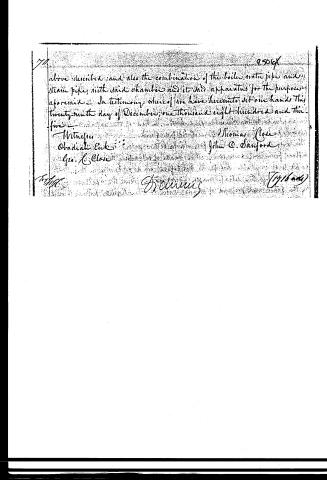
Page 5.
above described; and also the combination of the boiler, water pipe and steam pipe, with said chamber and its said apparatus for the purposes aforesaid. In testimony whereof we have hereunto set our hands this twenty-ninth day of December, one thousand eight hundred and thirty-five.
Witnesses
Obediah Eick
Geo. C. Close
Thomas Close
John C. Sanford
Filed
B. O'Connell
(1/16/1835)
Published accounts: journal notice
Notice in the monthly list of patents
Journal of the Franklin Institute, new ser., vol. 17 (1836), p. 438 · View the page
201. Making extracts.-T. Close and J. C. Sandford, Rye, N. York,
Published accounts: journal notice
Notice in the monthly list of patents, with remarks
Journal of the Franklin Institute, new ser., vol. 18 (1836), p. 387 · View the page
With Remarks and Exemplifications by the Editor. (CONTINUED FROM PAGE 329.) 61. For making Vegetable extracts; Thomas Close and John C. Sandford, Rye, West Chester county, New York, March 18.
Remarks. "The process consists in forcing through the cut, bruised, or powdered, particles of vegetable substances, a volume of steam, water, or other liquid, under and by a pressure, varying in intensity, according to the nature of the substances to be acted upon." This patent is not taken for any particular form of apparatus; but a description is given of one which is considered and claimed as new. The pressure is to be continued for a longer or shorter period, according to the nature of the substance to be acted upon, and it is said that "the colouring matter, tannin, and other soluble parts of the wood or vegetable substance will be immediately and perfectly extracted, and with the use of a much less quantity of water, and in much less time than would be required by the ordinary process of boiling, infusion, or steeping, leaching, &c." The patentees claim to be "the original discoverers and inventors of the art of extracting the soluble parts of vegetable substances, by means of the heavy pressure of steam, water, or other fluids, exerted upon and through the materials to be acted upon, however the pressure may be effected. Also the combination of the chamber and perforated lid as described; the combination of the boiler, water pipe, and steam pipe, with said chamber, and its said apparatus for the purposes aforesaid." The whole process is well described, and we are not aware of any theoretical, or practical, objection to it; but, on the contrary, it appears to us that for many purposes it may be used with great advantage.
About this record
- Patentee
- DATAMP
- Date
- the Name and Date index of patents, DATAMP, USPTO records
- Invention
- DATAMP
- Listed in
- the Name and Date index of patents, DATAMP, USPTO records, Jim Shaw's X-patent list, the Journal of the Franklin Institute, Burke's List of Patents (1847)
- Burke's 1847 Patent Office list gives the same patent.