

Drawings and documents
USPTO scan
The patent as scanned by the USPTO
-
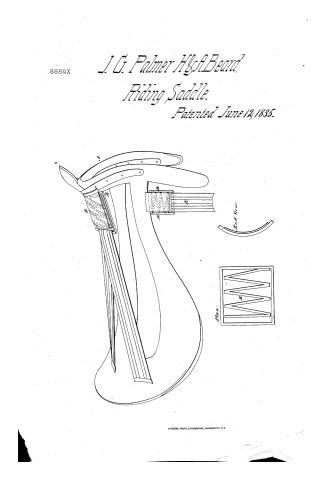 Page 1
-
 Page 2
-
 Page 3
-
 Page 4


U.S. Patent and Trademark Office · Google Patents
Show the transcription Hide (1,094 words)
Machine transcription (LightOnOCR) of the pages as scanned by the USPTO, most of them the handwritten copies made when the records were restored after the 1836 fire. Not checked; it can misread handwriting, so compare it with the scan.
Page 1.
8884X
J. G. Palmer & J. A. Beard,
Riding Saddle.
Patented June 12, 1835.

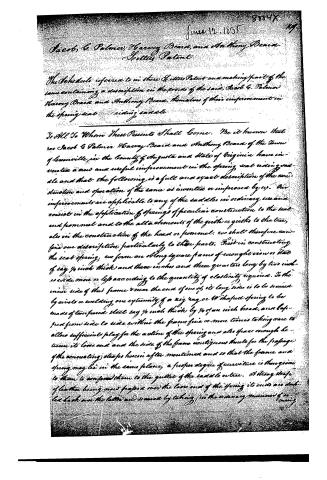
Page 2.
June 12, 1835
Jacob G. Palmer, Harvey Beard, and Anthony Beard.
Letters Patent
The Schedule referred to in these Letters Patent and making part of the same containing a description in the words of the said Jacob G. Palmer, Harvey Beard and Anthony Beard, themselves of their improvement in the spring seat riding saddle.
To All To Whom These Presents Shall Come. We it known that we Jacob G. Palmer, Harvey Beard and Anthony Beard of the Town of Knoxville, in the County of Augusta and State of Virginia have invented a new and useful improvement in the spring seat riding saddle and that the following is a full and exact description of the construction and operation of the same as invented or improved by us. Our improvements are applicable to any of the saddles in ordinary use and consist in the application of springs of peculiar construction to the seat and pommel and to the attachments of the girth or girths to the tree, also in the construction of the head or pommel: we shall therefore confine our description particularly to those parts. First in constructing the seat spring, we form an oblong square frame of wrought iron or steel of say ¼ inch thick and three inches and three quarters long by two inches wide more or less according to the quantity of elasticity required. To the inner side of this frame near the end of one of its long sides is to be secured by rivets or welding one extremity of a zig zag or W shaped spring to be made of tempered steel say ⅛ inch thick by ¼ of an inch broad, and fastened from side to side within the frame five or more times taking care to allow sufficient play for the action of the spring and also space enough between its lower end and the side of the frame contiguous thereto for the passage of the connecting straps herein after mentioned and so that the frame and spring may lie in the same plane, a proper degree of curvature is then given to them to conform them to the gullet of the saddle or tree. A strong strap of leather being now passed over the lower end of the spring its ends are doubled back over the latter and secured by taking in the ordinary manner of securing.
Page 3.
during webbing to the inferior side of the head of the tree, thus suspending the spring frame. We prefer also fastening an additional piece of strong webbing over the leather to be secured with it, so as to form a double covering to the spring and frame which serves the two-fold purpose of protecting the horse's back and of preventing the spring from corroding. We next fasten a piece of strong webbing, broad as the frame will admit, over the opposite side to that which bears the spring and drawing them tight in a diverging direction attach the ends by tacking firmly to the under side of the cantle, the covering of the seat is then drawn on in the common way.
Second: the girth springs are constructed precisely like that just described, the only difference being in their size, which is proportionally less and in them being perfectly flat; they are attached to the ends of the tree by straps in a similar manner. Third: the prominent, in the head of the tree which is made in the usual way. We secure an iron horn as follows. The pointed shanks of the horn, which also has shoulders, is passed in between the top and gullet plates and is then bent down or clinched over the back edge of the latter, by which means it is secured firmly to the tree. The horn itself is a spoon-shaped flattened piece of wrought iron, 1/4 of an inch thick at the shanks, and diminishing regularly to 1/8 of an inch at its front edge, its breadth being about two inches at its end and one at the shanks, rising from the shanks with a gentle curve forward to a horizontal line, the precise figure is not deemed material and is therefore left to the fancy of the maker. This horn is first completely covered with two pieces of thick leather stitched together all around close to the plate and then the whole covered with webbing or stitching as may be preferred. Some of the advantages of our improvements are the great simplicity and cheapness of the spring and its attachments being less liable to get out of order, and by conforming neatly to the gullet of the saddle; its bulk scarcely being perceptible, at the same time making an easy elastic seat for both the horse and the rider, also its application and perfect adaptation to the girth of the saddle which by its means not only performs its office better, but with more comfort to the horse and is completely protected from injuries arising from violence.
Page 4.
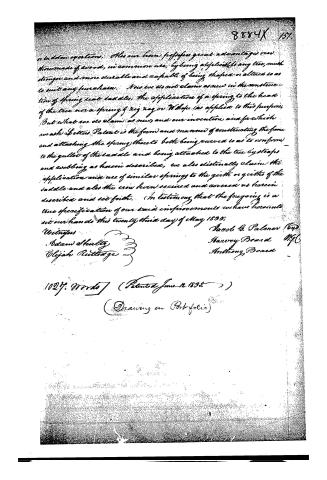
8884X 157.
in saddle operations. As we have professed great advantage over those made of wood, in common use, by being applicable to any tree, much stronger and more durable and capable of being shaped or altered so as to suit any furniture. Now we do not claim as new in the construction of spring seat saddles, the application of a spring to the head of the tree nor a spring of zig zag or Whose is applied to this purpose. But what we do claim as new and our invention and for which we ask Letters Patent is the form and manner of constructing the frame and attaching the spring thereto both being curved so as to conform to the gullet of the saddle and being attached to the tree by straps and working as herein described, we also distinctly claim the application and use of similar springs to the girths or girths of the saddle and also the iron horn secured and covered as herein described and set forth. In testimony that the foregoing is a true specification of our said improvements we have hereunto set our hands this twenty third day of May 1895.
Witnesses
Adam Shultz
Elijah Rutledge
Jacob G. Palmer
Harvey Beard
Anthony Beard
1027. Words] (Patented June 12 1895.)
(Drawing in Portfolio)
Published accounts: journal notice
Notice in the monthly list of patents
Journal of the Franklin Institute, new ser., vol. 16 (1835), p. 143 · View the page
338. Saddles, spring seat.-J. G. Palmer, H. & A. Beard, Greenville, Va.
Published accounts: journal notice
Notice in the monthly list of patents (listed with a different spelling or date)
Journal of the Franklin Institute, new ser., vol. 17 (1836), p. 47 · View the page
For a Spring Seat Riding Saddle; Jacob G. Patmer, Harvey Beard and Anthony Beard, Greenville, Augusta county, Virginia, April 12.
DATAMP: illustration
Illustrations from DATAMP

DATAMP (Directory of American Tool and Machinery Patents), via the Internet Archive · Archived DATAMP page
About this record
- Patentee
- DATAMP
- Date
- the Name and Date index of patents, DATAMP, USPTO records
- Invention
- DATAMP
- Listed in
- the Name and Date index of patents, DATAMP, USPTO records, Jim Shaw's X-patent list, the Journal of the Franklin Institute, the Journal of the Franklin Institute, Journal, Burke's List of Patents (1847)
- Also listed in a contemporary journal or list under a different spelling or date; the record shown follows the standard lists.
- Burke's 1847 Patent Office list gives the same patent.