

Drawings and documents
National Archives restored drawings: drawing
Peter Cooper's Patent Drawing for An Evaporating Pan for Making Glue

National Archives, Restored Patent Drawings (Record Group 241) · Full-size scan at the National Archives · Catalog record
Show the text on the drawing Hide (128 words)
Words on the drawing as machine-read by the National Archives; not checked. Useful mainly for searching.
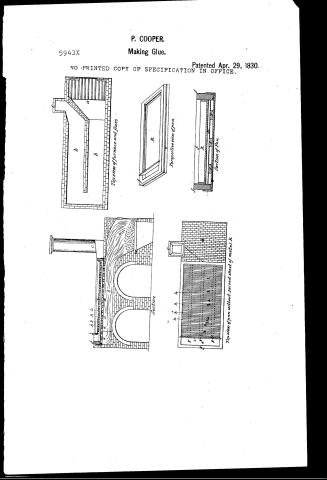
$250, 87. OILS, 'ATS & GLUR. / [28] Glue. / 1250 / Peter Cooper / 5943-X / Ex / Evaporating pan for making Glue. / Vol. io pg. 131. / Patented April 29. 1830 / Ireferences. / a the furnace / B. B the flue. / C. the chimney. / 20.2.2.2010 iron supporting. bars. / l the theet of lead. / of the wooden curb. / 9.9.9 horizontal scripsof wood. / Perspective view of the pan / L the crop board. / K the record sheet of metall. / Section / of / K. / lection of the pan. / Top view of the pan without the second sheet of metallk. / Patent affice 29th June 1841. / made under the direction of the Commifriour / Top viewoffurnace / of Patents in Con formity with act of 3. marchissy. / and flues. / ch h. Heischman freit / is L Elltworth / Commifirener of Patents.
USPTO scan
The patent as scanned by the USPTO
-
 Page 1
-
 Page 2
-
 Page 3


U.S. Patent and Trademark Office · Google Patents
Show the transcription Hide (715 words)
Machine transcription (LightOnOCR) of the pages as scanned by the USPTO, most of them the handwritten copies made when the records were restored after the 1836 fire. Not checked; it can misread handwriting, so compare it with the scan.
Page 1.
P. COOPER.
5943X
Making Glue.
Patented Apr. 29, 1830.
NO PRINTED COPY OF SPECIFICATION IN OFFICE.

Page 2.
X5943
April 29, 1850
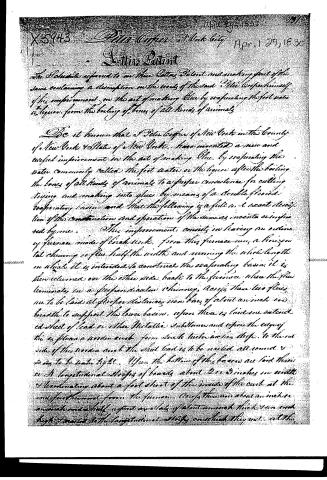
Peter Cooper of New York City
April 29, 1850
Letting Patent
The Petitioner referred to in these Letters Patent and making part of the same containing a description in the words of the said Peter Cooper himself of his improvement on the art of making glue by evaporating the foot water or liquor from the boiling of bones of all kinds of animals.
Be it known that I Peter Cooper of New York in the County of New York and State of New York, have invented a new and useful improvement on the art of making glue by evaporating the water commonly called the foot water or the liquor after the boiling the bones of all kinds of animals to a proper convenience for cutting drying and making into glue by means of a double flued evaporating basin and that the following is a full and exact description of the construction and operation of the same as invented or improved by me.
This improvement consists in having an ordinary furnace made of brick work. From this furnace runs a horizontal chimney or flue half the width and running the whole length on which it is intended to construct the evaporating basin it is then returned on the other side back to the furnace where the flue terminates in a perpendicular chimney. Across these two flues are to be laid at proper distances iron bars of about an inch and a half breadth to support the lower basin. Upon these is laid an extended sheet of lead or other metallic substance and upon the edge of this is placed a wooden arch from which wooden sides drop to the outside of the wooden arch the sheet lead is to be nailed all round so as to be water tight. Upon the bottom of the basin are laid thereon longitudinal strips of boards about 2 or 3 inches in width extending about a foot short of the inside of the arch at the end furthest from the furnace. Across these are about an inch or an inch and a half apart one slab of about an inch thick and an inch high nailed to the longitudinal strips on which they rest at the
Page 3.
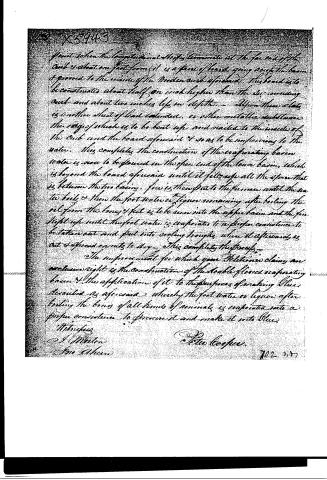
first when the temperature of the atmosphere at the far end of the cask is about one foot from it is a piece of board going across the basin & joined to the inside of the wooden cask aforesaid. This board is to be constructed about half an inch higher than the surrounding cask and about two inches less in depth. Upon these slats is another sheet of lead calendered, or other metallic substance the edge of which is to be bent up and nailed to the inside of the cask and the board aforesaid so as to be insuperious to the water. This completes the construction of the evaporating basin. Water is now to be poured in the open end of the lower basin, which is beyond the board aforesaid until it fills up all the space that is between the two basins. Fire is then put to the furnace until the water boils & then the first water or liquor remaining after boiling the oil from the bones & feet is to be run into the upper basin and the fire kept up until the foot water is evaporated to a proper consistency to be taken out and put into cooling troughs where it afterwards is set & spread on nets to dry. This completes the process.
The improvement for which your Petitioner claims an exclusive right is the construction of the double floored evaporating basin & the application of it to the purposes of making Glues described as aforesaid whereby the foot water or liquor after boiling the bones of all kinds of animals is evaporated into a proper consistency to procure it and make it into Glues.
Witnesses
J. Martin
Geo. Wilson
Peter Cooper.
Published accounts: journal notice
Notice in the monthly list of patents
Journal of the Franklin Institute, new ser., vol. 6 (1830), p. 18 · View the page
48. For an improvement in the Art of Making Glue; Peter Cooper, City of New York, April 29.
Published accounts: journal notice
Notice in the monthly list of patents, with remarks
Journal of the Franklin Institute, new ser., vol. 6 (1830), p. 86 · View the page
The cocking, or forward trigger, plays through the trigger plate, and its office is to supply the place of the common gun cock, and is operated on by the main spring; the forward end of which plays into the cocking trigger between the flanches in the same manner as the main spring of the common gun lock plays into the tumbler. When this forward, or cocking trigger, is pulled, the forward end of it comes down towards the bow of the trigger guard, and is set in the same manner and on the same principle as the common gun cock, by the sear, or dog, operated on by the feather spring which presses the forward end or point of the sear, or dog, into a notch or notches made for that purpose in the sear and circular end of the cocking trigger, on its upper edge. At the forward end of the cocking trigger, on its upper side, is to be either a hammer to strike on a percussion cap, or, instead of a hammer, there is to be a bill, or cone, to strike upon a kernel of percussion or fulminating powder, placed in the mouth of a tube passing through the trigger plate, stock and gun barrel, on the under side, and communicating with the charge of powder at the breach pin in the same manner as through the common tube or touch hole. This cocking trigger, which answers to the common gun cock, is unbent or discharged by the disCOOPER'S Improvement in making Glue. 1 charging trigger, in the same manner, in every respect, as the cock of the common gun lock, by the discharging trigger operating on the sear, or dog, which, by pressure, is disengaged from the notch in the cocking trigger. The cocking trigger may be either within or forward of the trigger guard, or playing through a slit cut for the purpose in the forward part of the guard. The same principle is intended to be applied to pistols and to double barrelled guns. G D B F E JOEL NEWBURY. 1 A A, guard. B, trigger plate. C, main spring. D, feather spring. E, cocking trigger. F, discharging trigger. G, sear, or dog. H, bill, or cone. I, tube which screws into the touch hole. Specification of a patent for an improvement in the art of making Glue, by evaporating the water commonly called the foot water, or the liquor after boiling the bones of all kinds of animals, to a proper consistence for cutting, drying, and making into Glue, by means of a double floored evaporating basin. Granted to PETER COOPER, City of New York, April 29th, 1830.
Remarks. THIS improvement consists in having an ordinary furnace made of brick work; from this runs a horizontal chimney or flue half the width, and running the whole length, on which it is intended to construct the evaporating basin, it is then returned on the other side back to the furnace where the flue terminates in a perpendicular chimney. Across these two flues are to be laid at proper distances, iron bars of about an inch in breadth, to support the lower basin; upon these is laid one extended sheet of lead, or other metallic substance, and upon the edge of this is placed a wooden curb from six to twelve inches deep. To the outside of this wooden curb the sheet of lead is to be nailed all round, and so as to be water tight. Upon the bottom of this basin are laid three or four longitudinal strips of boards about two or three inches in width, and terminating about a foot short of the inside of the curb at the end furthermost from the furnace. Across these, and about an inch, or an inch and 1 a half apart, are slats of about an inch thick, and an inch high, and nailed to the longitudinal strips on which they rest. At the point where the longitudinal strips terminate, at the far end of the curb, and about one foot from it, is a piece of board going across the basin and grooved to the inside of the wooden curb aforesaid, this board is to be constructed about half an inch higher than the surrounding curb, and about two inches less in depth. Upon these slats is another sheet of lead extended, or other metallic substance, the edge of which is to be bent up, and nailed to the inside of the curb and the board aforesaid, and so as to be impervious to the water.
Published accounts: specification
Specification printed in the Journal of the Franklin Institute
Journal of the Franklin Institute, new ser., vol. 6 (1830), p. 87 · View the page
Text of the specification as printed in the Journal, from OCR; not proofread.
Specification of a patent for an improvement in the art of making Glue, by evaporating the water commonly called the foot water, or the liquor after boiling the bones of all kinds of animals, to a proper consistence for cutting, drying, and making into Glue, by means of a double floored evaporating basin. Granted to PETER COOPER, City of New York, April 29th, 1830. THIS improvement consists in having an ordinary furnace made of brick work; from this runs a horizontal chimney or flue half the width, and running the whole length, on which it is intended to construct the evaporating basin, it is then returned on the other side back to the furnace where the flue terminates in a perpendicular chimney. Across these two flues are to be laid at proper distances, iron bars of about an inch in breadth, to support the lower basin; upon these is laid one extended sheet of lead, or other metallic substance, and upon the edge of this is placed a wooden curb from six to twelve inches deep. To the outside of this wooden curb the sheet of lead is to be nailed all round, and so as to be water tight. Upon the bottom of this basin are laid three or four longitudinal strips of boards about two or three inches in width, and terminating about a foot short of the inside of the curb at the end furthermost from the furnace. Across these, and about an inch, or an inch and 1 a half apart, are slats of about an inch thick, and an inch high, and nailed to the longitudinal strips on which they rest. At the point where the longitudinal strips terminate, at the far end of the curb, and about one foot from it, is a piece of board going across the basin and grooved to the inside of the wooden curb aforesaid, this board is to be constructed about half an inch higher than the surrounding curb, and about two inches less in depth. Upon these slats is another sheet of lead extended, or other metallic substance, the edge of which is to be bent up, and nailed to the inside of the curb and the board aforesaid, and so as to be impervious to the water. This completes the construction of the evaporating basin; water is now to be poured in the open end of the lower basin, which is beyond the board aforesaid, until it fills up all the space that is between the two basins. Fire is then put to the furnace until the water boils, and then the foot water or the liquor remaining after boiling the oil from the bones and feet, is to be run into the upper basin, and the fire kept up until the foot water is evaporated to a proper consistence to be taken out and put into cooling troughs, where it afterwards is cut and spread on nets to dry. This completes the process. The improvement for which your petitioner claims an exclusive right, is the construction of the double floored evaporating basin, and the application of it to the purposes of making glue, described as aforesaid, whereby the foot water, or liquor after boiling the bones of all kinds of animals, is evaporated into a proper consistence to preserve it, and make it into glue. PETER COOPER.
About this record
- Patentee
- DATAMP
- Date
- DATAMP
- Invention
- DATAMP
- Listed in
- the Name and Date index of patents, DATAMP, USPTO records, Jim Shaw's X-patent list, the Journal of the Franklin Institute, Burke's List of Patents (1847), the Journal of the Franklin Institute, Journal
- The sources give different dates; the date shown is the one most of them agree on.
- The date conflict was settled by Burke's 1847 list.
- The Franklin Institute's journal confirms the date shown.
- Burke's 1847 Patent Office list gives the same patent.
- Burke's 1847 Patent Office list gives a slightly different date; the date shown follows the standard lists.