

Drawings and documents
National Archives restored drawings: drawing
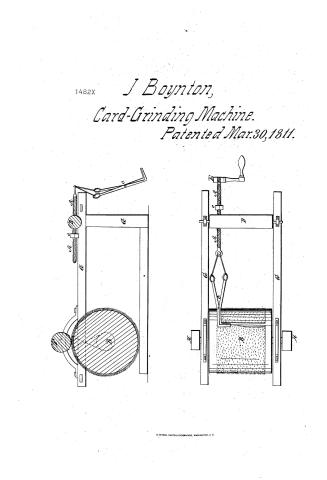
John Boynton's Patent Drawing for a Straining and Grinding Cards

National Archives, Restored Patent Drawings (Record Group 241) · Full-size scan at the National Archives · Catalog record
Show the text on the drawing Hide (84 words)
Words on the drawing as machine-read by the National Archives; not checked. Useful mainly for searching.
CLASSIFICATION / $5.000 / NIZZAD: / 1482X / Card Orinding DIVISION. / al O BOYNTON / 11 / Vob.3.p.1. / Straining E Grinding / No No. CARDS / CLASSIFICATION / Patented 30 March 1811. / DIVISION. / to / A. screw / B. Card englined / Patent Office Fab 1." 1840 / C. Niffersor Pincers Made under the discition of the Commissions of patients / D. Beam / E. Crank, e nut / in conformity with act y3 March 1837 / F G. brinding frame exglines covend with imeng / MennyL / H. Pully / commissioner of
USPTO scan
The patent as scanned by the USPTO
-
 Page 1
-
 Page 2
-
 Page 3


U.S. Patent and Trademark Office · Google Patents
Show the transcription Hide (469 words)
Machine transcription (LightOnOCR) of the pages as scanned by the USPTO, most of them the handwritten copies made when the records were restored after the 1836 fire. Not checked; it can misread handwriting, so compare it with the scan.
Page 1.
1482X
J Boynton,
Card-Grinding Machine.
Patented Mar. 30, 1811.

Page 2.
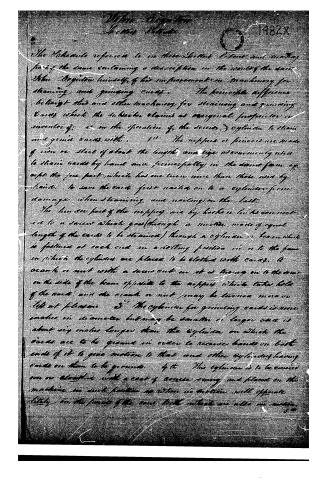
The Hakodate reference is to the above Letters Patent and making part of the same containing a description in the words of the said John Dighton himself of his improvement on machinery for steaming and grinding cards. The principal difference between this and other machinery for steaming and grinding cards which the subscriber claims as original property or invention is in the operation of the steaming cylinders to steam and grind cards with. 1st The rippers or pinners are made of iron or steel of about the length and size commonly used to steam cards by hand and principally in the same form except the free part which has one turn more than those used by hand, to save the cards first nailed on to a cylinder from damage when steaming and nailing on the last.
The lower part of the rippers are by hooks or hooks connected to a screw wheel gear (though a number made of equal length of the cards to be steamed) through a cylinder or beam which is fastened at each end in a rolling position or so to the frame in which the cylinders are placed to be clothes with cards. A crank or nut with a screw cut in it is brought on to the side on the side of the beam opposite to the rippers which takes hold of the card and the crank or nut may be turned more or less at pleasure. 3d The cylinder for grinding cards is nine inches in diameter but may be smaller or larger and is about six inches longer than the cylinder on which the cards are to be ground in order to receive bands on both ends of it to give motion to that and other cylinders leaving cards on them to be ground. 4th The cylinder is to be covered over or clothed with a coat of coarse sawing and placed on the machine in such position as when in motion will operate fully on the fronts of the card both which are also in motion.
Page 3.
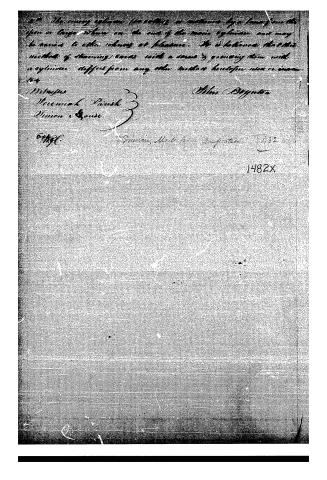
The energy splinter (presumably an instrument) by a lever from the floor or large surface on the end of the main splinter and may be moved to other rooms at pleasure. It is believed that this method of obtaining gases with a sound & producing them with a splinter differs from any other method heretofore used or invented.
John Boynton
Worcester
Worcester Parish
Union & House
6th H.
Provision, Made for a Suspension 1832
1482X
About this record
- Patentee
- Jim Shaw's X-patent list
- Date
- the Name and Date index of patents, USPTO records, Jim Shaw's X-patent list
- Invention
- the Name and Date index of patents
- Listed in
- the Name and Date index of patents, USPTO records, Jim Shaw's X-patent list, S. A. Elliot's printed list of patents, Burke's List of Patents (1847)
- S. A. Elliot's printed list of patents gives the same name and date.
- Burke's 1847 Patent Office list gives the same patent.