

Drawings and documents
USPTO scan
The patent as scanned by the USPTO
-
 Page 1
-
 Page 2
-
 Page 3
-
 Page 4
-
 Page 5


U.S. Patent and Trademark Office · Google Patents
Show the transcription Hide (1,722 words)
Machine transcription (LightOnOCR) of the pages as scanned by the USPTO, most of them the handwritten copies made when the records were restored after the 1836 fire. Not checked; it can misread handwriting, so compare it with the scan.
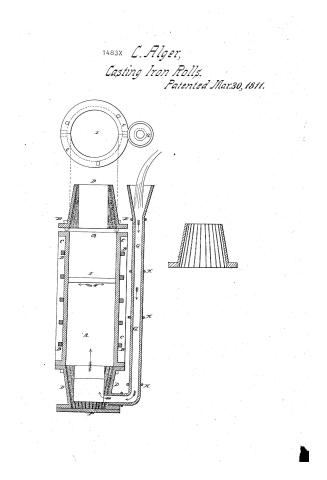
Page 1.
1483X C. Alger,
Casting Iron Rolls.
Patented Mar. 30, 1811.

Page 2.
Mar 30 1811 1483X
Cyrus Alger
Letters Patent
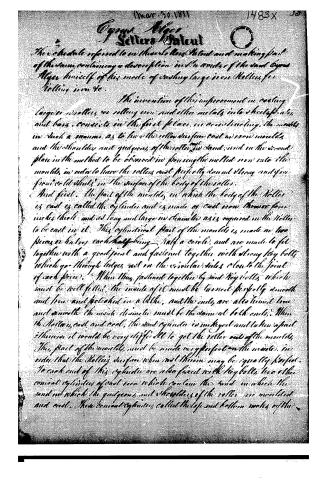
This schedule referred to in the Letters Patent and making part of the same, contains a description in the words of the said Cyrus Alger himself of his mode of casting large iron Rollers for Rolling iron &c.
The invention of this improvement in casting larger rollers, or rolling iron and other metals into sheets, plates, and bars, consists in the first place, in constructing the moulds in such a manner as to have the roller surface cast in iron moulds, and the shoulder and gudgeons of the roller in sand, and in the second place in the method to be observed in pouring the melted iron into the moulds, in order to have the rollers cast perfectly sound strong and free from "cold shuts" in the surface of the body of the rollers.
And first. The part of the moulds in which the body of the Roller is cast is called the cylinder and is made of cast iron, three or four inches thick and as long and large in diameter as is required in the Roller to be cast in it. This cylindrical part of the moulds is made in two pieces or halves, each half being half a circle, and are made to fit together with a good joint and fastened together with strong key bolts which go through lugs cast on the circular sides close to the joint of each piece. When thus fastened together by said key bolts, which must be well fitted, the inside of it must be turned perfectly smooth and true and polished in a lathe, and the ends are also turned true and smooth the inside diameter must be the same at both ends. When the Rollers are cast and cool, the said cylinder is unkeyed and taken apart otherwise it would be very difficult to get the roller out of the moulds. This part of the moulds must be made in perfect on the inside, in order that the Roller's surface when cast therein may be equally perfect. To each end of this cylinder are also fixed with key bolts, two other conical cylinders of cast iron which contain the sand in which the shoulders and gudgeons of the rollers are moulded and cast. These conical cylinders called the top and bottom molds of the
Page 3.
moulds are cast with a wide rim or flange at their largest ends when iron plates turned in a lathe to make it fit with a good joint to the end of the said cylinder, each of the said neck parts of the moulds is fastened to the end of the said cylinder by three key bolts, well filled so as to serve as steady; proper ears or handles must be fastened on each side of said cylinder and said top and bottom necks so as to handle them with ease and safety. The bore of these neck parts of the moulds is about a quarter smaller at their smallest ends than the bore of the cylinder, and are also much thinner than the said cylinder to whose ends are fastened. The inside of these neck pieces may have several small cuts in so as to prevent the sand from falling out. To the small end of the bottom neck piece a rim is cast in so as to fix on it a bottom piece of cast iron by key bolts. This said bottom piece serves as the base on which the whole mould is supported in a perpendicular position when cast. The cast iron part of the moulds being thus made, the pattern for the iron is then put into the moulds, which are then keyed together, and the body of said patterns must fill the inside of the cylinder part of the said iron such as is used in casting iron is then fitted into the neck of the moulds and founded in sufficiently firm round the gudgeons and said pattern, and against the shoulders of the body of it. The said bottom piece which serves as the base of the moulds is then keyed on firm. The top neck of the moulds being first so six inches longer than the gudgeon of the Roller to be cast therein has a hole made in the said thereon of the size of the gudgeon and in the same direction to the top of it, a hole being filled with melted iron, when the Roller is cast and fills the condensation of the gudgeon and roller below as they gradually cool and thereby render the roller and gudgeon sound and strong, when the roller cools the top and on the upper gudgeon which is called the "Spine" is cut off, the moulds are then made and keyed together, so that when the iron is cast and cooled it may be taken out by unkeying the moulds. The cylinder part of which being the part of the iron mould in which the bore of the roller is cast is taken off with ease from the body of the roller. The shoulders and gudgeons being cast in sand are also easily taken out of the mould.
Page 4.
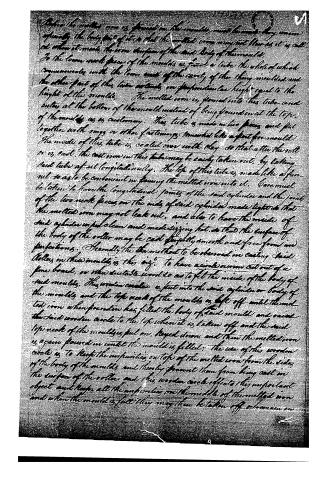
Before the molten iron is poured in, the moulds must be made very warm, especially the body part of it, so that the molten iron may not flow as it is called when it meets the iron surface of the said body of the moulds.
To the lower neck piece of the moulds is fixed a tube the whole of which communicates with the lower neck of the cavity of the thing moulded and the other part of this tube extends on perpendicular height equal to the height of the moulds. The molten iron is poured into this tube and enters at the bottom of the mould instead of being poured in at the top of the moulds as is customary. This tube is made in two pieces and put together with rings or other fastenings somewhat like a joint fire mould. The inside of this tube is coated over with clay so that after the roll is cast, the cast iron in this tube may be easily taken out, by taking said tube apart longitudinally. The top of this tube is made like a funnel so as to be convenient in pouring the molten iron into it. Care must be taken to have the longitudinal joints of the said cylinder and the joints of the two neck pieces on the ends of said cylinder made tight so that the molten iron may not leak out, and also to have the inside of said cylinder wiped clean and made sizing hot, so that the surface of the body of the roller may be cast perfectly smooth and free from imperfections.
Secondly, the method to be observed in casting said rollers in this mould is this: to have a circle or rim cut out of a pine board, or other suitable wood so as to fit the inside of the body of said moulds. This wooden circle is put into the said cylinder or body of the moulds and the top neck of the moulds is left off until the molten iron when pouring has filled the body of said mould and raised the said wooden circle to the top when it is taken off and the said top neck of the moulds is put on, keyed down, and then the molten iron is again poured in until the mould is filled; the use of this wooden circle is to keep the impurities on top of the molten iron from the sides of the body of the moulds and thereby prevent them from being cast in the surface of the roller, and this wooden circle effects this important object, and keeps all the impurities on the middle of the molten iron and when the mould is full they may then be taken off without an
Page 5.
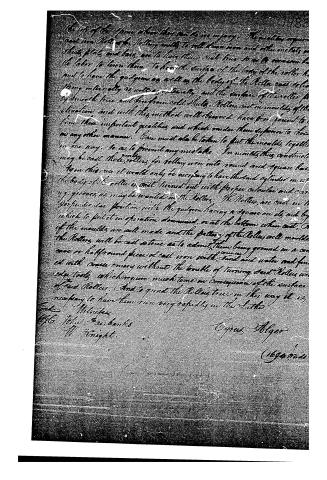
the top of the surface where they can do no injury. The qualities required in a rolling iron that is for rolling mills to roll down iron and other metals in sheets, plates, and bars, are to have them well true so as to convene to the labor to turn them, to have the surface of the body of the roller hard and to have the quignon as well as the body of the Roller cast without being internally as well as externally, and the surface of the roller perfectly smooth, true, and free from cold shots. Rollers cast in moulds of the situation, and with this method well observed, have been found to combine these important qualities, and which render them superior to those in any other manner. Care must also be taken to put the moulds together in one way, so as to prevent any mistakes. In moulds, they can usually may be cast those rollers for rolling iron into round and square bars. From this one it would only be necessary to have the said cylinder in the body of the roller is well turned out with proper circular and corresponding grooves as may be wanted in the Rollers. The Rollers are cast in a perpendicular position with the quignon having a square on its side by which to put it in operation downward, or at the bottom when cast. As if the moulds are well made and the pattern of the Rollers well moulded, the Rollers will be cast so true as to admit them being ground in a concave or half-round piece of cast iron with sand and water and finished with coarse emery without the trouble of turning said Rollers with edge tools, which require much time in consequence of the surface of said Rollers. And to grind the Rollers true in this way it is necessary to have them run very rapidly in the Lathes.
Ends. M. L. L.
Wm. John Fawbarks
W. Knight.
Cyprian Alger
(16947702)
About this record
- Patentee
- Jim Shaw's X-patent list
- Date
- the Name and Date index of patents, USPTO records, Jim Shaw's X-patent list
- Invention
- the Name and Date index of patents
- Listed in
- the Name and Date index of patents, USPTO records, Jim Shaw's X-patent list, S. A. Elliot's printed list of patents, Burke's List of Patents (1847)
- S. A. Elliot's printed list of patents gives the same name and date.
- Burke's 1847 Patent Office list gives the same patent.
- Residence from Burke's 1847 Patent Office list; the standard lists give none.