

Drawings and documents
National Archives restored drawings: drawing
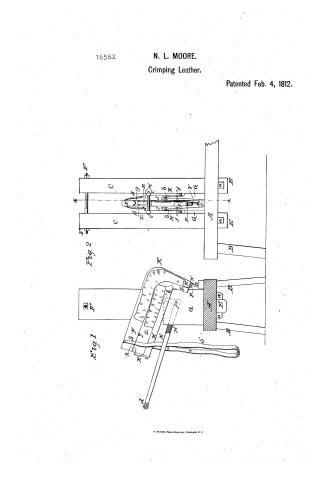
Nathaniel L. Moore's Patent Drawing for a Machine for Cramping Boot Legs

National Archives, Restored Patent Drawings (Record Group 241) · Full-size scan at the National Archives · Catalog record
Show the text on the drawing Hide (248 words)
Words on the drawing as machine-read by the National Archives; not checked. Useful mainly for searching.
SCLASSIFICATION / 12: ROOTS & SHOES. / I.NIEL L his / 1658 X / Vol: 3. page 133 / 136] Crimping. / DIVISION. / cramping Boot legs h. moore / Paten! Feb 4th 1812. / Reference / side view. / A, The bench / B. feet for the bruch to rest on / C,C, upright binders / E.E. tennons of binder C,C, secured by wedges a,a, / F, Connecting screws. / C' / G,G, two side pieces the upper ends of which at the back end / are formed into an are of a circle, at (b) / L, / H.H, arms of the rubbers, connected together at c). forming handle(d) / VI / f.f. pivots for the rubbers to turn are / J.J, the rubbers. / K, the boot tree proper / I,, the first binder with grove(g) / M, second bender / I, / N, prejecting hook / 0, staple & post / P, plate of metal & screw. for superling the and of the / first binder ( ).h, pin to hold up the other / end of first binder to the tree / Q, notch in first binder (I.) in which spegnd / THE / binde(NL) rests R, spring catch which / holds end of second binder to first binder. / End view / S, strap for dawing The burt tree down / T, T, Leather ready for cramping. / Side view through x,x, / Patent Office / Iany 1846 / made under the direction of the Commije nor / of Patents in conformity with the ust / 3rd of March 1857. / Eanume The / Venelchmedt Dela- / Com ifsioner of Patents
USPTO scan
The patent as scanned by the USPTO
-
 Page 1
-
 Page 2
-
 Page 3


U.S. Patent and Trademark Office · Google Patents
Show the transcription Hide (934 words)
Machine transcription (LightOnOCR) of the pages as scanned by the USPTO, most of them the handwritten copies made when the records were restored after the 1836 fire. Not checked; it can misread handwriting, so compare it with the scan.
Page 1.
1658X
N. L. MOORE.
Crimping Leather.
Patented Feb. 4, 1812.
Fig. 1
Fig. 2
N. PETERS, Photo-Lithographer, Washington, D. C.
Page 2.
Nathaniel S. Moore 1858X
Sellers Patent
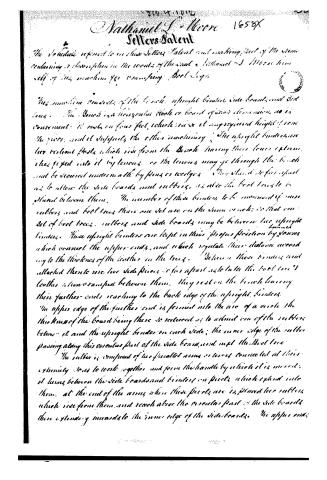
The Solemnly referred to in this Sellers Patent and making part of the same containing a description in the words of the said Nathaniel S. Moore himself of his machine for manufacturing Boot Soles.
This machine consists of the bench, upright binders, side boards and boot trees. The Bench is a horizontal block or board of even dimension, so as convenient it rests on four feet, which raise it any required height from the floor, and it supports the other machinery. The upright binders are two vertical posts which rise from the Bench having their lower extremities fixed into it by tenons, as the tenons may go through the bench and be secured underneath by pins or wedges. They stand so far apart as to allow the side boards and rollers, as also the boot trees to be placed between them. The number of these binders to be increased if more rollers and boot trees than one set are on the same bench; so that one set of boot trees, rollers and side boards may be between two upright binders. These upright binders are kept in their proper position by tenons which connect the upper ends, and which regulate their distance according to the thickness of the leather in the trees. Between these binders and attached thereto are two side pieces so far apart as to take the boot tree's leather when cramped between them. They rest on the bench having their further ends reaching to the back edge of the upright binders. The upper edge of the further end is formed into the arc of a circle the thickness of the board being there so reduced as to admit one of the rollers between it and the upright binder on each side; the inner edge of the roller passing along this circular part of the side board, and next the Boot tree.
The roller is composed of two parallel arms or tenons connected at their extremity so as to twist together and form the handle by which it is moved; it being between the side boards and binders on pivots which extend into them. At the end of the arms where these pivots are, is placed two rollers which rise from them and reach above the circular part of the side boards, there extending inward to the inner edge of the side boards. The upper ends
Page 3.
of these rollers are joined to a semicircle and they press up the leather on each side of the Boot tree, gathering so as to form or cramp the leather into the proper shape for Boot making. The Boot tree is composed of three parts. The Boot tree proper. The first binder which has the same case as the tree and has a groove along it which receives the edge of the tree and the second binder that forms the back of the Boot leg upon the first binder, in the same manner that the first binder confines the front of the Boot leg to the tree. At the lower extremity of the tree is a projecting hook which is fixed into a staple on the head of the post rising from the bench behind the upright binders, and which staple serves as a fulcrum when the tree is pressed down between the side boards, and the operation of rubbing is performed.
A piece of metal and some extending forwards from the end of the three hooks above mentioned is fixed upright, the end of the first binder is of the tree which by a projecting pin or other fastening is joined to the binder of the tree. The other end of the is held up to the tree. The upper or second binder has one end that goes into the notch in the first binder and is held to it at the other end by a spring catch of wood or iron. Or these binders and the tree may be fastened to each other when the leather is between them, in any other manner, as by bolts, pins, staples &c.
In using this machine, the leather which forms the front of the boot, is placed between the Boot and first binder the inside being where the tree turns downwards, and that part of the leather which forms the back of the Boot, between the first and second binders above described, the leather may be single or double at the pleasure of the person using the machine. The hook at the lower end of the tree, is then introduced into the staple on the post and with the opposite end of the tree drawn downwards by a strap with the feet or in any other manner, and as this downward pressure is given the handle of the rollers is raised and lowered so that the motion of the rollers in the arc of the circle over the side boards forces and gathers the leather to the tree at the inside with little labor and in a few minutes and as the tree passes down between the side boards it completes the operation of cramping the leather.
Witness Present — William Thornton Geo Lyon
With L Moore
Patented Feb 4th 1844
Drawing made A.M. 1844
About this record
- Patentee
- DATAMP
- Date
- the Name and Date index of patents, DATAMP, USPTO records
- Invention
- DATAMP
- Listed in
- the Name and Date index of patents, DATAMP, USPTO records, Jim Shaw's X-patent list, S. A. Elliot's printed list of patents, Burke's List of Patents (1847)
- S. A. Elliot's printed list of patents gives the same name and date.
- Burke's 1847 Patent Office list gives the same patent.