

Drawings and documents
USPTO scan
The patent as scanned by the USPTO
-
 Page 1
-
 Page 2
-
 Page 3


U.S. Patent and Trademark Office · Google Patents
Show the transcription Hide (601 words)
Machine transcription (LightOnOCR) of the pages as scanned by the USPTO, most of them the handwritten copies made when the records were restored after the 1836 fire. Not checked; it can misread handwriting, so compare it with the scan.
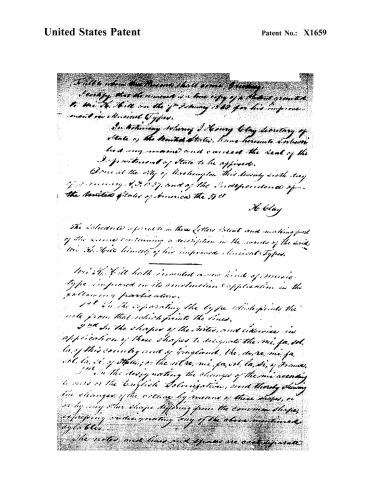
Page 2.
United States Patent
Patent No.: X1659
To all to whom this Patent shall come, Greeting:
I certify, that the annexed is a true copy of a Patent granted to Mr. H. Hill on the 7th February 1837 for his improvement in Musical Types.
In testimony whereof I Henry Clay, Secretary of State of the United States, have hereunto subscribed my name and caused the Seal of the Department of State to be affixed.
Done at the City of Washington this twenty sixth day of January A.D. 1837, and of the Independence of the United States of America the 57th.
H. Clay
The Schedule annexed to this Letter Patent and making part of the same containing a description in the words of the said Mr. Hill himself of his improvement in Musical Types.
Mr. H. Hill hath invented a new kind of music type improved in its construction & application in the following particulars.
1st In the separating the type which prints the note from that which prints the lines.
2nd In the shapes of the notes, and likewise in application of those shapes to designate the mi, fa, sol, la, of this country and of England, the, do, re, mi, fa, sol, la, si, of Italy, or the ut, re, mi, fa, sol, la, si, of France.
3rd In the designating the changes of the mi according to uses or the English Solmization, and thereby showing the changes of the octave by means of these shapes, or by any other shape differing from the common shape, expressing or designating any of the above mentioned syllables.
The notes and lines and spaces are each separate
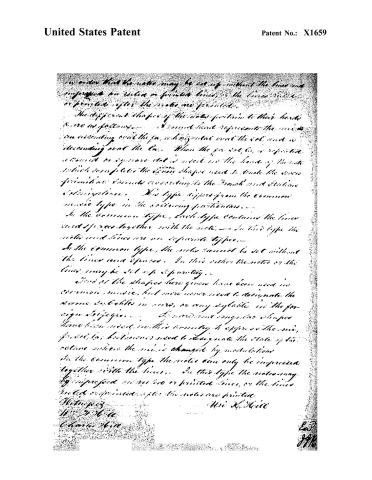
Page 3.
United States Patent
Patent No.: X1659
In order that the notes may be set up without the lines and impressed on ruled or printed lines, or the lines ruled or printed after the notes are printed.
The different shapes of the notes, pertinent to their heads, are as follows: A round head represents the note on ascending over the first horizontal over the rest, and a descending over the bar. When the first rest, &c., is repeated, a second or square dot is used in the head of the note which completes the given shape used to denote the above principles: Sounds according to the French and Italian classification. This type differs from the common music type in the following particulars:
In the common type, each type contains the lines and spaces together with the note. In this type the notes and lines are on separate types.
In the common type, the notes cannot be set without the lines and spaces. In this either the notes or the lines may be set up separately.
Two of the shapes here given have been used in common music, but were never used to designate the same symbols in ours, or any symbol in the foreign languages. The round and square shapes have been used in this country to express the note, first rest, &c., but never used to designate the state of the octave when the note is changed by modulation.
In the common type the notes can only be impressed together with the lines. In this type the notes may be impressed on ruled or printed lines, or the lines ruled or printed after the notes are printed.
Witnesses
Wm. J. Hill
Charles Hill
Wm. H. Hill
About this record
- Patentee
- Jim Shaw's X-patent list
- Date
- the Name and Date index of patents, USPTO records, Jim Shaw's X-patent list
- Invention
- the Name and Date index of patents
- Listed in
- the Name and Date index of patents, USPTO records, Jim Shaw's X-patent list, S. A. Elliot's printed list of patents, Burke's List of Patents (1847)
- S. A. Elliot's printed list of patents gives the same name and date.
- Burke's 1847 Patent Office list gives the same patent.