

Drawings and documents
USPTO scan
The patent as scanned by the USPTO
-
 Page 1
-
 Page 2
-
 Page 3
-
 Page 4


U.S. Patent and Trademark Office · Google Patents
Show the transcription Hide (1,045 words)
Machine transcription (LightOnOCR) of the pages as scanned by the USPTO, most of them the handwritten copies made when the records were restored after the 1836 fire. Not checked; it can misread handwriting, so compare it with the scan.
Page 2.
United States Patent
Patent No.: X4474
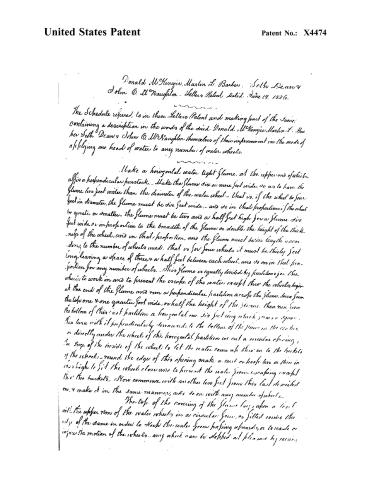
Donald McKenzie, Martin L. Barber, Seth Dean & John C. McNaughton. Letters Patent Dated: June 19, 1826.
The Schedule referred to in these Letters Patent and making part of the same, containing a description in the words of the said Donald McKenzie, Martin L. Barber, Seth Dean & John C. McNaughton themselves of their improvement in the mode of applying one head of water to any number of water wheels.
Make a horizontal water tight flume, at the upper end of which, affix a perpendicular penstock. Make the flume six or more feet wide, so as to have the flume two feet wider than the diameter of the water wheel—that is, if the wheel be four feet in diameter, the flume must be six feet wide—and so in that proportion if the wheel be greater or smaller—the flume must be two and a half feet high for a flume six feet wide or in proportion to the breadth of the flume or double the height of the thickness of the wheel, and in that proportion, and the flume must be in length according to the number of wheels used, that is for four wheels it must be thirty feet long, leaving a space of three and a half feet between each wheel, and so on in that proportion for any number of wheels. This flume is equally divided by partitions for the wheel to work in and to prevent the escape of the water except thro’ the wheels, begin at the end of the flume and run a perpendicular partition across the flume, down from the top one and one quarter foot wide, or half the height of the flume, then run from the bottom of this last partition a horizontal one, six feet long which joins a square thin turn with it perpendicularly downwards to the bottom of the flume in the center, or directly under the wheel of this horizontal partition we cut a circular opening, the size of the inside of the wheel, to let the water come up thro’ on to the buckets of the wheel—round the edge of this opening make a cut or hook like a shoe in its high to fit the wheel closewise to prevent the water from escaping over the top of the buckets. Now commence with another two feet from this last described one, and make it in the same manner, and so on with any number of wheels.
The top of the covering of the flume has, upon a level with the upper rim of the water wheels in a circular form, or fitted round the edge of the same, in order to keep the water from passing upwards, or to waste or injure the motion of the wheels, any wheel can be stopped at pleasure by raising
Page 3.
United States Patent
Patent No.: X4474
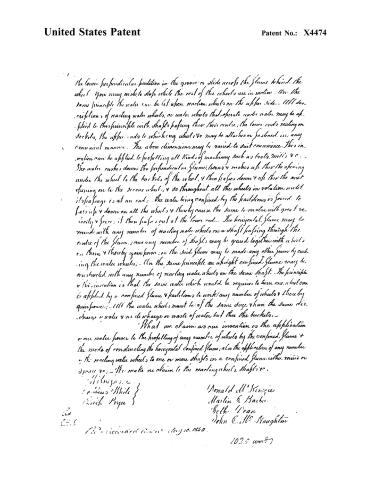
the lower perpendicular partition in the groove or slide across the flume behind the wheel. You may wish to stop while the rest of the wheels are in motion. On the same principle the water can be let when reaction wheels on the upper side. All descriptions of reacting water wheels, or water wheels that operate under water, may be applied to this principle with shafts passing through their centre, the lower ends resting on sockets, the upper ends to which any wheels may be attached or fastened in any convenient manner. The above dimensions may be varied to suit convenience. This invention can be applied to propelling all kinds of machinery such as boats, mills &c. The water rushes down the perpendicular flume, turns & rushes up through the opening under the wheel to the buckets of the wheel, & then passes down & up through the next opening on to the second wheel, & so throughout all the wheels in rotation until its passage is at an end; the water being confined by the partitions is forced to pass up & down on all the wheels & thereby cause the same to revolve with great velocity & force; it then passes out at the lower end. The horizontal flume may be round with any number of reacting water wheels on a shaft passing through the centre of the flume; and any number of shafts may be geared together with wheels on them & thereby gain power; or the said flume may be made any other form by curving the water wheels; On the same principle an upright confined flume may be constructed with any number of reacting water wheels on the same shaft. The principle of this invention is that the same water which would be required to turn one wheel can be applied by a confined flume & partitions to work any number of wheels & thereby gain power; All the water wheels must be of the same size & have the same discharge of water & no discharge or waste of water but thru the buckets.
What we claim as our invention is the application of our water power to the propelling of any number of wheels by the confined flume & the mode of constructing the horizontal confined flume; also the application of any number of the reacting water wheels to one or more shafts in a confined flume, either round or square &c. We make no claim to the reacting wheels, shafts &c.
Witnesses:
Robert White
Briech Pryer
Donald M. Kenzie
Martin S. Barker
Beth Dean
John C. McNaughton
Filed
C.S.
(3) - recorded in our day 10. 1850.
102.0 words
Page 4.
United States Patent
Patent No.: X4474
DRAFTSMAN'S DIVISION.
All communications should be addressed to
"The Commissioner of Patents."
Washington, D. C.
DEPARTMENT OF THE INTERIOR,
United States Patent Office,
Washington, D. C., 189
SIR:
The printed copies of Patent No. O. McKenzie et al.
as exhausted.
As soon as printed a copy will be mailed you to complete your order.
By direction of the Commissioner:
Very respectfully,
Chief Clerk.
314306-97-5m
Published accounts: journal notice
Notice in the monthly list of patents
Franklin Journal and American Mechanics' Magazine, vol. 2 (1826), p. 128 · View the page
In the mode of applying water to water wheels, June 19, D. M'Kenzie, M. L. Barber, S. Dean, and John C. Narlghton, Caledonia, New York.
About this record
- Patentee
- DATAMP
- Date
- the Name and Date index of patents, DATAMP, USPTO records
- Invention
- DATAMP
- Listed in
- the Name and Date index of patents, DATAMP, USPTO records, Jim Shaw's X-patent list, the Journal of the Franklin Institute, S. A. Elliot's printed list of patents, Burke's List of Patents (1847)
- S. A. Elliot's printed list of patents gives the same name and date.
- Burke's 1847 Patent Office list gives the same patent.